



Deputy Secretary Trottenberg Announces Intent to Approve Expanded TIFIA Financing for Sound Transit
The package will total $3.84 billion for six projects. It includes a new TIFIA loan for the Downtown Redmond Link Extension, and refinancing of five previously approved loans under improved terms.
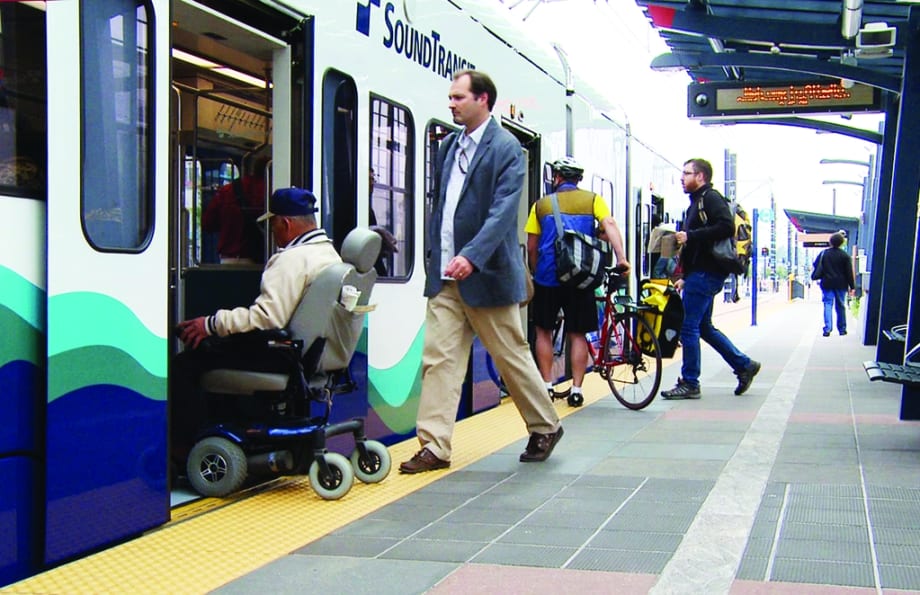
In addition to the new loan for the Downtown Redmond Link Extension, the USDOT announced it will approve refinanced loans for the Northgate Link Extension; East Link Extension; Lynnwood Link Extension; Federal Way Link Extension; and Link Operations and Management Facility East.
Sound Transit
U.S. Transportation Deputy Secretary Polly Trottenberg led a news conference in Redmond, Wash., to announce that USDOT will approve expanded financing assistance for Sound Transit, which will create more than $500 million in savings for regional taxpayers.
The upcoming action will represent USDOT’s largest-ever package of loans for a single borrower in the history of the department’s Transportation Infrastructure Finance and Innovation Act (TIFIA) program. The package will total $3.84 billion for six projects. It includes a new TIFIA loan for the Downtown Redmond Link Extension, and refinancing of five previously approved loans under improved terms.
“The major package of loans that U.S. DOT has approved for Sound Transit demonstrates the Biden-Harris Administration’s commitment to public transit, job creation, equity and tackling climate change,” said Deputy Secretary Trottenberg. “As excited as we are about these projects in the Puget Sound region, we also know that there is so much more to do across the country, and the Bipartisan Infrastructure Deal will allow us to deliver on that.”
“This historic extension of our TIFIA partnership with USDOT will create more than $500 million in savings for our region’s taxpayers, helping us deliver the largest transit infrastructure program in the country as quickly as we can,” said Sound Transit CEO Peter Rogoff. “With our population growing and our planet warming, the stakes are high, and we are creating truly impactful benefits. We thank USDOT and our congressional delegation for their dedicated leadership toward making our transit expansions possible.”
The TIFIA loans allow Sound Transit to borrow money at rates significantly lower than otherwise available. In addition to the new loan for the Downtown Redmond Link Extension, the USDOT announced it will approve refinanced loans for the Northgate Link Extension; East Link Extension; Lynnwood Link Extension; Federal Way Link Extension; and Link Operations and Management Facility East.
The expanded federal support, and further collaboration at the local, state, and federal levels, is critical for helping Sound Transit stay on ambitious schedules delivering transit expansions to protect the region’s mobility, economy, and environment.
Steep rises in real estate and construction costs in the region, in combination with work to advance environmental review and project designs, have driven up cost estimates for future transit expansions. While projects already in construction are moving forward on schedule, the Sound Transit board on Aug. 5 adopted a realignment plan that established updated delivery dates for the next generation of voter-approved projects.
As current construction advances rapidly, commuters around the region will increasingly see the fruits of Sound Transit’s strong federal and local partnerships take shape. Between now and 2024, Sound Transit will nearly triple the length of the region’s light rail system from 22 to 62 miles. The agency will open new extensions to: Northgate on Oct. 2 of this year; to Tacoma’s Hilltop neighborhood in 2022; to Bellevue and Redmond’s Overlake area 2023; and to Lynnwood, Federal Way and Downtown Redmond in 2024.
Meanwhile, Sound Transit will continue work closely with local communities and jurisdictions on further light rail expansions to complete a 116-mile regional system, as well as complete Stride bus rapid transit and Sounder rail investments.
The news conference also highlighted the critical benefits provided by the Infrastructure Investment and Jobs Act that is now under consideration by Congress.
The Act would double the funding for the competitive Capital Investment Grants program supporting large transit expansion projects around the country. With the help of our congressional delegation, Sound Transit has always competed well for these funds and we hope to expand our participation in the future. In total, as part of the $550 billion in new spending in the bipartisan bill, $39.2 billion is provided for transit. The act’s surface transportation reauthorization includes a 75% increase for transit over the previous five years. Separate from the boost in Capital Investment Grants, the Seattle urbanized area is forecasted to receive $1.3 billion in federal formula funds through FY2006, with Sound Transit expected to receive approximately $360 million, an increase of $50 million from the agency’s previous assumptions.
More Management

METRO Opens Submissions for 2026 Motorcoach Awards
Nominations are now being accepted for METRO Magazine’s Operator of the Year and Innovative Operator of the Year awards.
Read More →
New York MTA Advances Final Contract for Second Avenue Subway Expansion
Contract Four is the largest in the Second Avenue Subway Phase 2 project and includes construction of station infrastructure, tracks, and signals for the subway expansion, MTA officials said. Work on Contract Four will begin in 2027.
Read More →
Transit Agencies Highlight Safety Gains at National Summit
Leaders from 15 major transit systems shared crime-reduction results and safety initiatives while discussing the role of continued federal support.
Read More →

NITA Names New Leadership, Expands Reduced-Fare Program at First Board Meeting
The new regional transit authority appointed its first board chair and interim executive director while extending reduced fares across CTA, Metra, and Pace for eligible riders.
Read More →
Beyond the Checklist: A Structured Approach to Transit Maintenance
Reliability-Centered Maintenance helps transit agencies move beyond routine checklists to focus limited resources on the assets and failures that have the greatest impact on safety, reliability, and service.
Read More →
APTA 2026 Nominating Committee Selects Leadership Slate, Names Chair and Vice Chair Nominees
Leadership changes will help shape the association’s priorities and its representation of the transportation industry during the 2026–2027 term.
Read More →
DART Launches Major Security, Fare Enforcement Initiative
The 90-day demonstration will deploy coordinated security teams at five light rail stations while testing controlled access and gathering data to guide future investments.
Read More →
Advancing Fare Collection Through Technology and Innovation
Learn about delivering 1300 gates at 91 stations while managing fare evasion. Explore the large scale deployment, solution customization and real-world results that affect the region. Prepare for deployment in your region now.
Read More →
Game Day in Motion: Moving Millions During the 2026 World Cup
Between packed transit stations and team motorcoaches, see how agencies and operators across North America tackled the transportation demands of the 2026 FIFA World Cup.
Read More →
Surface Transportation Extension Averts Shutdown, Leaves Transit Funding Gap
The stopgap keeps federal transportation programs moving, but missing advance funding could complicate the transit and rail projects agencies are planning next.
Read More →