




RELATED: Higher mass transit use linked to lower obesity rates
Diversity, health care, and public transit linked to well-being, study says
Well-being — defined as an individual's assessment of his or her health and quality of life — is associated with longevity and better health outcomes.
June 20, 2018
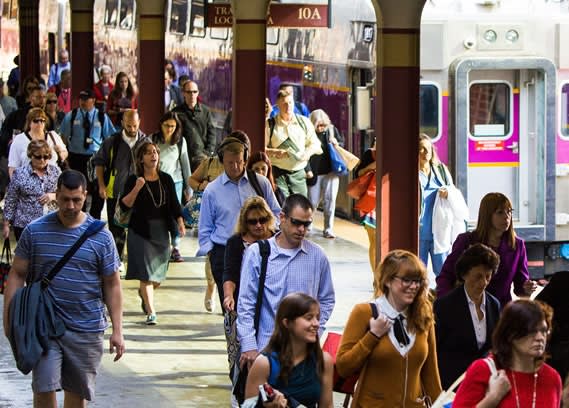
Passengers departing a Massachusetts Bay Transportation Authority commuter train. Photo: Keolis
3 min to read
Passengers departing a Massachusetts Bay Transportation Authority commuter train. Photo: Keolis
Diverse neighbors. Health centers. Commuter trains. These community attributes, and other key factors, are linked to well-being and quality of life, according to Yale researchers.
In a new nationwide study of more than 300,000 adults, the Yale-led team found that people who live in communities that offer racial diversity, access to preventive health care, and public transportation, among other elements, are more likely to report high levels of well-being, the researchers said.
Well-being — defined as an individual's assessment of his or her health and quality of life — is associated with longevity and better health outcomes. Research shows that well-being also varies by region.
To investigate correlations between community attributes and well-being, the Yale-led research team examined data on 77 characteristics of counties across the U.S. related to demographics, clinical care, social and economic factors, and the physical environment. They also analyzed findings from the Gallup-Sharecare Well-Being Index. The index measures Americans' perceptions of their daily life experiences, including their sense of purpose, financial security, relationships, and physical health.
Linking the well-being data to specific county characteristics, and using a step-wise process to eliminate redundancy, the researchers identified 12 attributes that were strongly and independently associated with well-being.
"We came up with attributes that explained a large portion of the variation we see in well-being," said first author and assistant professor medicine Brita Roy, M.D. "Several factors were related to income and education, which is expected. But we also found that attributes related to the community environment and the way people commute and variables related to health care were linked to well-being."
For example, living in a community with a higher percentage of black residents was associated with greater well-being for all. Access to preventive health care, such as mammography, and health centers were linked to well-being. Individuals in communities where they could commute to work by public transit or bicycle reported feelings of satisfaction and fulfillment, the researchers noted.
While the study did not prove a cause-and-effect relationship between community attributes and well-being, the correlations were significant, said the researchers. The findings suggest strategies for policymakers and public health experts who seek to enhance health and well-being in their communities, they said, noting that promoting diversity and better education, transportation, and primary care may make a difference.
"The results of this study represent a step forward in our understanding of how we may efficiently and effectively improve well-being through community-based action," said Carley Riley, M.D., co-author and assistant professor at Cincinnati Children's Hospital Medical Center.
"To improve the well-being of a community, you need to work across multiple sectors and fields, to include the economy and health care and urban planning and transportation," said Roy, who points to examples of communities in Richmond, Calif., and Chittenden County, Vt., that have taken this approach to health. "Working across different groups, in coalitions, has the greatest potential to improve health and quality of life."
The study is published in the journal PLOS ONE.
More Management

METRO Opens Submissions for 2026 Motorcoach Awards
Nominations are now being accepted for METRO Magazine’s Operator of the Year and Innovative Operator of the Year awards.
Read More →
New York MTA Advances Final Contract for Second Avenue Subway Expansion
Contract Four is the largest in the Second Avenue Subway Phase 2 project and includes construction of station infrastructure, tracks, and signals for the subway expansion, MTA officials said. Work on Contract Four will begin in 2027.
Read More →
Transit Agencies Highlight Safety Gains at National Summit
Leaders from 15 major transit systems shared crime-reduction results and safety initiatives while discussing the role of continued federal support.
Read More →

NITA Names New Leadership, Expands Reduced-Fare Program at First Board Meeting
The new regional transit authority appointed its first board chair and interim executive director while extending reduced fares across CTA, Metra, and Pace for eligible riders.
Read More →
Beyond the Checklist: A Structured Approach to Transit Maintenance
Reliability-Centered Maintenance helps transit agencies move beyond routine checklists to focus limited resources on the assets and failures that have the greatest impact on safety, reliability, and service.
Read More →
APTA 2026 Nominating Committee Selects Leadership Slate, Names Chair and Vice Chair Nominees
Leadership changes will help shape the association’s priorities and its representation of the transportation industry during the 2026–2027 term.
Read More →
DART Launches Major Security, Fare Enforcement Initiative
The 90-day demonstration will deploy coordinated security teams at five light rail stations while testing controlled access and gathering data to guide future investments.
Read More →
Sponsored•September 9, 2026
Advancing Fare Collection Through Technology and Innovation
Learn about delivering 1300 gates at 91 stations while managing fare evasion. Explore the large scale deployment, solution customization and real-world results that affect the region. Prepare for deployment in your region now.
Read More →
Game Day in Motion: Moving Millions During the 2026 World Cup
Between packed transit stations and team motorcoaches, see how agencies and operators across North America tackled the transportation demands of the 2026 FIFA World Cup.
Read More →
Surface Transportation Extension Averts Shutdown, Leaves Transit Funding Gap
The stopgap keeps federal transportation programs moving, but missing advance funding could complicate the transit and rail projects agencies are planning next.
Read More →