




RELATED: Driverless car testing site opens opens at U. of Michigan
Driverless shuttle introduced at U. of Mich. specialized test site
A fully autonomous, 15-passenger electric shuttle manufactured by French firm NAVYA will support research and provide self-guided tours of Mcity, the university's test site for connected and automated vehicles.
December 9, 2016
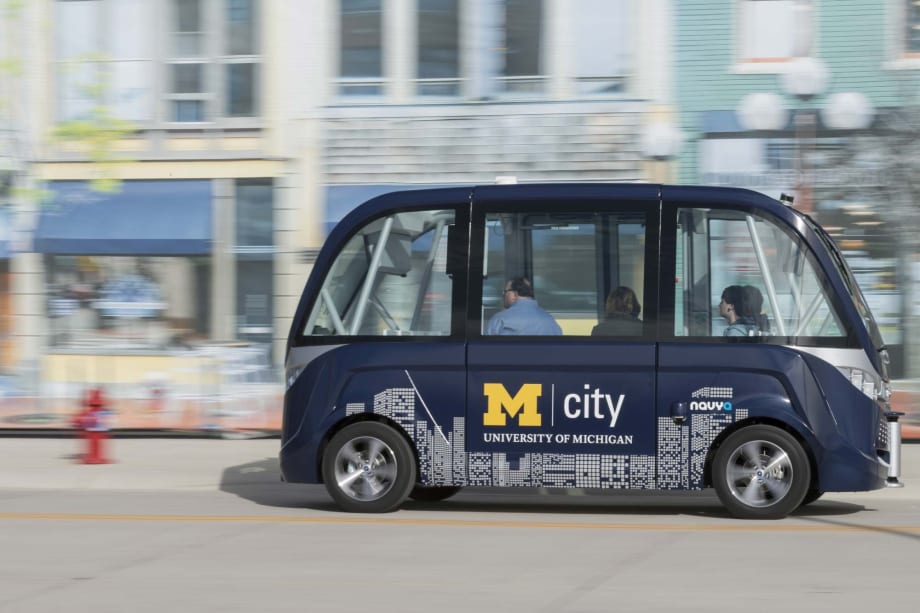
The driverless shuttle at Mcity. Image credit: Roger Hart, Michigan Photography
3 min to read
The driverless shuttle at Mcity. Image
Roger Hart, Michigan Photography
A fully autonomous, 15-passenger electric shuttle manufactured by French firm NAVYA will support research and provide self-guided tours of Mcity, the University of Michigan's one-of-a-kind test site for connected and automated vehicles. U-M and NAVYA announced the collaboration today.
This is the first of NAVYA's ARMA vehicles to operate in North America. The shuttles are already on the road in countries all over the world. They're designed for use at a broad range of sites that need efficient, convenient and safe first and last mile transportation — places such as theme parks and large campus-like environments.
"The ARMA at Mcity supports the university's interrelated missions of research and education," said S. Jack Hu, U-M VP for research. "It also underscores the importance of international collaboration as we work with companies from around the world to help society realize the substantial benefits in safety and sustainability promised by connected and automated vehicles."
NAVYA is bringing the ARMA to U-M and will become an affiliate member of the Mobility Transformation Center, a public-private partnership dedicated to leading the auto industry into a future of connected and automated mobility. The center operates Mcity.
The shuttle will provide fully automated, self-guided tours of Mcity and support research, initially through TechLab at Mcity, the university's incubator for mobility startups. The collaboration will give students a chance to work with the ARMA. MTC and NAVYA will also explore potential joint research opportunities.
Using the ARMA for automated, self-guided tours at Mcity will help to educate visitors about the potential of autonomous vehicle technology, said MTC Deputy Director Carrie Morton.
As a research platform, the ARMA offers an opportunity to study how automated vehicles could help people connect to mass transit easily, Morton said.
Researchers may also study new ways for driverless vehicles to perceive the world around them, which is key to their safe operation, she said. In addition, there are many critical research questions still to be answered about consumers and automated vehicles. How do they engage with self-driving cars? Do they accept the technology? Are they comfortable with it?
In January, NAVYA will join TechLab, which is managed by Michigan Engineering's Center for Entrepreneurship and MTC.
TechLab is an experiential incubator that matches early-stage technology companies with engineering students interested in applying classroom learning to practical tech development –– a model of applied learning that will be a key driver for innovation. Through TechLab, U-M undergraduate students will gain hands-on experience working with the ARMA to develop new machine vision capabilities, for example.
"We are excited to have NAVYA as a partner in the upcoming semester of TechLab," said TechLab instructor Jay Ellis. "It is becoming more apparent that the collaboration between university researchers, advanced mobility startups and student innovators is key in pushing the boundaries of autonomous and connected vehicle technologies and bringing these innovations closer to market."
The NAVYA ARMA is the latest addition to Mcity's vehicle resources. Last month, MTC said it will provide new research vehicles as open testbeds that will allow academic and industry researchers to rapidly test a wide range of self-driving and connected vehicle technologies.
The first open connected and automated research vehicle, or Open CAV, is a Lincoln MKZ that is already in use. In coming months, MTC will add two more testbeds based on the Kia Soul. The Open CAVs are available to U-M faculty and students, startups and possibly other MTC industry partners.
More New Mobility

From Hardware to Digital Partner: Luminator Charts Its Next Chapter
CEO Magnus Friberg discusses Luminator’s shift toward becoming a digital partner, the growing importance of software and interoperability, and how AI can help agencies improve operations and passenger experience.
Read More →
Biz Briefs: Alstom Lands Canadian Contract, LYT to Supply California TSP, and More
In METRO's latest installment, we take a look at recent news from Complete Coach Works, Beep, FlixBus, and more partnerships making headlines across the transportation sector.
Read More →
CharterUP’s Armir Harris on Technology, AI, and the Future of Group Mobility
In a recent episode of METROspectives, CharterUP Founder/CEO Armir Harris discussed the company’s evolution from an online charter bus marketplace into a technology platform supporting public- and private-sector mobility and much more.
Read More →
Jacksonville’s NAVI Project Charts a New Course for Autonomous Public Transportation
Through its NAVI program, JTA is showing how autonomous vehicles, intelligent infrastructure, and coordinated operations can work together to deliver everyday public transportation.
Read More →
Biz Briefs: Luminator Marks Milestone and More
From manufacturers and suppliers to transit agencies and motorcoach operators, these updates offer a snapshot of the projects, partnerships and business moves driving the industry forward.
Read More →
New Tricks for Old Bureaucracies: Joshua Schank on Making Transit Innovation Stick
Former LA Metro Chief Innovation Officer Joshua Schank discusses why good ideas aren't enough, how transit agencies can overcome resistance to change, and why today's challenges demand more innovation.
Read More →
How DART's GoPass Is Redefining Regional Mobility
Serving 14 transit agencies, GoPass simplifies multimodal travel by allowing riders to plan, pay for, and manage an entire trip through one app.
Read More →
Biz Briefs: OCTA Taps Clean Energy for Hydrogen Station, Stadler to Supply Via Rail Vehicles, and More
From manufacturers and suppliers to transit agencies and motorcoach operators, these updates offer a snapshot of the projects, partnerships and business moves driving the industry forward.
Read More →CharterUP Expands Into New Mobility and Autonomous Transportation
Vice President of New Mobility Stephen Joos discusses how CharterUP is leveraging its nationwide transportation network, technology platform, and autonomous vehicle partnerships to expand into workforce mobility, campus shuttles, and transit solutions.
Read More →
METRO Magazine Announces 2026 Innovative Solutions Awards Winners
Projects Recognized for Advancing Mobility Through Technology, Accessibility, Workforce Innovation, and Operational Excellence
Read More →