



Driverless shuttle service coming to University of Michigan
Will use two fully automated, 15-passenger, all-electric shuttles manufactured by French firm NAVYA to transport students, faculty and staff on a nonstop two-mile route.


Mcity will study how passengers react to the vehicle, manufactured by Navya, as a way to gauge consumer acceptance of the technology. Photo: Michigan Photography
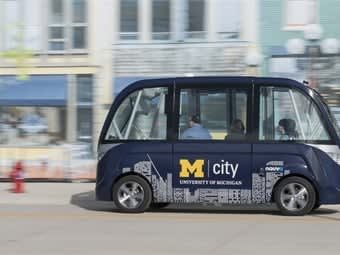
Mcity will study how passengers react to the vehicle, manufactured by Navya, as a way to gauge consumer acceptance of the technology. Photo: Michigan Photography
Mcity will launch a driverless shuttle service on the University of Michigan's North Campus beginning this fall.
The service will use two fully automated, 15-passenger, all-electric shuttles manufactured by French firm NAVYA to transport students, faculty and staff on a nonstop two-mile route between the Lurie Engineering Center and the university's North Campus Research Complex on Plymouth Road.
"This first-ever automated shuttle service on campus is a critical research project that will help us understand the challenges and opportunities presented by this type of mobility service and how people interact with it," said Huei Peng, director of Mcity and the Roger L. McCarthy Professor of Mechanical Engineering at U-M. "The shuttles will augment U-M's busy campus bus service to provide another mobility option."
Mcity is a U-M-led public-private partnership to accelerate advanced mobility vehicles and technologies.
In addition to lidar, which uses invisible laser beams to build a view of the surrounding environment, and GPS for localization, the two NAVYA ARMA shuttles will also be equipped with on-board cameras and Wi-Fi communications to capture data generated during operation.
Mcity will study how passengers react to the vehicle as a way to gauge consumer acceptance of the technology. Exterior cameras will capture the reaction and behavior of other road users, especially bicyclists and pedestrians. Mcity will also track ridership and usage patterns, and survey users about their experience.The data gathered will help researchers understand how to design safer vehicles and how to operate them more efficiently.
The shuttle service will run on U-M roads during business hours to start. There will be no cost to riders, and the two shuttles will cover the route roughly every 10 minutes. Hours of operation and the service area could be increased later if the technology proves effective and consumer acceptance supports expansion.
NAVYA is an affiliate member of Mcity.The first of NAVYA's ARMA vehicles to operate in North America is based at Mcity, where it is used to support research and to demonstrate automated vehicle technology.
ARMA shuttles are on the road in countries all over the world. They're designed for use at a broad range of sites that need efficient, convenient, and safe first and last mile transportation — places such as theme parks and large campus-like environments.
Earlier this week, NAVYA announced that it will establish a manufacturing location in Southeast Michigan.
More New Mobility

From Hardware to Digital Partner: Luminator Charts Its Next Chapter
CEO Magnus Friberg discusses Luminator’s shift toward becoming a digital partner, the growing importance of software and interoperability, and how AI can help agencies improve operations and passenger experience.
Read More →
Biz Briefs: Alstom Lands Canadian Contract, LYT to Supply California TSP, and More
In METRO's latest installment, we take a look at recent news from Complete Coach Works, Beep, FlixBus, and more partnerships making headlines across the transportation sector.
Read More →
CharterUP’s Armir Harris on Technology, AI, and the Future of Group Mobility
In a recent episode of METROspectives, CharterUP Founder/CEO Armir Harris discussed the company’s evolution from an online charter bus marketplace into a technology platform supporting public- and private-sector mobility and much more.
Read More →
Jacksonville’s NAVI Project Charts a New Course for Autonomous Public Transportation
Through its NAVI program, JTA is showing how autonomous vehicles, intelligent infrastructure, and coordinated operations can work together to deliver everyday public transportation.
Read More →
Biz Briefs: Luminator Marks Milestone and More
From manufacturers and suppliers to transit agencies and motorcoach operators, these updates offer a snapshot of the projects, partnerships and business moves driving the industry forward.
Read More →
New Tricks for Old Bureaucracies: Joshua Schank on Making Transit Innovation Stick
Former LA Metro Chief Innovation Officer Joshua Schank discusses why good ideas aren't enough, how transit agencies can overcome resistance to change, and why today's challenges demand more innovation.
Read More →
How DART's GoPass Is Redefining Regional Mobility
Serving 14 transit agencies, GoPass simplifies multimodal travel by allowing riders to plan, pay for, and manage an entire trip through one app.
Read More →
Biz Briefs: OCTA Taps Clean Energy for Hydrogen Station, Stadler to Supply Via Rail Vehicles, and More
From manufacturers and suppliers to transit agencies and motorcoach operators, these updates offer a snapshot of the projects, partnerships and business moves driving the industry forward.
Read More →CharterUP Expands Into New Mobility and Autonomous Transportation
Vice President of New Mobility Stephen Joos discusses how CharterUP is leveraging its nationwide transportation network, technology platform, and autonomous vehicle partnerships to expand into workforce mobility, campus shuttles, and transit solutions.
Read More →
METRO Magazine Announces 2026 Innovative Solutions Awards Winners
Projects Recognized for Advancing Mobility Through Technology, Accessibility, Workforce Innovation, and Operational Excellence
Read More →