




RELATED: Hyperloop One reveals vision for Dubai transport system
Dubai RTA launches tests of world's first autonomous pods
The autonomous pods are designed to travel short and medium distances in dedicated lanes.
February 13, 2018
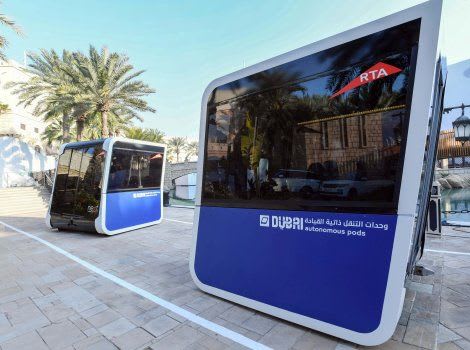
NEXT Future Transportation's autonomous pods for the Roads and Transport Authority of Dubai. Photo: RTA
2 min to read
NEXT Future Transportation's autonomous pods for the Roads and Transport Authority of Dubai. Photo: RTA
Dubai's Roads and Transport Authority (RTA), in cooperation with Next Future Transportation, launched testing of the world's first autonomous pods during the World Government Summit in Dubai.
The autonomous pods are designed to travel short and medium distances in dedicated lanes. They can be coupled in 15 to 20 seconds or detached, depending on the destination of riders, in five seconds. The autonomous pods are fitted with cameras and electromechanical technologies to carry out the coupling and detaching processes, and this feature can be activated in-motion.
Each pod measures 9.4 feet in length, 7.3 feet in width and 9.25 feet in height. It weighs about 3,300 lbs. and has a capacity to accommodate ten riders (six seated, four standing). The autonomous pod is fitted with a battery that supports three hours of operation; which is chargeable in six hours. Its average speed is 12 mph.
"It echoes the Dubai Autonomous Transport Strategy aimed at converting 25% of mobility journeys in Dubai to autonomous transportation by 2030," HE Mattar Al Tayer, RTA director-general/chairman, said of the testing.
“The RTA has signed an agreement with the American Next Future Inc. to develop autonomous units named (NX1) as part of the initial phase of Dubai Future Accelerators. The prototypes of these units are manufactured in Italy and shipped to Dubai to put them on trials. These pods run on a virtual pre-configured and programmed lane and are overseen by the operational system.
According to Al Tayer, the autonomous pods have three protection systems in order to ensure full control and avoid collisions. The main system comprises 3D cameras, and the second one is a standby system based on ordinary cameras, and the last is operated manually by the operator.
Based in Italy, Next Future Transportation designs, manufactures, and sells advanced electric cars and robotic systems, including software, hardware, and logistic solutions.
More New Mobility
ENC Unveils ZAVIR Medium-Duty Electric Shuttle at APTA EXPO
The new ZAVIR brand targets shuttle and paratransit operations with battery-electric and range-extended electric vehicle options.
Read More →
Public Transit Conference Returning to GFX in 2027, Call for Papers Now Open
The Call for Papers is now open, allowing transit agency professionals and industry experts to help shape the PTC educational program by submitting session ideas for consideration.
Read More →
Everett Transit, Community Transit Outline Consolidation Agreement
The proposed agreement calls for a 50% increase in bus service in Everett, a new microtransit zone, continued paratransit service, and the transfer of Everett Transit operations to Community Transit.
Read More →
What Multimodal Data Can Tell Transit Agencies About Rider Demand
See how bike-on-bus data is giving transit agencies new insight into rider demand, capacity constraints, and gaps in first- and last-mile connections.
Read More →
From Hardware to Digital Partner: Luminator Charts Its Next Chapter
CEO Magnus Friberg discusses Luminator’s shift toward becoming a digital partner, the growing importance of software and interoperability, and how AI can help agencies improve operations and passenger experience.
Read More →
Biz Briefs: Alstom Lands Canadian Contract, LYT to Supply California TSP, and More
In METRO's latest installment, we take a look at recent news from Complete Coach Works, Beep, FlixBus, and more partnerships making headlines across the transportation sector.
Read More →
CharterUP’s Armir Harris on Technology, AI, and the Future of Group Mobility
In a recent episode of METROspectives, CharterUP Founder/CEO Armir Harris discussed the company’s evolution from an online charter bus marketplace into a technology platform supporting public- and private-sector mobility and much more.
Read More →
Jacksonville’s NAVI Project Charts a New Course for Autonomous Public Transportation
Through its NAVI program, JTA is showing how autonomous vehicles, intelligent infrastructure, and coordinated operations can work together to deliver everyday public transportation.
Read More →
Biz Briefs: Luminator Marks Milestone and More
From manufacturers and suppliers to transit agencies and motorcoach operators, these updates offer a snapshot of the projects, partnerships and business moves driving the industry forward.
Read More →
New Tricks for Old Bureaucracies: Joshua Schank on Making Transit Innovation Stick
Former LA Metro Chief Innovation Officer Joshua Schank discusses why good ideas aren't enough, how transit agencies can overcome resistance to change, and why today's challenges demand more innovation.
Read More →