



EAO showcasing latest in Human Machine Interface tech
Company's Series 04 have been developed to withstand the challenging demands of operator controls within driver cabs and can be seamlessly implemented in ergonomically-friendly designs to fulfil UIC 612 guidelines.

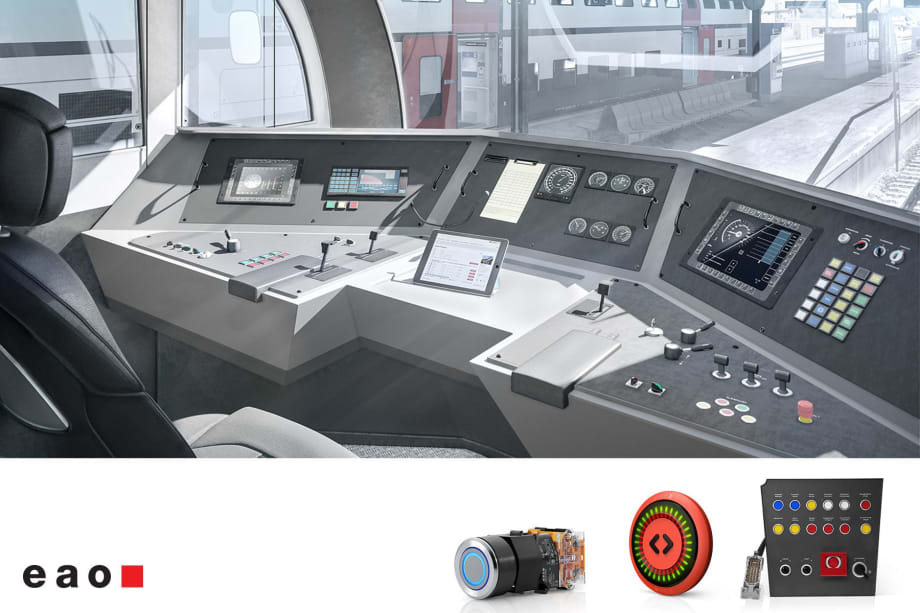
EAO, the expert partner for Human Machine Interfaces (HMI), is considered one of the world’s leading manufacturers of premium HMI Components and complete HMI Systems for the passenger transportation industry. With value-added partners across all markets, EAO possesses the resources to satisfy the certifications, approvals, and legally applicable standards necessary for operator controls in driver cabs, passenger access, passenger convenience, and lavatories within successful rail applications.
Founded in 1947 as a solution-focused partner, EAO technically and mechanically offers existing internationally certified HMI Components to satisfy any end-user requirement, and a five-phase project management process within the HMI Systems capabilities ensures completion of customized products or complete systems in an efficient and cost-effective manner. Additionally, certified quality management combined with global acceptance guarantee these efforts are met without sacrificing ease-of-use and reliability.
Driver cabs are the central focus of operation within rail applications and are essential for the safe and reliable transportation of passengers. EAO’s Series 04 have been developed to withstand the challenging demands of operator controls within driver cabs and can be seamlessly implemented in ergonomically-friendly designs to fulfil UIC 612 guidelines.
Furthermore, products such as the Series 56 and 57 meet TSI PRM and ADA standards, as well as the new EN 14752, ensuring everyone can travel safely and conveniently — including those with disabilities. EAO’s comprehensive range of HMI solutions, both with individual components and completely designed systems, satisfy customer requirements while simultaneously increasing passenger convenience. The importance of regulation compliance for impaired mobility also extends to lavatory controls in most modern trains as well. EAO offers special accessory components, such as SOS buttons and status indicators for on-board restrooms, to meet these needs.
With over 600 dedicated employees, EAO has an international production and distribution network at its disposal. Production sites in Switzerland, Germany, North America, and China, an 11-country sales company, and distributors in over 50 countries, guarantee global and immediate availability.
From simple control elements to sophisticated HMI Systems, and serial production through installation — EAO offers a comprehensive range of HMI services that inspires confidence in all of its customers.
APTA EXPO Booth # 8717
More Technology

ENC Lands MATA Contract and More in Biz Briefs
In this edition of Biz Briefs, we spotlight the latest developments shaping the future of mobility.
Read More →
Strada360’s Steve Lassey on Turning Transit Data Into Better Decisions
From breaking down data silos to preparing for AI, Strada360 CEO Steve Lassey discusses how transit agencies can use technology to improve operations, customer information, and long-term decision-making.
Read More →
Almaviva Looks to Open Architecture to Advance Transit Technology
Eric Reese discusses how interoperability, open architecture, and modular design can help transit agencies control costs, reduce vendor lock-in, and upgrade technology without starting over.
Read More →

Driving Smarter Paratransit
John Hanlon shares how AlphaRoute is leveraging AI-powered technology to help paratransit providers optimize operations, support frontline staff, and enhance the rider experience.
Read More →
From Hardware to Digital Partner: Luminator Charts Its Next Chapter
CEO Magnus Friberg discusses Luminator’s shift toward becoming a digital partner, the growing importance of software and interoperability, and how AI can help agencies improve operations and passenger experience.
Read More →
Beyond the Checklist: A Structured Approach to Transit Maintenance
Reliability-Centered Maintenance helps transit agencies move beyond routine checklists to focus limited resources on the assets and failures that have the greatest impact on safety, reliability, and service.
Read More →
NJ TRANSIT Advances Bus Technology Upgrades Across Statewide Fleet
More than 1,500 buses now feature upgraded technology designed to improve arrival predictions and provide free Wi-Fi, with deployment expected to reach nearly 2,000 buses by the end of 2026.
Read More →
Building a Flexible Path to Transit Electrification
John Hroncich discusses BAE Systems’ modular and scalable approach, lessons learned from decades of real-world operations, and how agencies can identify electrification strategies that fit their fleets.
Read More →
Biz Briefs: Alstom Lands Canadian Contract, LYT to Supply California TSP, and More
In METRO's latest installment, we take a look at recent news from Complete Coach Works, Beep, FlixBus, and more partnerships making headlines across the transportation sector.
Read More →
From Legacy Silos to Conversational Intelligence
What if transit leaders could ask any operational question and get a trusted answer in seconds? Conversational AI is transforming how agencies use their data.
Read More →