



Elaine Chao Resigns as Transportation Secretary
Secretary of Transportation Elaine Chao is resigning, effective Monday, Jan. 11, the first member of President Donald Trump’s cabinet to leave in the wake of the Jan. 6 mob of his supporters breaching the U.S. Capitol.

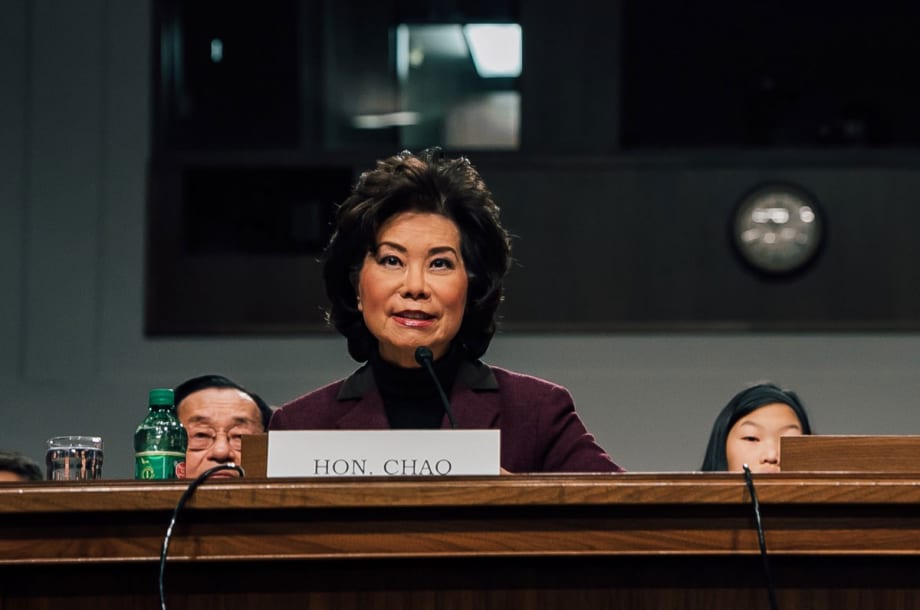
During her confirmation hearing four years ago for secretary of transportation, Elaine Chao advocated strongly for “unleashing the potential for private investment in our nation’s infrastructure.”
Photo: Trump-Pence Transition project (file)
Secretary of Transportation Elaine Chao is resigning, effective Monday, Jan. 11, the first member of President Donald Trump’s cabinet to leave in the wake of the Jan. 6 mob of his supporters breaching the U.S. Capitol.
In a letter to her DOT colleagues she posted in Twitter, she wrote:
“Yesterday, our country experienced a traumatic and entirely avoidable event as supporters of the President stormed the capitol building following a rally he addressed. As I’m sure is the case with many of you, it has deeply troubled me in a way that I simply cannot set aside.
“I am tremendously proud of the many accomplishments we were able to achieve together for our country and I will never forget the commitment you have for this department and the United States of America….
“We will help my announced successor Mayor Pete Buttigieg, with taking on the responsibility of running this wonderful department.”
Chao came into her post with a focus on the nation's crumbling infrastructure, backed by years of government experience, having served in both Bush administrations.
Chao was the first Asian-American woman and the first Taiwanese American in history to be appointed to a Cabinet post. She is married to Senate Majority Leader Mitch McConnell (R-Ky.).
At the time, American Trucking Associations President and CEO Chris Spear was quick to praise Trump’s selection to head the DOT.
During her confirmation hearings, Chao unequivocally signaled her willingness to cooperate with Congress to enact the trillion-dollar infrastructure investment plan floated by President-elect Trump, and advocated strongly for “unleashing the potential for private investment in our nation’s infrastructure.”
However, Trump’s plans for a giant infrastructure package did not come to fruition, although he had campaigned on spending $1 trillion on infrastructure – nearly four times as much as his opponent, Hillary Clinton.
Once president, Trump spoke a lot about his desire to pass an infrastructure bill, but never was able to develop specific plans that gained any traction in Congress.
ATA's Spear issued a statement on the news of the resignation: “Secretary Chao has been a strong leader and a tremendous partner on a host of issues impacting the trucking industry. She came into the role as one of the most experienced cabinet secretaries in our nation’s history, and has proven to be a leader who embodies integrity, courage and conviction.
“From the Department’s efforts to improve safety while providing flexibility for commercial drivers, drawing a roadmap for future transportation leaders to follow on automated vehicles, and recognizing the unique role drivers play in our industry, she should be commended for her vision." He praised her leadership throughout the COVID-19 pandemic.
"On a personal note, having worked for and with her over many years, I can attest that Elaine is a person of strong moral character, and should be applauded for not standing idly by following yesterday’s abhorrent and shameful events at the Capitol."
He also said the association looks forward to working with President-elect Biden’s Transportation Secretary nominee Pete Buttigieg.
Updated 7:15 p.m. 1/7/2021 to add comments from ATA.
Originally posted on Heavy Duty Trucking
More Management

METRO Opens Submissions for 2026 Motorcoach Awards
Nominations are now being accepted for METRO Magazine’s Operator of the Year and Innovative Operator of the Year awards.
Read More →
New York MTA Advances Final Contract for Second Avenue Subway Expansion
Contract Four is the largest in the Second Avenue Subway Phase 2 project and includes construction of station infrastructure, tracks, and signals for the subway expansion, MTA officials said. Work on Contract Four will begin in 2027.
Read More →
Transit Agencies Highlight Safety Gains at National Summit
Leaders from 15 major transit systems shared crime-reduction results and safety initiatives while discussing the role of continued federal support.
Read More →

NITA Names New Leadership, Expands Reduced-Fare Program at First Board Meeting
The new regional transit authority appointed its first board chair and interim executive director while extending reduced fares across CTA, Metra, and Pace for eligible riders.
Read More →
Beyond the Checklist: A Structured Approach to Transit Maintenance
Reliability-Centered Maintenance helps transit agencies move beyond routine checklists to focus limited resources on the assets and failures that have the greatest impact on safety, reliability, and service.
Read More →
APTA 2026 Nominating Committee Selects Leadership Slate, Names Chair and Vice Chair Nominees
Leadership changes will help shape the association’s priorities and its representation of the transportation industry during the 2026–2027 term.
Read More →
DART Launches Major Security, Fare Enforcement Initiative
The 90-day demonstration will deploy coordinated security teams at five light rail stations while testing controlled access and gathering data to guide future investments.
Read More →
Advancing Fare Collection Through Technology and Innovation
Learn about delivering 1300 gates at 91 stations while managing fare evasion. Explore the large scale deployment, solution customization and real-world results that affect the region. Prepare for deployment in your region now.
Read More →
Game Day in Motion: Moving Millions During the 2026 World Cup
Between packed transit stations and team motorcoaches, see how agencies and operators across North America tackled the transportation demands of the 2026 FIFA World Cup.
Read More →
Surface Transportation Extension Averts Shutdown, Leaves Transit Funding Gap
The stopgap keeps federal transportation programs moving, but missing advance funding could complicate the transit and rail projects agencies are planning next.
Read More →