




RELATED: Mobileye collision avoidance system to be added to Proterra buses
First U.S. student-led transit agency orders Proterra electric buses
The Associated Students of the University of Montana Transportation ordered two 40-foot Catalyst Fast Charge buses and one semi-autonomous fast charger for its UDASH routes.
February 2, 2016
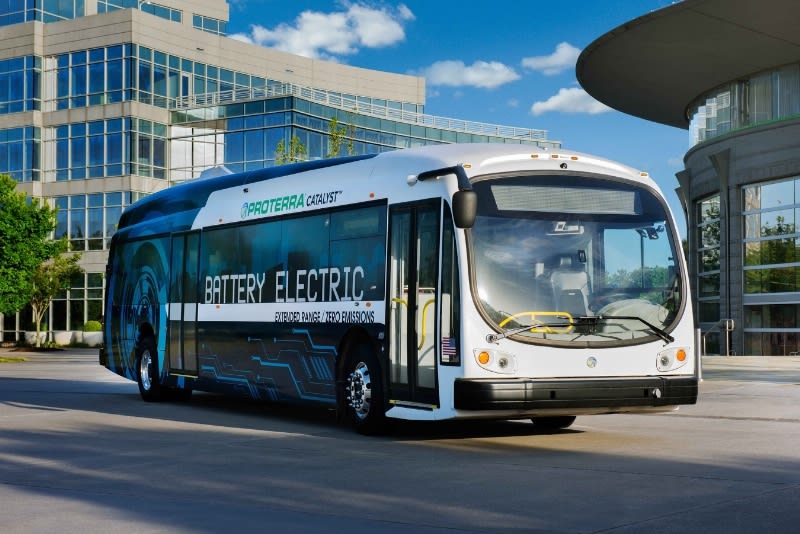
Proterra, provider of zero-emission, battery-electric buses, today announced that it will begin supplying buses to campus locations nationwide. Photo: Proterra
2 min to read
Proterra, provider of zero-emission, battery-electric buses, today announced that it will begin supplying buses to campus locations nationwide. Photo: Proterra
Proterra, provider of zero-emission, battery-electric buses, today announced that it will begin supplying buses to urban and suburban university systems nationwide, with its first university customer being the student-led Associated Students of the University of Montana (ASUM) Transportation.
The ASUM has ordered two Proterra 40-foot Catalyst Fast Charge buses and one semi-autonomous fast charger for its UDASH routes. This procurement marks a new era for ASUM as it prioritizes electric vehicle mass transit and begins to replace its diesel vehicles with Proterra's state-of-the-art technology. Notably, ASUM is one of a handful of student-led transit agencies in the U.S., demonstrating that the next generation of transit market leaders will regard sustainable transport as a priority rather than a luxury.
"As part of our ongoing effort to innovate service, align with student advocacy and reduce our carbon footprint, we take great pride in our decision to go electric," said Jordan Hess, ASUM Office of Transportation Director. "We hope this encourages and challenges — other universities to seriously consider the economic and environmental benefits of zero-emission buses."
Founded in 1999 by a student referendum, ASUM Transportation has a unique history of fostering student governance and tackling critical issues to ensure a safe and efficient transit experience for the university's population. Since its inception, ASUM's weekly ridership has grown to nearly 15,000; last year alone it provided more than 400,000 complimentary rides to students, faculty and visitors and 14% of all trips to campus occur on ASUM's UDASH service.
ASUM's purchase of zero-emission, battery-electric buses is a testament to its community leadership and environmental stewardship and will help the UM meet its goals of carbon neutrality by 2020. When the Proterra buses enter service in September 2016, ASUM Transportation expects them to immediately improve local air quality, reducing emission by 1,392 tons over their 12-year lifespan.
Proterra's Total Cost of Ownership was a major selling point for ASUM, given the transit agency's size and limited resources. In addition to financing the buses through the state of Montana's INTERCAP program, ASUM received a Diesel Emissions Reduction Act grant from the U.S. Environmental Protection Agency for $163,191, which aims to improve public health through reducing emissions and particulate matter.
"Bringing more zero-emission buses to university campuses around the U.S. will be an integral part of Proterra's next stage of growth, and we couldn't be happier to announce ASUM as our first university customer," said Ryan Popple, CEO of Proterra. "Millennials are driving less and seeking out transit more. With this increase in demand, our mission is to guarantee that younger riders have clean, quiet, emission-free public transportation. Proterra is taking state-of-the-art EV technology and deploying it into the most accessible transportation asset in the country."
More Technology

From Hardware to Digital Partner: Luminator Charts Its Next Chapter
CEO Magnus Friberg discusses Luminator’s shift toward becoming a digital partner, the growing importance of software and interoperability, and how AI can help agencies improve operations and passenger experience.
Read More →
Beyond the Checklist: A Structured Approach to Transit Maintenance
Reliability-Centered Maintenance helps transit agencies move beyond routine checklists to focus limited resources on the assets and failures that have the greatest impact on safety, reliability, and service.
Read More →
NJ TRANSIT Advances Bus Technology Upgrades Across Statewide Fleet
More than 1,500 buses now feature upgraded technology designed to improve arrival predictions and provide free Wi-Fi, with deployment expected to reach nearly 2,000 buses by the end of 2026.
Read More →

Building a Flexible Path to Transit Electrification
John Hroncich discusses BAE Systems’ modular and scalable approach, lessons learned from decades of real-world operations, and how agencies can identify electrification strategies that fit their fleets.
Read More →
Biz Briefs: Alstom Lands Canadian Contract, LYT to Supply California TSP, and More
In METRO's latest installment, we take a look at recent news from Complete Coach Works, Beep, FlixBus, and more partnerships making headlines across the transportation sector.
Read More →
Sponsored•September 8, 2026
From Legacy Silos to Conversational Intelligence
What if transit leaders could ask any operational question and get a trusted answer in seconds? Conversational AI is transforming how agencies use their data.
Read More →
USDOT Announces Rail Vehicle Replacement Grants, Chattanooga AV Shuttle Funding
More than $191 million in federal funding will help three transit agencies replace aging rail vehicles and support a new autonomous shuttle service in Chattanooga.
Read More →
Bus Tech Talk: Keeping Transit Technicians Ahead of the Technology Curve
LA Metro’s Obed Mejia discusses technician training, evolving maintenance technology, fleet replacement, and strategies for getting the most out of today’s transit fleets.
Read More →
Biz Briefs: RIPTA Unveils New Frontrunners, Clevland RTA Adds New Siemens, and More
In METRO's latest installment, we take a look at recent news from Siemens, Prevost, Dodge, and more partnerships making headlines across the transportation sector.
Read More →
Why Simulating Pedestrian Movement Has Become Essential for Modern Rail Stations
Pedestrian microsimulation is helping rail planners identify bottlenecks, test station designs, and prepare complex transit hubs for growing passenger volumes.
Read More →