




Related: Siemens completes first car shell for Fla.'s Brightline
Fla.'s Brightline trains to use retractable gap filler
Will be the first rail system in the U.S. to use the technology, which will make boarding and disembarking the trains easy and convenient for all riders.
February 9, 2016
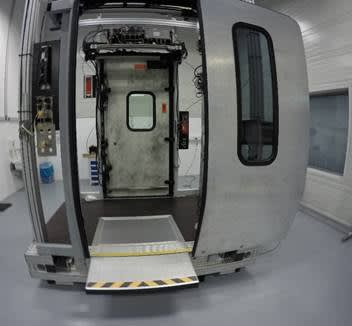
Brigthline’s retractable gap filler extended on a prototype door.
2 min to read
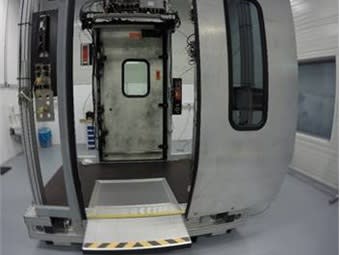
Brigthline’s retractable gap filler extended on a prototype door.
Fla.'s Brightline commuter rail system announced that its new trains will be the first in the U.S. to utilize retractable gap fillers, making boarding and disembarking the trains easy and convenient for all riders.
Brightline and Siemens collaborated with Bode to develop the custom gap filler that is integrated into the train car door system. Bode has gained global recognition for its custom-built door systems, which are in use on passenger trains and light rail vehicles across the world.
Prior to the doors opening, the custom gap filler will extend up to 12 inches from the train and pivot to meet the station platform, creating a flush surface for passengers to cross and making it easy for those in wheelchairs, pushing strollers or luggage to board Brightline at stations in Miami, Fort Lauderdale, West Palm Beach and Orlando.
“In order to make boarding our trains fast and easy for our all of our guests, we are using the latest technology available and have customized it to create a smart solution unique to our trains and stations,” said Gene Skoropowski, Brightline’s sr. VP, railroad operations. “In building our trains, we are innovating to make train travel easier and more comfortable for all of our guests. We are thrilled to be the first passenger train in the U.S. using this technology from Bode.”
Brightline’s trains are being constructed by Siemens at their state-of-the-art manufacturing facility in Sacramento, Calif. The first passenger coach shell was completed recently and is going through a finishing process, preparing it for final assembly. Brightline is expected to take delivery of the first train sets later this year. Construction is also underway on Brightline’s train stations in Downtown Miami at MiamiCentral, Fort Lauderdale, West Palm Beach and Orlando.
More Security and Safety
FTA Ends Direct Oversight of MBTA Safety Actions
The federal agency closed its remaining special directive to the Massachusetts Department of Public Utilities following a safety review that began in 2022.
Read More →
Transit Agencies Highlight Safety Gains at National Summit
Leaders from 15 major transit systems shared crime-reduction results and safety initiatives while discussing the role of continued federal support.
Read More →
DART Launches Major Security, Fare Enforcement Initiative
The 90-day demonstration will deploy coordinated security teams at five light rail stations while testing controlled access and gathering data to guide future investments.
Read More →
RTD Launches NextRide App to Consolidate Trip Planning, Fares, Security Reporting
The app expands on RTD’s existing NextRide web application and allows customers to view real-time vehicle locations and service alerts, purchase and store digital fares, and access customer support.
Read More →
TAPTCO Updates OSHA Compliance Training for Transit Maintenance Operations
The revamped program addresses 26 OSHA standards for maintenance facilities, with TAPTCO pointing to training, documentation, and everyday shop hazards as continuing challenges for transit operations.
Read More →
FRA Announces $5.3B in Rail Investments, Including $2B for Amtrak
Funding will support grade-crossing improvements, infrastructure upgrades, and new Amtrak equipment in 23 states.
Read More →
Chicago, Maryland Expand Non-Law-Enforcement Safety, Rider Support
The CTA and MTA are launching new programs aimed at de-escalation, crisis response, rider assistance, and greater transparency.
Read More →
LA Metro, City of West Hollywood, and Partners Advance Smarter Bus Lane Enforcement
The award-winning partnership combines AI-powered detection with human oversight to improve bus reliability, accessibility, and enforcement efficiency.
Read More →
LA Metro Reports 57% Decline in Homelessness on Transit System Since 2024
The agency's latest homelessness count offers new data on how care-based services and cross-sector partnerships can complement traditional transit security strategies.
Read More →
FTA Launches 'Transit Moves America' Dashboard to Highlight Agency Safety and Performance
The online dashboard transforms National Transit Database information into a public-facing resource that allows users to compare transit agencies on key operational and safety metrics.
Read More →