



Fla.'s PSTA Launches AV Pilot
The agency’s fare free electric shuttle, AVA, will begin serving the public as part of a three-month pilot in downtown St. Petersburg.
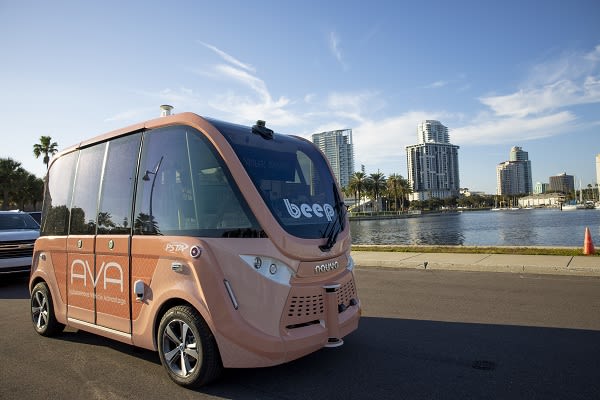
The agency’s fare free electric shuttle, AVA, will begin serving the public on Nov. 25 until February 2021 in downtown St. Petersberg.
PSTA
The Pinellas Suncoast Transit Authority (PSTA), in partnership with Beep and funded by the Florida Department of Transportation (FDOT), launched a three-month autonomous vehicle pilot in downtown St. Petersburg. The fare free all-electric shuttle, named AVA, short for Autonomous Vehicle Advantage, is the state’s first autonomous vehicle fleet launched by a transit agency in mixed traffic.
AVA will operate along Bayshore Drive Wednesday through Sunday from 10 a.m. to 10 p.m. beginning on Nov. 25 until February 2021. The shuttle uses eight sensors on the outside of the vehicle providing a 360-degree view of the environment. An on-board shuttle attendant, or copilot, serves as an ambassador for the riders to learn more about the technology and oversee the passenger experience. Riders will be limited to one round trip.
“We are beyond excited for the community to try this all new experience with AVA,” said Brad Miller, CEO of PSTA. “Like an attraction at Disney World, we hope all who come to enjoy AVA leave with a better understanding of how technology can help enhance safety all while providing clean-energy solutions that could transform transportation.”
The functionality of the shuttle is enabled by a safe, pre-determined planned route. AVA is equipped with multiple onboard LiDAR sensors and GPS tracking to ensure the path is maintained during operation. The vehicle performance is monitored by an onboard shuttle specialist as well as Beep’s Global Command Center located in Orlando, Fla. The vehicles are 100-percent electric, cost less than $30 per month to charge, and react 10 times faster than a human can, while never getting distracted from the roadway.
Due to COVID-19, passengers can expect processes and procedures onboard that align with best practices and federal guidelines for ridesharing and transit, such as frequent cleaning procedures and a modified seating capacity. Riders will also be required to wear a seatbelt and use a face covering while on the shuttle.
More New Mobility

From Hardware to Digital Partner: Luminator Charts Its Next Chapter
CEO Magnus Friberg discusses Luminator’s shift toward becoming a digital partner, the growing importance of software and interoperability, and how AI can help agencies improve operations and passenger experience.
Read More →
Biz Briefs: Alstom Lands Canadian Contract, LYT to Supply California TSP, and More
In METRO's latest installment, we take a look at recent news from Complete Coach Works, Beep, FlixBus, and more partnerships making headlines across the transportation sector.
Read More →
CharterUP’s Armir Harris on Technology, AI, and the Future of Group Mobility
In a recent episode of METROspectives, CharterUP Founder/CEO Armir Harris discussed the company’s evolution from an online charter bus marketplace into a technology platform supporting public- and private-sector mobility and much more.
Read More →
Jacksonville’s NAVI Project Charts a New Course for Autonomous Public Transportation
Through its NAVI program, JTA is showing how autonomous vehicles, intelligent infrastructure, and coordinated operations can work together to deliver everyday public transportation.
Read More →
Biz Briefs: Luminator Marks Milestone and More
From manufacturers and suppliers to transit agencies and motorcoach operators, these updates offer a snapshot of the projects, partnerships and business moves driving the industry forward.
Read More →
New Tricks for Old Bureaucracies: Joshua Schank on Making Transit Innovation Stick
Former LA Metro Chief Innovation Officer Joshua Schank discusses why good ideas aren't enough, how transit agencies can overcome resistance to change, and why today's challenges demand more innovation.
Read More →
How DART's GoPass Is Redefining Regional Mobility
Serving 14 transit agencies, GoPass simplifies multimodal travel by allowing riders to plan, pay for, and manage an entire trip through one app.
Read More →
Biz Briefs: OCTA Taps Clean Energy for Hydrogen Station, Stadler to Supply Via Rail Vehicles, and More
From manufacturers and suppliers to transit agencies and motorcoach operators, these updates offer a snapshot of the projects, partnerships and business moves driving the industry forward.
Read More →CharterUP Expands Into New Mobility and Autonomous Transportation
Vice President of New Mobility Stephen Joos discusses how CharterUP is leveraging its nationwide transportation network, technology platform, and autonomous vehicle partnerships to expand into workforce mobility, campus shuttles, and transit solutions.
Read More →
METRO Magazine Announces 2026 Innovative Solutions Awards Winners
Projects Recognized for Advancing Mobility Through Technology, Accessibility, Workforce Innovation, and Operational Excellence
Read More →