




Looking Back: Feds Cancel $929 Million in Grant Funds for California’s High-Speed Rail
FRA Pulls More Funding from California High-Speed Rail Amid Progress and Dispute
USDOT cites failure to meet obligations, while California defends project progress and continues the track-laying phase.
July 17, 2025
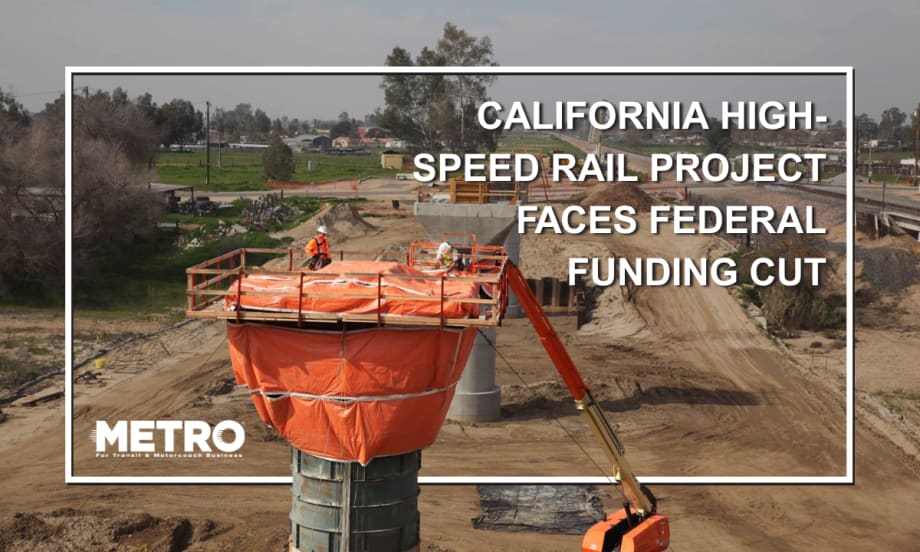
The Federal Railroad Administration has pulled $4 billion in funding from California’s high-speed rail project, citing delays, cost overruns, and unmet obligations.
Photo: California High-Speed Rail Authority / METRO
3 min to read
U.S. Transportation Secretary Sean P. Duffy recently announced the Federal Railroad Administration terminated approximately $4 billion in unspent federal funding for California’s High Speed Rail project.
According to a USDOT release, after 16 years and roughly $15 billion spent, “not one high-speed track has been laid by the California High-Speed Rail Authority (CHSRA).” The rail plan had a projected total cost of $135 billion.
“Federal dollars are not a blank check — they come with a promise to deliver results,” Duffy said. “After over a decade of failures, CHSRA’s mismanagement and incompetence have proven it cannot build its train to nowhere on time or on budget.”
The decision follows FRA’s compliance review, resulting in a 300-page report noting that, “CHSRA could not meet its binding obligations under the agreements it made to receive federal funding.”
According to the release, the CHSRA was given two opportunities to respond consistently with the grant agreements after the review. “Neither response addressed FRA’s significant concerns. CHSRA simply cannot meet its obligations under the grant agreement,” the USDOT release stated.
Track-Laying Begins as Federal Support Wavers
As the California governor’s office reported, the termination comes as the project enters the track laying phase, actively building across 171 miles, has built more than 50 major railway structures — including bridges, overpasses, and viaducts — and completed over 60 miles of guideway.
“With projects like the Texas high-speed rail failing to take off, we are miles ahead of others,” said California Governor Gavin Newsom in response to the termination. “We’re now in the track-laying phase and building America’s only high-speed rail. California is putting all options on the table to fight this illegal action.”
In January, Gov. Newsom joined CHSRA CEO Ian Choudri, local leaders, and workers outside Bakersfield to break ground on the railhead and allow the authority to begin laying track.
“[This] is one of the last steps in construction, occurring only after land acquisition, environmental clearances, and completion of supporting structures,” the release reported.
“Canceling these grants without cause isn’t just wrong — it’s illegal,” Choudri said. “These are legally binding agreements, and the authority has met every obligation, as confirmed by repeated federal reviews, as recently as February 2025.
According to the governor’s office statement, the high-speed rail has marked “significant” progress, including:
The completion of environmental reviews spanning 463 miles from Los Angeles to the Bay Area.
Completion of Caltrain electrification.
Trainset selection underway.
Station and track construction on deck.
Continued work with partner rail systems to create a southwest regional high-speed rail network.
More than 15,000 jobs created.
“This is no time for Washington to walk away on America’s transportation future,” Choudri said.
Passenger service was expected in the coming years, between 2030 and 2033.
More Rail

New York MTA Advances Final Contract for Second Avenue Subway Expansion
Contract Four is the largest in the Second Avenue Subway Phase 2 project and includes construction of station infrastructure, tracks, and signals for the subway expansion, MTA officials said. Work on Contract Four will begin in 2027.
Read More →
San Diego MTS Breaks Monthly Trolley Ridership Record
Agency officials said July’s ridership indicates MTS’s continued recovery from the pandemic.
Read More →
Report Examines NJ TRANSIT Reliability, Funding Challenges
The Garden State Initiative analysis examines the roles of Amtrak infrastructure, fleet management, and agency operations while recommending a more performance-based approach to improving reliability.
Read More →
Stadler, CapMetro Sign Long-Term Rail Fleet Support Agreement
Beginning in 2027, Stadler will provide on-site technical expertise, spare parts support, training, and obsolescence management to help extend the reliability and longevity of CapMetro’s GTW fleet.
Read More →
Biz Briefs: Alstom Lands Canadian Contract, LYT to Supply California TSP, and More
In METRO's latest installment, we take a look at recent news from Complete Coach Works, Beep, FlixBus, and more partnerships making headlines across the transportation sector.
Read More →
CATS Gold Line Marks 5 Years of Service, 2.8M Passenger Trips
With a six-mile expansion planned, the Charlotte streetcar is positioned to connect more neighborhoods and major transit hubs across the region.
Read More →
Why Simulating Pedestrian Movement Has Become Essential for Modern Rail Stations
Pedestrian microsimulation is helping rail planners identify bottlenecks, test station designs, and prepare complex transit hubs for growing passenger volumes.
Read More →
Amtrak Begins Major Construction at New York’s Sunnyside Yard
The new maintenance facility will support Amtrak’s Airo trainsets while improving maintenance efficiency and turnaround times in New York.
Read More →
Chicago Leaders Unveil Plans for O’Hare Airport Express Train
The privately developed project would offer a 15-minute trip between downtown and O’Hare’s Terminal 2, with trains operating every 15 minutes on a dedicated track. The service would use battery-electric trains and three existing freight rail rights-of-way.
Read More →
OCTA Maps Out 30-Year Strategy to Protect Coastal Rail Corridor
The draft feasibility report identifies strategies to protect the coastal rail line for decades as the agency continues near-term stabilization and sand placement efforts.
Read More →