




Related: Calif.'s Metrolink operating 341 miles of agency-hosted lines
FRA report finds most railroads will miss PTC deadline
The report is mandated by the House of Representatives Appropriations Committee and shows that after seven years and significant assistance from FRA, most railroads will miss the Dec. 31, 2015 implementation deadline that Congress established in 2008.
August 11, 2015
3 min to read
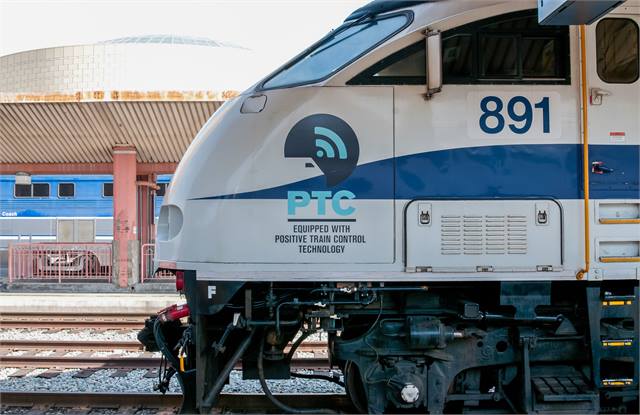
The Federal Railroad Administration (FRA) sent its “Status of Positive Train Control Implementation” report to Congress. The report is mandated by the House of Representatives Appropriations Committee and shows that after seven years and significant assistance from FRA, most railroads will miss the Dec. 31, 2015 positive train control (PTC) implementation deadline that Congress established in 2008.
“Positive Train Control is the most significant advancement in rail safety technology in more than a century. Simply put: it prevents accidents and saves lives, which is exactly what we seek to do at The Department of Transportation every single day. We will continue to do everything in our power to help railroads install this technology,” U.S. Transportation Secretary Anthony Foxx said.
The National Transportation Safety Board (NTSB) began calling for train control systems like PTC in 1969, and FRA was involved in establishing PTC standards with stakeholders for more than a decade before the 2008 mandate. Three years before Congress passed the PTC mandate, FRA issued its final rule that established uniform PTC standards for railroads willing to voluntarily install the technology.
PTC prevents train-to-train collisions, over-speed derailments, incursions into established work zone limits and a train going to the wrong track because a switch was left in the wrong position.
In 2008, Congress passed the Rail Safety Improvement Act (RSIA), requiring all Class I railroads transporting poisonous-by-inhalation hazardous (PIH) or toxic-by-inhalation hazardous (TIH) materials and all railroads providing passenger service to implement Positive Train Control by Dec. 31, 2015.
FRA has provided significant assistance and support to railroads in order to help them become PTC compliant. Those efforts include:
Providing more than $650 million to passenger railroads, including nearly $400 million in Recovery Act funding.
Issuing a nearly $1 billion loan to the Metropolitan Transportation Authority to implement PTC on the Long Island Rail Road and Metro-North.
Building a PTC test bed in Pueblo, Colo.
Working directly with the Federal Communications Commission and the Advisory Council on Historic Preservation to resolve issues related to spectrum use and improve the approval process for PTC communication towers.
Dedicating staff to continue work on PTC implementation in March 2010, including establishing a PTC task force.
To view the full report, click here.
"The commuter rail industry is 100 percent committed to developing and installing positive train control (PTC) technology. Despite the commuter rail industry's best efforts, implementing PTC nationwide by the end of this year is not possible. This was never a realistic deadline because of the significant challenges — technology, spectrum, and funding — that still remain to successfully and safely implement PTC.
"It is important to note that when Congress passed the 2008 Rail Safety Improvement Act and mandated PTC, the technology available then was not mature and did not meet all the requirements of the statute.
"In addition, as explained in the new Federal Railroad Administration report, commuter rail systems have had a significant challenge in acquiring radio spectrum. PTC is a communications intense technology which requires radio spectrum to transmit data between trains and communications towers. APTA has asked the Federal Communications Commission to allocate free spectrum for commuter railroads as a public safety priority, but so far, it has refused to do so. Congress can solve this problem by directing the FCC to make the necessary spectrum available.
"Last but not least, the commuter rail industry has already spent $950 million on PTC implementation and conservative estimates are that $3.48 billion is needed to complete implementation nationwide. Currently, Congress has only appropriated $50 million for this critical federal safety technology."
More Rail

New York MTA Advances Final Contract for Second Avenue Subway Expansion
Contract Four is the largest in the Second Avenue Subway Phase 2 project and includes construction of station infrastructure, tracks, and signals for the subway expansion, MTA officials said. Work on Contract Four will begin in 2027.
Read More →
San Diego MTS Breaks Monthly Trolley Ridership Record
Agency officials said July’s ridership indicates MTS’s continued recovery from the pandemic.
Read More →
Report Examines NJ TRANSIT Reliability, Funding Challenges
The Garden State Initiative analysis examines the roles of Amtrak infrastructure, fleet management, and agency operations while recommending a more performance-based approach to improving reliability.
Read More →
Stadler, CapMetro Sign Long-Term Rail Fleet Support Agreement
Beginning in 2027, Stadler will provide on-site technical expertise, spare parts support, training, and obsolescence management to help extend the reliability and longevity of CapMetro’s GTW fleet.
Read More →
Biz Briefs: Alstom Lands Canadian Contract, LYT to Supply California TSP, and More
In METRO's latest installment, we take a look at recent news from Complete Coach Works, Beep, FlixBus, and more partnerships making headlines across the transportation sector.
Read More →
CATS Gold Line Marks 5 Years of Service, 2.8M Passenger Trips
With a six-mile expansion planned, the Charlotte streetcar is positioned to connect more neighborhoods and major transit hubs across the region.
Read More →
Why Simulating Pedestrian Movement Has Become Essential for Modern Rail Stations
Pedestrian microsimulation is helping rail planners identify bottlenecks, test station designs, and prepare complex transit hubs for growing passenger volumes.
Read More →
Amtrak Begins Major Construction at New York’s Sunnyside Yard
The new maintenance facility will support Amtrak’s Airo trainsets while improving maintenance efficiency and turnaround times in New York.
Read More →
Chicago Leaders Unveil Plans for O’Hare Airport Express Train
The privately developed project would offer a 15-minute trip between downtown and O’Hare’s Terminal 2, with trains operating every 15 minutes on a dedicated track. The service would use battery-electric trains and three existing freight rail rights-of-way.
Read More →
OCTA Maps Out 30-Year Strategy to Protect Coastal Rail Corridor
The draft feasibility report identifies strategies to protect the coastal rail line for decades as the agency continues near-term stabilization and sand placement efforts.
Read More →