




Miss This? FTA Eases Grant Rules, Allows Shift from Zero to Low Emission Tech
FTA Launches Investigation of North Carolina CATS' Security Spending & Safety Plans
The Federal Transit Administration will evaluate CATS' compliance with federal safety directives after multiple violent incidents in 2025.
September 11, 2025
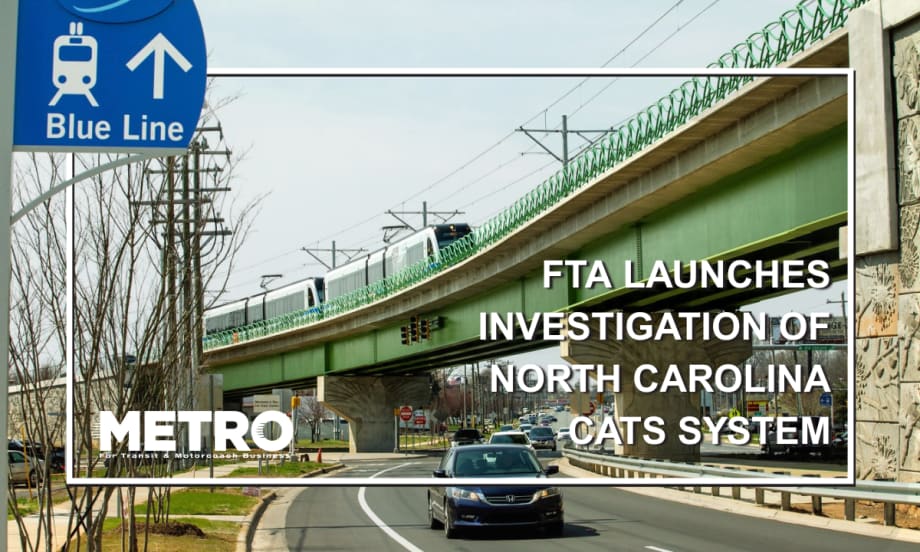
Iryna Zarutska was fatally stabbed on August 22, 2025, at the East/West Boulevard light rail station in Charlotte, North Carolina.
Photo: CATS/METRO
3 min to read
In the wake of Iryna Zarutska's murder on August 22, U.S. Transportation Secretary Sean P. Duffy announced that the Federal Transit Administration (FTA) is launching an investigation of North Carolina's Charlotte Area Transit System (CATS).
According to a USDOT release, the investigation will review the transit agency's security spending, safety plans, and ongoing risks to operators and customers being assaulted on the system.
"[USDOT is] investigating CATS and other transit agencies to determine whether they are taking the necessary actions to keep riders and transit workers safe," Secretary Duffy said.
FTA has jurisdiction over transit worker safety and argues that conditions must be evaluated to guarantee similar incidents do not endanger transit workers or commuters in the future.
This investigation is intended to determine whether conditions exist that endanger transit workers and customers by assessing the agency's compliance with 49 CFR Part 673, Public Transportation Agency Safety Plans program, and the sufficiency of the agency's responses to FTA's directives and correspondence implemented to mitigate the safety risks associated with assaults on transit workers.
FTA Calls for Transparent Safety Plan from CATS
In a letter to Charlotte Mayor Vi Lyles, FTA Administrator Marc Molinaro emphasizes that collaboration between the U.S. Department of Transportation (USDOT) and CATS fully relies on both entities doing their part to ensure the safety and security of transportation systems for commuters and transit workers.
Molinaro also calls on CATS to develop a transparent and measurable plan to "secure" Charlotte's buses, trains, and stations.
In a separate letter to Interim Chief Executive Officer Brent Cagle, the FTA informs CATS that the federal agency will launch an investigation to address the ongoing risk of operators and customers being assaulted on the system.
FTA notes that the rate of assault on transit workers at CATS has jumped to five times the national average in 2025 after being below the national average for the last two years. That is a change from one major assault on a transit vehicle in 2024 to six in 2025 so far.
FTA is providing CATS 15 days to provide details on its actions and funding to reduce crime and fare evasion, including current trends and past efforts. Specifically, CATS must outline FY2025 budgeted and FY2026 planned security and safety funds, compare them to prior years, and report on expenditures that meet federal safety and security set-aside requirements, along with any non-FTA federal funds (such as DHS) directed toward passenger and worker protection.
Additionally, FTA will conduct:
An assessment of the CATS Safety Risk Reduction Program related to assaults on transit workers.
An evaluation of the effectiveness of the mitigations identified and implemented by CATS in response to General Directive 24-1: Required Actions Regarding Assaults on Transit Workers, issued by FTA on September 25, 2024.
More Rail
NJ TRANSIT Approves $65.6M for Hudson-Bergen Light Rail Improvements
The funding marks the first phase of a planned $250 million investment over five years to modernize stations, overhaul vehicles, and improve system reliability and passenger safety.
Read More →
STraffic Expands North American Presence with Fare Collection Technology
John Moon, Associate Director, Product Strategy at STraffic, discusses the company's growth in North America, its efforts to reduce fare evasion, and more.
Read More →
Study: Denver RTD Generates $2.1 Billion in Annual Economic Activity
An economic impact study finds the agency supports approximately 17,500 jobs, delivers $1.6 billion in annual community and mobility benefits, and generates $2.42 in economic value for every dollar invested.
Read More →
Mark Aesch Nominated to Lead Federal Transit Administration
The former Rochester transit chief and TransPro founder, who has also contributed to METRO Magazine, brings decades of industry experience and a focus on performance, accountability, and financial sustainability to the nomination.
Read More →
Transit Expands Agency Partnerships, Reaching 200 Official App Partners
COO Jake Sion discusses Transit’s growth, the success of its Transit Royale program, and how technology is helping agencies improve the rider experience.
Read More →
Trinity Metro Breaks Ground on $270M TEXRail Extension
The 2.1-mile extension will connect Fort Worth’s Medical District and Near Southside to downtown, surrounding communities, and Dallas-Fort Worth International Airport.
Read More →
Bringing Austin’s First Light Rail System to Life
Austin Transit Partnership CEO Greg Canally discusses the city's nearly 10-mile light rail project, its collaborative approach to project delivery, the importance of community engagement, and the milestones ahead as construction approaches in 2027.
Read More →
Metra Draft Plan Outlines Costs, Service Improvements for Regional Rail
The Systemwide Network Plan identifies infrastructure needs and potential investments to expand all-day, bidirectional rail service across the Chicago region.
Read More →
Amtrak Completes First Street Tunnel Upgrades, Restores Service
The nine-day construction project included replacing aging track infrastructure and modernizing switch systems near Washington Union Station.
Read More →
FRA Announces $2.3B for Passenger, Freight Rail Projects Nationwide
The CRISI Grant Program funding will support rail infrastructure improvements, safety upgrades, and projects aimed at improving freight and passenger rail service across 45 states and Washington, D.C.
Read More →