



Indiana U. issues traffic safety recommendations
Task force report points out that Indiana laws on pedestrian crossings are confusing, creating a need for better signage and education.

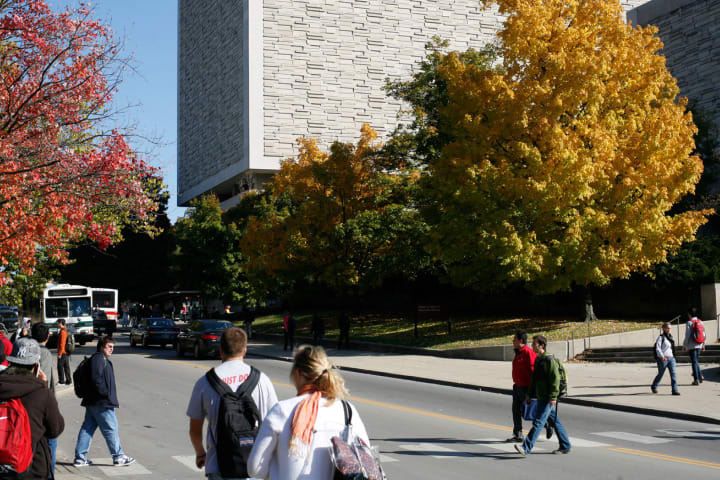
Photo courtesy of Indiana University.
An Indiana University, Bloomington, task force on traffic safety recommended an extensive education campaign and phased installation of a more effective type of pedestrian crosswalk as key steps to improving vehicle, pedestrian and bicycle safety on campus.
The Bloomington Campus Traffic Safety Task Force report also calls for coordinating the locations of campus and city bus stops and establishing an IU Bloomington standing committee with ongoing oversight of issues related to campus traffic safety.
Provost and Executive Vice President Karen Hanson created the task force on Sept. 18, 2009, charging it to study traffic safety issues, examine factors that had led to recent accidents and recommend measures to improve safety throughout campus.
"The task force has conducted a thorough investigation of the issues and made thoughtful and appropriate recommendations," Hanson said. "The campus is grateful to the members of this group for their outstanding work, and we look forward to working with the City of Bloomington to improve campus traffic safety for students, staff, faculty and community members."
The task force was chaired by Kurt Zorn, associate vice provost for undergraduate education, and Paul Sullivan, deputy vice president for capital projects and facilities. It included representatives of various IU offices and departments; student, staff and faculty representatives; and members from city government.
"Director of Public Works Susie Johnson and Bloomington Chief of Police Mike Diekhoff were actively engaged in the deliberations and decisions," Hanson said. "This exemplary cooperation between campus and community is essential to improving traffic safety."
Bloomington Mayor Mark Kruzan also praised the teamwork represented by the task force. "The task force recommendations are important for two reasons. They will result in real safety improvements, and they are indicative of how much good comes from campus-community cooperation," Kruzan said.
Hanson appointed the task force in response to growing concerns about campus safety and accidents involving vehicles, bicycles and pedestrians. Three accidents in the past seven years have resulted in fatalities.
Task force recommendations include:
Undertaking an extensive safety education program, ensuring that the campus community understands the "rules of the road" and the inherent dangers associated with pedestrian, bicycle and vehicle traffic on campus.
Implementing a plan that creates a new type of pedestrian crosswalk with clear delineation of a "safe zone" in which pedestrians have the right of way. The crosswalks would be installed first at two locations on Fee Lane, with more sites possibly to follow.
Making a limited number of changes in bus stops with the goal of eliminating confusion between IU Campus Bus and Bloomington Transit bus-stop locations.
Engaging a traffic engineer to study pedestrian, bicycle and vehicle traffic patterns with attention to speed limits, traffic signals and street alignment. The study would be coordinated with implementation of the campus master plan.
Forming a standing committee or advisory body to maintain oversight of campus traffic safety issues and coordinate efforts with the City of Bloomington.
The education campaign recommended by the task force would convey a safety message that is simple, visual and straightforward. It would be repeated each semester and would be as widespread as possible, presented in cooperation with the Office of Enrollment Management and Residential Programs, and making use of the campus Web page, social networking tools, orientation and student-information meetings, Campus Bus messages and the media.
The new type of pedestrian crosswalk would include clear signage for both pedestrians and drivers to clearly delineate a "safe zone" — an adequate distance between the crosswalk and approaching vehicles to make it safe for pedestrians to cross. Depending on the configuration of the roadway, the design could include a pedestrian island.
Two such crosswalks would be initially installed on Fee Lane — one near the Fee Lane Parking Garage and the other near a bus stop across from Foster Residence Center. IU and Bloomington police would launch an education campaign on the new crosswalks, coupled with increased enforcement. If the effort is successful, crosswalks could be added at six other locations identified by the task force.
The report points out that Indiana laws on pedestrian crossings are confusing, creating a need for better signage and education.
The complete report can be seen at online at http://www.iub.edu/provost/traffic/.
More Bus

Report: Transit Bus Manufacturing Supports 34,100 Jobs, $5.1B in GDP
The “Buses Mean Business” report examines the transit bus manufacturing industry’s economic footprint, supply chain, and rising demand for vehicle replacements.
Read More →
Biz Briefs: New Flyer Delivers in Columbus, Houston, Beep and Freebee Merge, and More
In this edition of Biz Briefs, we spotlight the latest developments shaping the future of mobility.
Read More →
People Movement: Dan Dipert Coaches Adds Third-Generation Leader, Keolis Names New Valley Metro VP/GM, and More
In this edition, we also cover recent appointments and announcements at the Wabtec, SilverRide, HNTB, and more, showcasing the individuals helping to shape the future of transportation.
Read More →
New York MTA Plans Largest Bus Fleet Upgrade in More Than a Decade
The agency is seeking manufacturers for 650 new CNG buses to replace aging vehicles, improve reliability, and advance its broader fleet modernization strategy.
Read More →
Building a Flexible Path to Transit Electrification
John Hroncich discusses BAE Systems’ modular and scalable approach, lessons learned from decades of real-world operations, and how agencies can identify electrification strategies that fit their fleets.
Read More →
Bus Tech Talk: Keeping Transit Technicians Ahead of the Technology Curve
LA Metro’s Obed Mejia discusses technician training, evolving maintenance technology, fleet replacement, and strategies for getting the most out of today’s transit fleets.
Read More →
Biz Briefs: RIPTA Unveils New Frontrunners, Clevland RTA Adds New Siemens, and More
In METRO's latest installment, we take a look at recent news from Siemens, Prevost, Dodge, and more partnerships making headlines across the transportation sector.
Read More →
People Movement: Holly Arnold Joins Transdev and More
In this edition, we also cover recent appointments and announcements at Pace, CamTran, MCI, and more, showcasing the individuals helping to shape the future of transportation.
Read More →
The High Cost of Transit Buses: Industry Leaders Look to Procurement Reform
Transit leaders and policymakers examine how standardized bus designs, streamlined procurement, and predictable funding could help agencies stretch budgets and deliver better service.
Read More →
The Business Voice Behind Public Transportation
As chair of APTA’s Business Members Board of Governors, Ray Melleady explains how more than 850 business members are partnering with transit agencies to advance funding, innovation, and industry-wide collaboration.
Read More →