




Looking Back:Austin Light Rail Project Initiates Procurement of Final Design, Construction Contract
Inside ATP’s RFP Process for Landmark Austin Light Rail System
Earlier this month, the final design and construction contract were released as the city prepares to break ground on its first light rail system in 2027.
June 26, 2025
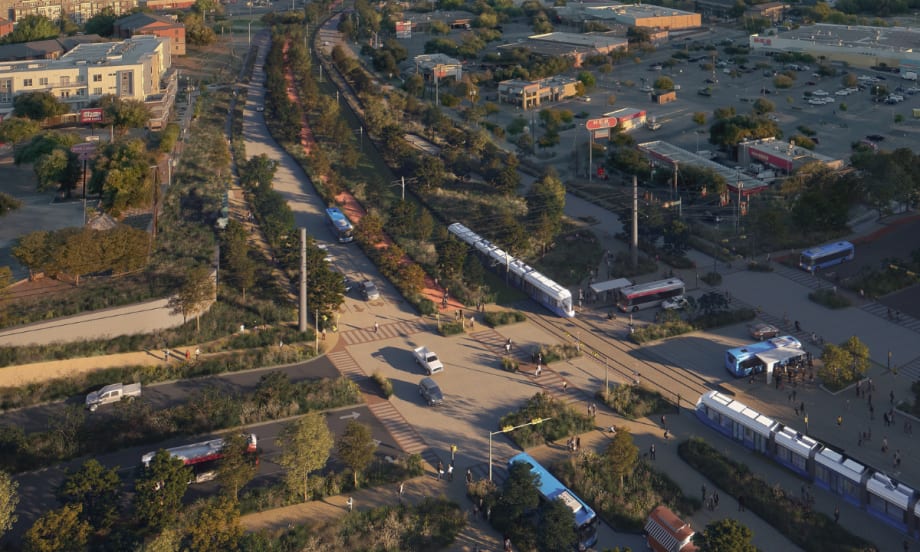
ATP will build Austin Light Rail using a progressive design-build delivery model that enables the organization to collaborate with industry partners.
Source: Artist Conceptual Visualization | Austin Transit Partnership
4 min to read
Earlier this month, Austin Transit Partnership (ATP) released the official solicitation for the multibillion-dollar final design and construction contract that will be awarded early next year in preparation for breaking ground on the Austin Light Rail Phase 1 in 2027.
Austin’s first light rail system will feature all-electric trains running every five to 10 minutes most of the day. The route will connect people to major job centers, education hubs, and popular destinations. It addresses immediate transportation needs by prioritizing accessible and reliable transportation around the city.
The $7.1 billion project, which is designed to expand as the city grows, includes 15 stations along a nearly 10-mile alignment, miles of new pedestrian and cycling paths, and a new bridge across Lady Bird Lake.
"Austin Light Rail is a mega infrastructure project that will offer qualified businesses across Texas and beyond a competitive opportunity to provide the materials and services needed to deliver the project," said CEO Greg Canally. "This final design and construction contract adheres to ATP's model to partner with the private sector to attract top talent to deliver a world-class light rail system for Austin."
The partners ATP selects for this contract will help shape and build nearly every aspect of the system, including the transitway, tracks, systems, stations, bridges, traffic signals, utilities, drainage structures, and streetscape. The agreement is expected to extend through the duration of design, construction, and opening for service, which is planned for 2033.
Community-Driven Vision Sets Stage for Austin Light Rail
Before adoption by the Austin City Council, ATP Board, and the CapMetro board in June 2023, ATP conducted a robust community engagement process to review options for the first phase of light rail.
According to Jennifer Pyne, executive VP, planning, community, and federal programs, at Austin Transit Partnership, Austinites made clear that expanding public transit is a priority, demonstrated by the approval of Prop A in 2020.
"Success in 2033 means delivering the system Austinites envisioned and providing a safe and reliable light rail that transports people to jobs, schools, health care, entertainment, and essential services," Pyne said.
With the groundbreaking not until 2027 and a service launch planned for 2033, Pyne insists that morale remains strong because the benefits of Austin Light Rail are already taking shape long before construction begins.
As the region prepares the workforce for the economic opportunities the project will generate, ATP has made steady progress through the completion of the NEPA scoping phase, collected nearly 4,000 public comments, hosted multiple open houses, advanced design work, and prepared the Draft Environmental Impact Statement.
"Each step has kept the community and project partners engaged and informed," Pyne said.
ATP hosts regular public board meetings and coordinates with TxDOT and federal agencies such as the FTA. These built-in checks and transparent processes ensure that ATP stays focused and aligned with local and federal expectations at every project stage.
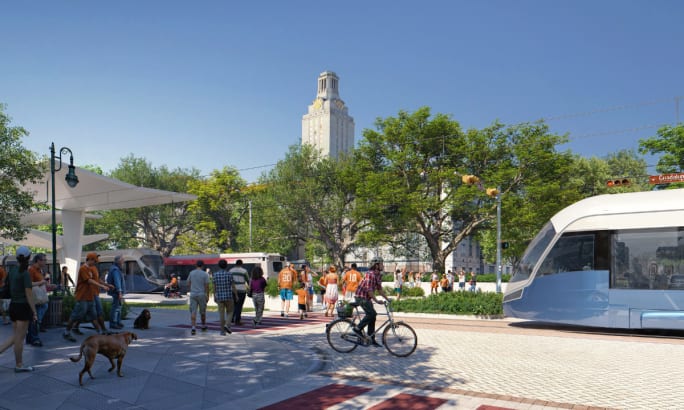
Austin's first light rail system will feature all-electric trains running every 5-10 minutes most of the day, connecting people to major job centers, education hubs, and popular destinations.
Source: Artist Conceptual Visualization | Austin Transit Partnership
ATP and Industry Unite for Rail Delivery Success
As it developed its project delivery approach, ATP has also actively engaged the transit and construction industry.
ATP will build Austin Light Rail using a progressive design-build delivery model that enables the organization to collaborate with industry partners through:
Innovative design solutions that balance technical requirements with Austin's unique needs.
A design focused on efficient construction to keep Austin moving while the project is being built.
Integrating the latest construction costs into design development to ensure the project design aligns with the budget.
ATP worked over the last year to finalize the solicitation, which was informed by industry feedback.
"We practice releasing solicitation documents in draft form, which allows feedback on the approach we may consider. It also promotes a shared understanding of our objectives for the project," Pyne said.
ATP is using a two-step procurement process that began with the June 5, 2025, release of a Request for Qualifications (RFQ), with responses due by July 3, 2025. Qualified firms will then be invited to participate in a comprehensive Request for Proposals (RFP) process evaluating team experience, approach, and cost.
To strengthen competition and encourage early engagement, ATP issued a Request for Information (RFI) last February and hosted the Connect and Build: Partnerships for Austin Light Rail industry event. This allowed firms to preview the scope and assemble strong teams.
Input from industry partners has shaped strategies for contract phasing, risk-sharing, promoting competition, and attracting diverse firms.
"ATP's ultimate vision of success is delivering a system that Austinites are proud of, one that reflects their community, helps keep Austin livable, serves their daily lives, and helps build a more connected and sustainable Austin for generations to come," Pyne said.
ATP anticipates awarding the final design and construction contract in early 2026.
More Rail

New York MTA Advances Final Contract for Second Avenue Subway Expansion
Contract Four is the largest in the Second Avenue Subway Phase 2 project and includes construction of station infrastructure, tracks, and signals for the subway expansion, MTA officials said. Work on Contract Four will begin in 2027.
Read More →
San Diego MTS Breaks Monthly Trolley Ridership Record
Agency officials said July’s ridership indicates MTS’s continued recovery from the pandemic.
Read More →
Report Examines NJ TRANSIT Reliability, Funding Challenges
The Garden State Initiative analysis examines the roles of Amtrak infrastructure, fleet management, and agency operations while recommending a more performance-based approach to improving reliability.
Read More →
Stadler, CapMetro Sign Long-Term Rail Fleet Support Agreement
Beginning in 2027, Stadler will provide on-site technical expertise, spare parts support, training, and obsolescence management to help extend the reliability and longevity of CapMetro’s GTW fleet.
Read More →
Biz Briefs: Alstom Lands Canadian Contract, LYT to Supply California TSP, and More
In METRO's latest installment, we take a look at recent news from Complete Coach Works, Beep, FlixBus, and more partnerships making headlines across the transportation sector.
Read More →
CATS Gold Line Marks 5 Years of Service, 2.8M Passenger Trips
With a six-mile expansion planned, the Charlotte streetcar is positioned to connect more neighborhoods and major transit hubs across the region.
Read More →
Why Simulating Pedestrian Movement Has Become Essential for Modern Rail Stations
Pedestrian microsimulation is helping rail planners identify bottlenecks, test station designs, and prepare complex transit hubs for growing passenger volumes.
Read More →
Amtrak Begins Major Construction at New York’s Sunnyside Yard
The new maintenance facility will support Amtrak’s Airo trainsets while improving maintenance efficiency and turnaround times in New York.
Read More →
Chicago Leaders Unveil Plans for O’Hare Airport Express Train
The privately developed project would offer a 15-minute trip between downtown and O’Hare’s Terminal 2, with trains operating every 15 minutes on a dedicated track. The service would use battery-electric trains and three existing freight rail rights-of-way.
Read More →
OCTA Maps Out 30-Year Strategy to Protect Coastal Rail Corridor
The draft feasibility report identifies strategies to protect the coastal rail line for decades as the agency continues near-term stabilization and sand placement efforts.
Read More →