




Related: KCATA adopts new brand, improved paratransit services
KCATA to offer Wi-Fi on all buses by 2016
The agency started offering Wi-Fi services in early 2014, but it was only available on the MAX routes operating on Main Street and Troost Avenue, plus 22 other Metro buses.
September 22, 2015

2 min to read
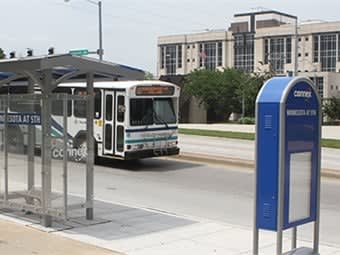
All Kansas City buses will be equipped with Wi-Fi next year when the Kansas City Area Transportation Authority expands the amenity to more than 200 buses.
Currently, 55 buses in the KCATA’s 263-vehicle fleet are fitted with Wi-Fi allowing riders to surf the Internet, check office email, update their Facebook status or Tweet without relying on their own data packages.
The KCATA started offering Wi-Fi services in early 2014, but it was only available on the MAX routes operating on Main Street and Troost Avenue, plus 22 other Metro buses.
The expansion of Wi-Fi is yet another reason for choosing to ride the bus whether someone is going to work, to school or to the store.
“We believe that an expanded offering of Wi-Fi services will make public transit even more attractive,” said KCATA President/CEO Joe Reardon. “Our riders can now more readily turn to the Internet at any time during their commute, a distinct advantage over driving since multi-tasking presents a clear hazard on the road.”
Adding Wi-Fi to the entire bus fleet should prove to be popular with the tech savvy millennial generation that places premium on being connected.
A 2013 survey done by the American Public Transportation Association revealed that 54% of millennials — ages 18 to 34 — want their transportation options to include Wi-Fi everywhere they go within 10 years.
Forty-five percent of those surveyed said they wanted transportation options that are more connected and tech friendly within 10 years.
The poll of 1,000 people in six cities also found that 44% of millennials use public transportation so they can socialize online.
The study concluded that fully leveraging technology, including Wi-Fi, allows transit riders to be more spontaneous and helps undercut one key competitive advantage of the car.
More Management

METRO Opens Submissions for 2026 Motorcoach Awards
Nominations are now being accepted for METRO Magazine’s Operator of the Year and Innovative Operator of the Year awards.
Read More →
New York MTA Advances Final Contract for Second Avenue Subway Expansion
Contract Four is the largest in the Second Avenue Subway Phase 2 project and includes construction of station infrastructure, tracks, and signals for the subway expansion, MTA officials said. Work on Contract Four will begin in 2027.
Read More →
Transit Agencies Highlight Safety Gains at National Summit
Leaders from 15 major transit systems shared crime-reduction results and safety initiatives while discussing the role of continued federal support.
Read More →

NITA Names New Leadership, Expands Reduced-Fare Program at First Board Meeting
The new regional transit authority appointed its first board chair and interim executive director while extending reduced fares across CTA, Metra, and Pace for eligible riders.
Read More →
Beyond the Checklist: A Structured Approach to Transit Maintenance
Reliability-Centered Maintenance helps transit agencies move beyond routine checklists to focus limited resources on the assets and failures that have the greatest impact on safety, reliability, and service.
Read More →
APTA 2026 Nominating Committee Selects Leadership Slate, Names Chair and Vice Chair Nominees
Leadership changes will help shape the association’s priorities and its representation of the transportation industry during the 2026–2027 term.
Read More →
DART Launches Major Security, Fare Enforcement Initiative
The 90-day demonstration will deploy coordinated security teams at five light rail stations while testing controlled access and gathering data to guide future investments.
Read More →
Sponsored•September 9, 2026
Advancing Fare Collection Through Technology and Innovation
Learn about delivering 1300 gates at 91 stations while managing fare evasion. Explore the large scale deployment, solution customization and real-world results that affect the region. Prepare for deployment in your region now.
Read More →
Game Day in Motion: Moving Millions During the 2026 World Cup
Between packed transit stations and team motorcoaches, see how agencies and operators across North America tackled the transportation demands of the 2026 FIFA World Cup.
Read More →
Surface Transportation Extension Averts Shutdown, Leaves Transit Funding Gap
The stopgap keeps federal transportation programs moving, but missing advance funding could complicate the transit and rail projects agencies are planning next.
Read More →