



Keolis launches electric autonomous shuttle pilot in Paris business district
If these trials are successful, this shuttle service could become a permanent mobility solution in the region, with additional services and the creation of new lines.

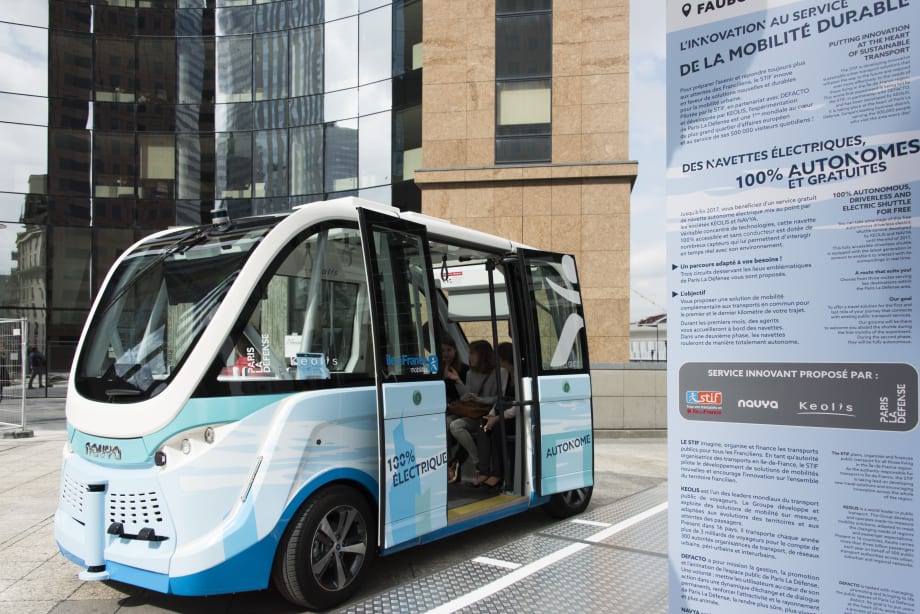
Keolis started shuttle services of three electric autonomous vehicles, developed by Navya, in the La Defense Paris business district, which will run until the end of the year. The service will provide a new “first and last mile” mobility solution for the 500,000 people travelling to and from La Defense every day. The free shuttles will service key sites along a pedestrian-only esplanade, and are accessible to passengers with reduced mobility.
The aim of the trial is to test these vehicles under realistic operating conditions. While Keolis and Navya have already been trialing the shuttles in Lyon, France since September 2016, this is the first time that these vehicles will operate on a public road without personnel on-board.
Each shuttle can accommodate up to 15 passengers. Keolis has already identified a range of sites where these vehicles would be ideal for use including airports, hospitals, university campuses, tourist attractions, industrial sites, and shopping centers. While the shuttle can travel at up to approximately 13 miles per hour, in a pedestrian and densely populated area like La Defense, the shuttle will run at an average speed of approximately four miles per hour. The three shuttles will run seven days a week, including public holidays. During peak hours, shuttles will depart every 10 minutes and every 20 minutes in the off-peak periods.
A number of other autonomous vehicle trials are already planned in the coming months in the Greater Paris region, including in the Bois de Vincennes, east of Paris. If these trials are successful, this shuttle service could become a permanent mobility solution in the region, with additional services and the creation of new lines. Internationally, Navya’s autonomous, electric shuttles have already been trialed in Las Vegas in January 2017 and will soon be tested in Terrebonne, Canada; Victoria, Australia; and Aalborg, Denmark. Keolis is also currently working on 10 different autonomous vehicle projects across the world.
Keolis has partnered with Navya since 2016. In October 2016 it became a minority shareholder of Navya.
Autonomous vehicles and their impact on transportation operations will be discussed during BusCon's Keynote Address in Indianapolis Sept. 11 to 13. For information, click here.
More New Mobility

From Hardware to Digital Partner: Luminator Charts Its Next Chapter
CEO Magnus Friberg discusses Luminator’s shift toward becoming a digital partner, the growing importance of software and interoperability, and how AI can help agencies improve operations and passenger experience.
Read More →
Biz Briefs: Alstom Lands Canadian Contract, LYT to Supply California TSP, and More
In METRO's latest installment, we take a look at recent news from Complete Coach Works, Beep, FlixBus, and more partnerships making headlines across the transportation sector.
Read More →
CharterUP’s Armir Harris on Technology, AI, and the Future of Group Mobility
In a recent episode of METROspectives, CharterUP Founder/CEO Armir Harris discussed the company’s evolution from an online charter bus marketplace into a technology platform supporting public- and private-sector mobility and much more.
Read More →
Jacksonville’s NAVI Project Charts a New Course for Autonomous Public Transportation
Through its NAVI program, JTA is showing how autonomous vehicles, intelligent infrastructure, and coordinated operations can work together to deliver everyday public transportation.
Read More →
Biz Briefs: Luminator Marks Milestone and More
From manufacturers and suppliers to transit agencies and motorcoach operators, these updates offer a snapshot of the projects, partnerships and business moves driving the industry forward.
Read More →
New Tricks for Old Bureaucracies: Joshua Schank on Making Transit Innovation Stick
Former LA Metro Chief Innovation Officer Joshua Schank discusses why good ideas aren't enough, how transit agencies can overcome resistance to change, and why today's challenges demand more innovation.
Read More →
How DART's GoPass Is Redefining Regional Mobility
Serving 14 transit agencies, GoPass simplifies multimodal travel by allowing riders to plan, pay for, and manage an entire trip through one app.
Read More →
Biz Briefs: OCTA Taps Clean Energy for Hydrogen Station, Stadler to Supply Via Rail Vehicles, and More
From manufacturers and suppliers to transit agencies and motorcoach operators, these updates offer a snapshot of the projects, partnerships and business moves driving the industry forward.
Read More →CharterUP Expands Into New Mobility and Autonomous Transportation
Vice President of New Mobility Stephen Joos discusses how CharterUP is leveraging its nationwide transportation network, technology platform, and autonomous vehicle partnerships to expand into workforce mobility, campus shuttles, and transit solutions.
Read More →
METRO Magazine Announces 2026 Innovative Solutions Awards Winners
Projects Recognized for Advancing Mobility Through Technology, Accessibility, Workforce Innovation, and Operational Excellence
Read More →