



Ky.'s TARC launches all-electric Proterra fleet
The all-electric system - 10 buses and two charging stations - is an $11 million investment, with the bulk of funding from federal and state grants. Louisville Metro contributed $500,000.

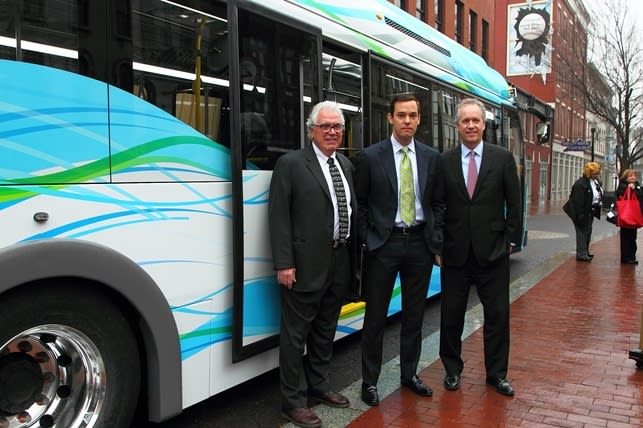
TARC Executive Director J. Barry Barker, Proterra President/CEO Ryan Popple and Mayor Greg Fischer (left to right) joined others on a maiden ZeroBus trip. Courtesy Transit Authority of River City
TARC Executive Director J. Barry Barker, Proterra President/CEO Ryan Popple and Mayor Greg Fischer (left to right) joined others on a maiden ZeroBus trip. Courtesy Transit Authority of River City
Transit Authority of River City (TARC) and local officials celebrated the launch of its all-electric, ZeroBus service in downtown Louisville, Ky. this week.
ZeroBus, TARC’s all-electric fleet, is now providing fare-free rides for passengers along Main, Market and Fourth streets. The zero-emission buses are replacing diesel-powered trolleys, the highest polluting TARC vehicles.
RELATED:Ky.'s TARC orders 10 Proterra all-electric buses
“ZeroBus changes the game for public transportation in downtown and represents the type of progress and forward-thinking focus we are embracing to improve our city,” said Mayor Greg Fischer, who joined TARC Executive Director J. Barry Barker and others on a maiden ZeroBus trip.
“Louisville is the first city in this part of the country to have a fleet of all-electric buses in operation, putting us at the leading edge of high-technology, cleaner, greener transportation,” Barker said.
TARC
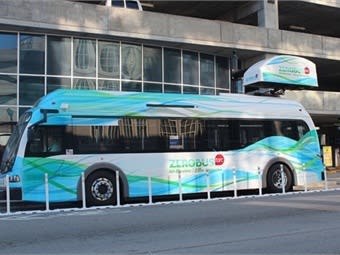
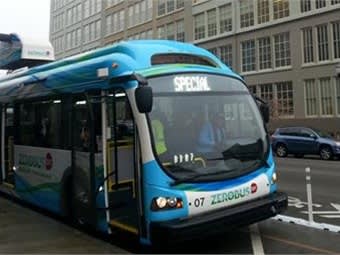
The vehicles, with free wi-fi onboard, arrive at stops frequently - from every 10-18 minutes depending on the time of day - and offer a quiet ride. With expansive windows, an oval shape and a colorful blue and green design, they’re a distinctive addition to downtown.
The all-electric system - 10 buses and two charging stations - is an $11 million investment, with the bulk of funding from federal and state grants. Louisville Metro contributed $500,000.
ZeroBus
The ZeroBus recharges in just a few minutes along the route while passengers load and unload at a charging stop. Each time a ZeroBus pulls up to a charging stop, it automatically connects to an overhead, high-capacity charger. Charging stops are on the south side of Market Street, between Eighth and Ninth streets, and on the west side of South Third Street, between York and Breckinridge streets.
Since 2010, Proterra Inc., of Greenville, S.C., has produced 38 of these type of vehicles which are operating in eight other states, mostly on the east and west coasts.
“Proterra is honored to partner with Louisville Metro, TARC and the Federal Transit Administration on this innovative project,” said Ryan Popple, president and CEO of Proterra Inc. “As an American technology company, and the U.S. market leader in electric buses for public transit, we’re especially proud to see this newest fleet of Proterra vehicles providing high performance, zero-emission service in Louisville."
TARC
The five oldest trolley buses combined now emit a total of about 1,135 pounds of carbon monoxide in a year, compared to zero emissions from the all-electric buses. TARC will also save thousands of dollars each year in lower operating costs. In fuel costs alone, each electric bus will save TARC an estimated $10,000 per year.
RELATED:(video) Jay Leno's Garage - Proterra's Ecoliner Electric Bus
Main-Market ZeroBuses circle between 10th and Campbell streets. On Fourth Street, the buses travel between Breckinridge Street and the Galt House, circling around Fourth Street Live! by taking Fifth Street northbound and Third Street southbound. South of Broadway the buses travel south on Third Street and north on Fourth Street.
ZeroBuses operate on Fourth Street from 7 a.m. - 7 p.m. and on Main-Market from 7 a.m. - 8 p.m. on weekdays. Buses run on both routes from 10 a.m. – 6 p.m. on Saturdays. The Main-Market route features red ZeroBus stop signs. Green bus stop signs are on the Fourth Street route.
More Technology

From Hardware to Digital Partner: Luminator Charts Its Next Chapter
CEO Magnus Friberg discusses Luminator’s shift toward becoming a digital partner, the growing importance of software and interoperability, and how AI can help agencies improve operations and passenger experience.
Read More →
Beyond the Checklist: A Structured Approach to Transit Maintenance
Reliability-Centered Maintenance helps transit agencies move beyond routine checklists to focus limited resources on the assets and failures that have the greatest impact on safety, reliability, and service.
Read More →
NJ TRANSIT Advances Bus Technology Upgrades Across Statewide Fleet
More than 1,500 buses now feature upgraded technology designed to improve arrival predictions and provide free Wi-Fi, with deployment expected to reach nearly 2,000 buses by the end of 2026.
Read More →

Building a Flexible Path to Transit Electrification
John Hroncich discusses BAE Systems’ modular and scalable approach, lessons learned from decades of real-world operations, and how agencies can identify electrification strategies that fit their fleets.
Read More →
Biz Briefs: Alstom Lands Canadian Contract, LYT to Supply California TSP, and More
In METRO's latest installment, we take a look at recent news from Complete Coach Works, Beep, FlixBus, and more partnerships making headlines across the transportation sector.
Read More →
From Legacy Silos to Conversational Intelligence
What if transit leaders could ask any operational question and get a trusted answer in seconds? Conversational AI is transforming how agencies use their data.
Read More →
USDOT Announces Rail Vehicle Replacement Grants, Chattanooga AV Shuttle Funding
More than $191 million in federal funding will help three transit agencies replace aging rail vehicles and support a new autonomous shuttle service in Chattanooga.
Read More →
Bus Tech Talk: Keeping Transit Technicians Ahead of the Technology Curve
LA Metro’s Obed Mejia discusses technician training, evolving maintenance technology, fleet replacement, and strategies for getting the most out of today’s transit fleets.
Read More →
Biz Briefs: RIPTA Unveils New Frontrunners, Clevland RTA Adds New Siemens, and More
In METRO's latest installment, we take a look at recent news from Siemens, Prevost, Dodge, and more partnerships making headlines across the transportation sector.
Read More →
Why Simulating Pedestrian Movement Has Become Essential for Modern Rail Stations
Pedestrian microsimulation is helping rail planners identify bottlenecks, test station designs, and prepare complex transit hubs for growing passenger volumes.
Read More →