



Mass. Governor Files Bill to Improve Safety, Data Reporting for TNCs
The legislation would also provide flexibility for the ban on surge pricing during a state of emergency and expand the types of companies subject to state TNC laws and regulations.
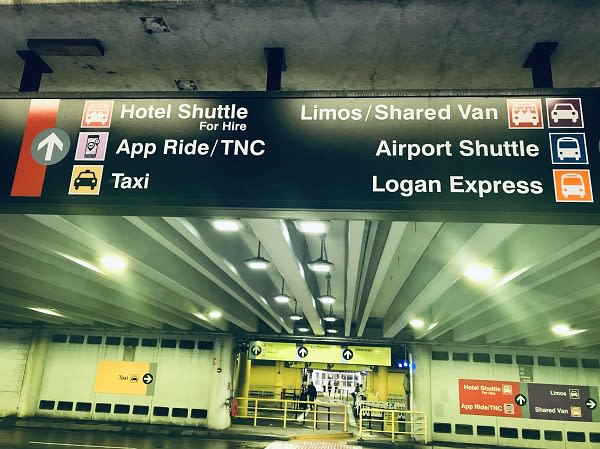
Boston's Logan Airport signage directs passengers to various transportation modes, including TNCs.
File photo
Gov. Charlie Baker and Lt. Gov. Karyn Polito recently filed legislation to build on the state's oversight of transportation network companies (TNCs) by improving public safety requirements and obtaining additional ride data to assist with transportation planning, congestion management, and vehicle emissions tracking.
The legislation, titled "An Act Relative to Transportation Network Companies," would also provide needed flexibility for the ban on surge pricing during a state of emergency, and expand the types of companies subject to state TNC laws and regulations.
“The safety of Massachusetts residents and visitors is our top priority and this legislation will institute additional public safety measures for passengers and law enforcement, provide important information to transportation planners, and reduce administrative burdens for cities and towns,” Baker said in a news release about the legislation’s filing.
The Administration previously filed "An Act Relative to Public Safety and Transparency by Transportation Network Companies" in 2019, but now the legislation includes a newly filed provision that gives the Department of Public Utilities (DPU) exclusive authority to regulate large livery companies operating throughout the state on a digital network. This provision will ensure that livery companies operating on a digital network with over 100 drivers will be subject to the statewide TNC laws and regulations. Smaller livery companies will remain regulated at the municipal level, regardless of whether they operate on a digital network.
The proposal would build on Massachusetts’s TNC safety and enforcement laws, some of the most stringent and comprehensive in the country, by:
Increasing fines and penalties, up to two and half years in a House of Correction, for the practice of “account renting,” or allowing another individual to utilize a TNC driver’s account or identity, to provide TNC services.
Making it a criminal offense for a driver to exploit the personal information of a rider to stalk, harass, or defraud a rider.
Implementing tougher penalties for drivers who:
Fail to maintain a driver certificate or a background check clearance certificate.
Fail to display TNC vehicle decals.
Fail to maintain adequate insurance or carry proof of a TNC vehicle inspection.
This legislation also allows for new transportation data to be collected from TNCs and eases the administrative burden on small towns. Specifically, the bill will:
Authorize the DPU to obtain more detailed trip data from TNCs on a monthly basis that can then be shared in an anonymous and confidential manner with state agencies, municipalities, and local organizations for planning purposes.
The more detailed data called for in this legislation includes total miles and minutes when drivers are en-route to pick up riders and when they are providing rides; whether riders were successfully matched for shared rides; and additional data on accidents and reasonable accommodations.
Allow better emissions data to be collected by requiring TNCs to report the total miles and minutes that each vehicle is on the road, together with vehicle make, model and year information.
Reduce the reporting requirements for communities that receive $25,000 or less annually from TNCs and allow those communities to make spending decisions on those relatively small funds without going through their local appropriation process.
The additional data will help transportation planners analyze how rides impact transportation infrastructure and the environment, and allow them to make more informed decisions about the location of dedicated bus lanes, specific investments in infrastructure, and overall impacts from vehicle emissions.
The legislation also gives the DPU the authority to determine whether it is appropriate to permit TNCs to utilize surge pricing during a state of emergency. Enabling surge pricing under certain circumstances and with appropriate limitations could increase the supply of drivers, which reduces wait times and ensures reliable transportation options.
More New Mobility

From Hardware to Digital Partner: Luminator Charts Its Next Chapter
CEO Magnus Friberg discusses Luminator’s shift toward becoming a digital partner, the growing importance of software and interoperability, and how AI can help agencies improve operations and passenger experience.
Read More →
Biz Briefs: Alstom Lands Canadian Contract, LYT to Supply California TSP, and More
In METRO's latest installment, we take a look at recent news from Complete Coach Works, Beep, FlixBus, and more partnerships making headlines across the transportation sector.
Read More →
CharterUP’s Armir Harris on Technology, AI, and the Future of Group Mobility
In a recent episode of METROspectives, CharterUP Founder/CEO Armir Harris discussed the company’s evolution from an online charter bus marketplace into a technology platform supporting public- and private-sector mobility and much more.
Read More →
Jacksonville’s NAVI Project Charts a New Course for Autonomous Public Transportation
Through its NAVI program, JTA is showing how autonomous vehicles, intelligent infrastructure, and coordinated operations can work together to deliver everyday public transportation.
Read More →
Biz Briefs: Luminator Marks Milestone and More
From manufacturers and suppliers to transit agencies and motorcoach operators, these updates offer a snapshot of the projects, partnerships and business moves driving the industry forward.
Read More →
New Tricks for Old Bureaucracies: Joshua Schank on Making Transit Innovation Stick
Former LA Metro Chief Innovation Officer Joshua Schank discusses why good ideas aren't enough, how transit agencies can overcome resistance to change, and why today's challenges demand more innovation.
Read More →
How DART's GoPass Is Redefining Regional Mobility
Serving 14 transit agencies, GoPass simplifies multimodal travel by allowing riders to plan, pay for, and manage an entire trip through one app.
Read More →
Biz Briefs: OCTA Taps Clean Energy for Hydrogen Station, Stadler to Supply Via Rail Vehicles, and More
From manufacturers and suppliers to transit agencies and motorcoach operators, these updates offer a snapshot of the projects, partnerships and business moves driving the industry forward.
Read More →CharterUP Expands Into New Mobility and Autonomous Transportation
Vice President of New Mobility Stephen Joos discusses how CharterUP is leveraging its nationwide transportation network, technology platform, and autonomous vehicle partnerships to expand into workforce mobility, campus shuttles, and transit solutions.
Read More →
METRO Magazine Announces 2026 Innovative Solutions Awards Winners
Projects Recognized for Advancing Mobility Through Technology, Accessibility, Workforce Innovation, and Operational Excellence
Read More →