




RELATED: How reverse commutes can help reshape rail ridership
MBTA accelerates rail signal repairs after derailment
Red Line recovery work is expected to continue through the summer to gradually restore impacted portions of the Red Line to full service.
June 24, 2019
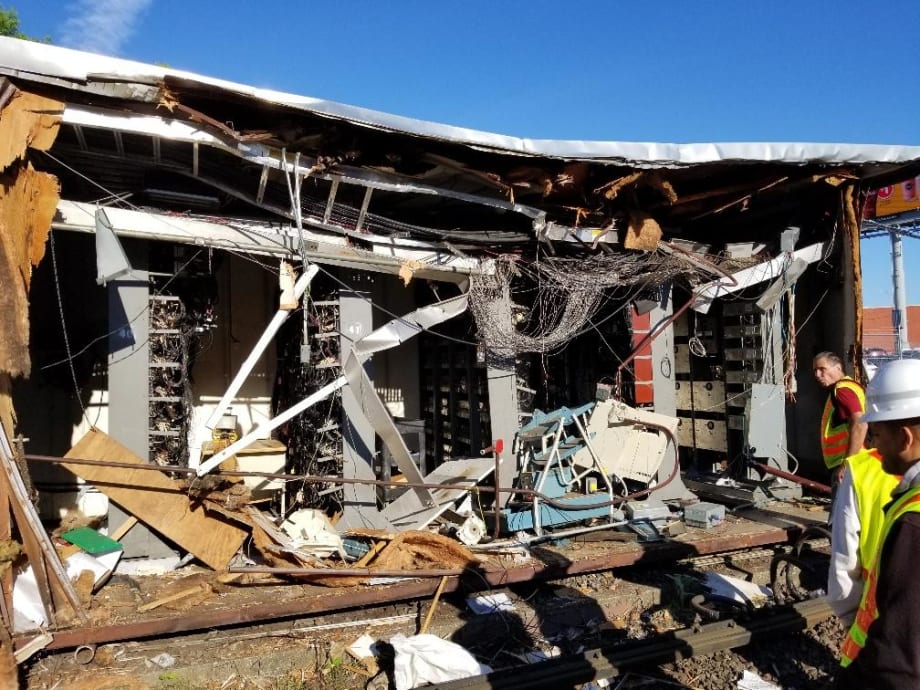
Crews inspect the damaged signal house at JFK/UMass, following the derailment of a Red Line train on June 11, 2019.
MBTA
3 min to read
Crews inspect the damaged signal house at JFK/UMass, following the derailment of a Red Line train on June 11, 2019.
MBTA
The MBTA announced an accelerated repair schedule for its Red Line passenger rail signal system.
Following a derailment earlier this month, initial recovery efforts were focused on repairs to track and power systems in the area of JFK/UMass Station.
In the immediate aftermath of the derailment, trains could only run at a rate of approximately one train every 10 minutes, or six trains per hour, during peak travel hours through the Red Line core, which spans from JFK/UMass to Alewife.
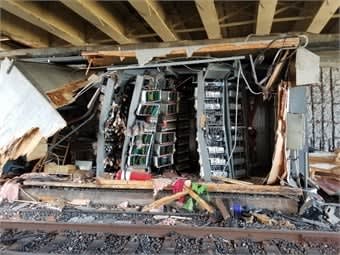
A view of the damaged signal house at JFK/UMass on June 11, 2019.
MBTA
With both contractor personnel and MBTA forces working around the clock, train speeds could safely increase to 25 miles per hour through most of the affected area. As a result, the MBTA was able to restore Red Line frequency to one train every six minutes during rush hour, or about 10 trains per hour.
To safely operate trains at six-minute intervals, while also allowing crews to continue signal-system repairs, Red Line trains are passing through the JFK/UMass area under a carefully controlled manual operation. The complex process involves over 50 people at a given time to safely coordinate the movement of trains between the Red Line core and the Braintree and Ashmont branches.
Red Line recovery work is expected to continue through the summer to gradually restore impacted portions of the Red Line to full service.
Work remains ongoing to address critical signal infrastructure that will allow the MBTA to resume normal levels of service. After conducting a careful evaluation of remaining work, the MBTA expects that this work will continue throughout the summer.
During the derailment, the train struck and damaged multiple structures that house critical Red Line signal hardware and equipment in the area near JFK/UMass.
The equipment controls the intricate system of track, signals, and switches where the Ashmont and Braintree branches diverge on the Red Line. Without the signal system, each Red Line train must be given permission to proceed from one station to the next with personnel along the tracks physically directing trains’ routing. While this limits train speeds as well as the total number of trains in service, this manual process is necessary to allow trains to move safely along tracks.
In addition to controlling the speed and frequency of Red Line trains traveling in passenger service, the signal system also plays a vital role in dispatching trains during the start of service each day.
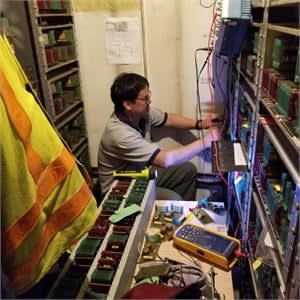
A technician makes repairs inside the signal house at JFK/UMass on June 20, 2019.
MBTA
MBTA signal and power teams continue to simultaneously assess the scope of damage and make repairs to the signal systems. Because of the age of the system and the extent of the damage, initial restoration of the signal system was projected to take approximately one year.
The Red Line derailment continues to be under investigation. Operator error (including speed), foul play, and track infrastructure have been ruled out as the probable cause at this time. After disassembling the car that derailed, MBTA personnel are in the process of determining potential causes of its failure through rigorous evaluations of the car’s components. Out of an abundance of caution, the MBTA conducted a rigorous inspection of all related components of all vehicles of the same type involved in the derailment. As of last Friday, all vehicles of the same type involved in the derailment have been inspected.
More Security and Safety

Transit Agencies Highlight Safety Gains at National Summit
Leaders from 15 major transit systems shared crime-reduction results and safety initiatives while discussing the role of continued federal support.
Read More →
DART Launches Major Security, Fare Enforcement Initiative
The 90-day demonstration will deploy coordinated security teams at five light rail stations while testing controlled access and gathering data to guide future investments.
Read More →
RTD Launches NextRide App to Consolidate Trip Planning, Fares, Security Reporting
The app expands on RTD’s existing NextRide web application and allows customers to view real-time vehicle locations and service alerts, purchase and store digital fares, and access customer support.
Read More →
TAPTCO Updates OSHA Compliance Training for Transit Maintenance Operations
The revamped program addresses 26 OSHA standards for maintenance facilities, with TAPTCO pointing to training, documentation, and everyday shop hazards as continuing challenges for transit operations.
Read More →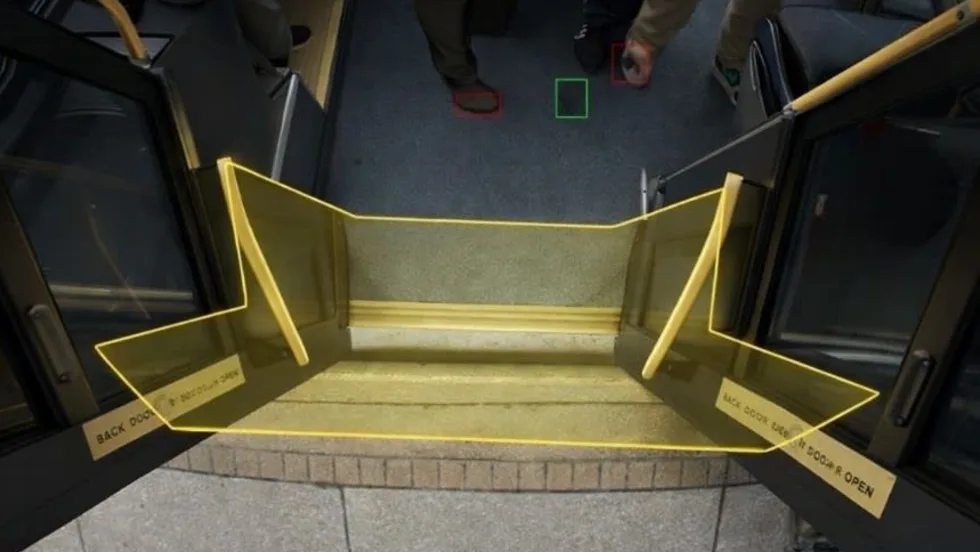
Sponsored•August 18, 2026
How VaporVision Adds Value to Transit Door Systems
Wabtec engineers explain how the system improves doorway detection, strengthens diagnostics and gives transit agencies and OEMs greater operating flexibility.
Read More →
FRA Announces $5.3B in Rail Investments, Including $2B for Amtrak
Funding will support grade-crossing improvements, infrastructure upgrades, and new Amtrak equipment in 23 states.
Read More →
Chicago, Maryland Expand Non-Law-Enforcement Safety, Rider Support
The CTA and MTA are launching new programs aimed at de-escalation, crisis response, rider assistance, and greater transparency.
Read More →
LA Metro, City of West Hollywood, and Partners Advance Smarter Bus Lane Enforcement
The award-winning partnership combines AI-powered detection with human oversight to improve bus reliability, accessibility, and enforcement efficiency.
Read More →
LA Metro Reports 57% Decline in Homelessness on Transit System Since 2024
The agency's latest homelessness count offers new data on how care-based services and cross-sector partnerships can complement traditional transit security strategies.
Read More →
FTA Launches 'Transit Moves America' Dashboard to Highlight Agency Safety and Performance
The online dashboard transforms National Transit Database information into a public-facing resource that allows users to compare transit agencies on key operational and safety metrics.
Read More →