



MBTA anti-sexual harassment campaign to help people with disabilities
The campaign’s message is that sexual assaults will not be tolerated on the T or anywhere else.

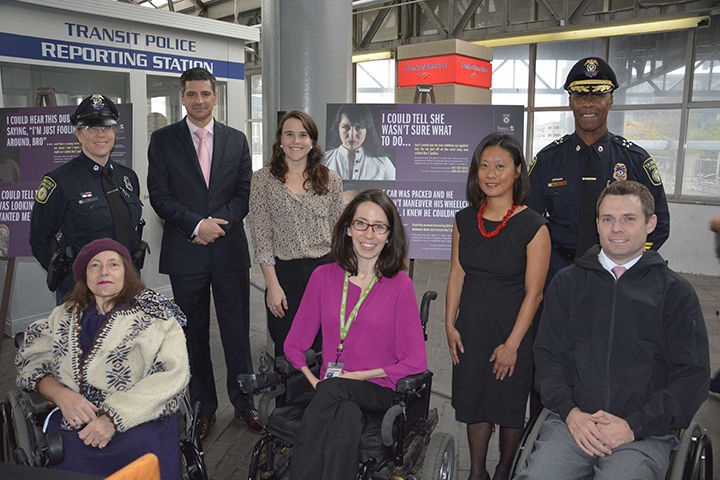
MBTA
MBTA
The Massachusetts Bay Area Transportation Authority (MBTA), as part of a coalition of organizations, launched a new information campaign in November to enhance passenger safety and encourage the public to report incidents of sexual harassment. The campaign’s message is that sexual assaults will not be tolerated on the T or anywhere else.
This year, the MASS Collaboration, a partnership with the Boston Center for Independent Living (BCIL), the Boston Area Rape Crisis Center (BARCC), the MBTA, and the MBTA Transit Police, developed the campaign with a focus on people with disabilities. MASS — Movement for Access, Safety & Survivors — is a collaboration whose goal is to insure that survivors and victims of sexual violence with disabilities in the Boston area have access to quality support services.
“Findings show that people with disabilities experience sexual assault twice as often as those without disabilities. We have also been learning how people with disabilities can be active participants in preventing sexual violence against others,” said BCIL senior advocacy specialist Karen Schneiderman.
MASS Collaboration works to create a safe environment for all customers, one that includes the needs of people with disabilities, including ensuring that reporting and response mechanisms are accessible. The MASS Collaboration is also increasing the skill and comfort of employees at BARCC, BCIL and the MBTA with respect to working with victims/survivors with disabilities.
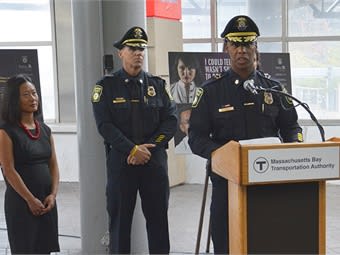
MBTA Transit Police Chief Kenneth Green speaking during the campaign announcement.
Efforts at the T have included developing information and trainings on topics such as responding to reports of sexual violence from those with disabilities, and how to secure wheeled mobility devices in a manner that is safe and empowering to customers.
As in past campaigns, advertisements will be posted on trains and buses, and postcards will be handed out to riders at several stations. Postcards will be available in large print and the MASS Collaboration has also created an online website to make the information accessible to those who are blind or have low vision.
“By increasing visibility of an under-addressed issue, we hope to let all riders know that you can make a difference if you intervene when you witness sexual violence. Accessible services are available at BARCC for survivors and those supporting and assisting them,” said Shelley Yen-Ewert, director of the MASS Collaboration.
More Security and Safety

Transit Agencies Highlight Safety Gains at National Summit
Leaders from 15 major transit systems shared crime-reduction results and safety initiatives while discussing the role of continued federal support.
Read More →
DART Launches Major Security, Fare Enforcement Initiative
The 90-day demonstration will deploy coordinated security teams at five light rail stations while testing controlled access and gathering data to guide future investments.
Read More →
RTD Launches NextRide App to Consolidate Trip Planning, Fares, Security Reporting
The app expands on RTD’s existing NextRide web application and allows customers to view real-time vehicle locations and service alerts, purchase and store digital fares, and access customer support.
Read More →

TAPTCO Updates OSHA Compliance Training for Transit Maintenance Operations
The revamped program addresses 26 OSHA standards for maintenance facilities, with TAPTCO pointing to training, documentation, and everyday shop hazards as continuing challenges for transit operations.
Read More →
How VaporVision Adds Value to Transit Door Systems
Wabtec engineers explain how the system improves doorway detection, strengthens diagnostics and gives transit agencies and OEMs greater operating flexibility.
Read More →
FRA Announces $5.3B in Rail Investments, Including $2B for Amtrak
Funding will support grade-crossing improvements, infrastructure upgrades, and new Amtrak equipment in 23 states.
Read More →
Chicago, Maryland Expand Non-Law-Enforcement Safety, Rider Support
The CTA and MTA are launching new programs aimed at de-escalation, crisis response, rider assistance, and greater transparency.
Read More →
LA Metro, City of West Hollywood, and Partners Advance Smarter Bus Lane Enforcement
The award-winning partnership combines AI-powered detection with human oversight to improve bus reliability, accessibility, and enforcement efficiency.
Read More →
LA Metro Reports 57% Decline in Homelessness on Transit System Since 2024
The agency's latest homelessness count offers new data on how care-based services and cross-sector partnerships can complement traditional transit security strategies.
Read More →
FTA Launches 'Transit Moves America' Dashboard to Highlight Agency Safety and Performance
The online dashboard transforms National Transit Database information into a public-facing resource that allows users to compare transit agencies on key operational and safety metrics.
Read More →