




Related: Metra seeks firm to manufacture up to 367 new railcars
Metra Electric's original Highliner railcars officially retired
The railcars began serving customers on the Illinois Central, now the Metra Electric Line, on May 31, 1971. Federal funds covered two-thirds of the $40 million cost and the IC paid the rest.
February 12, 2016
2 min to read
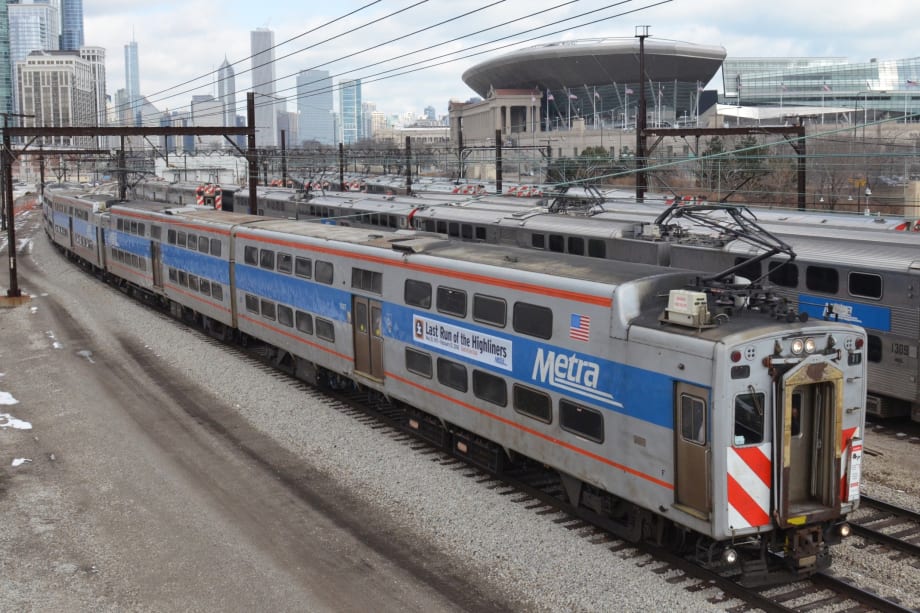
Forty-four years after the debut of the original Highliner cars on the Metra Electric Line, the last six of them carried their final passengers on Friday from Chicago to University Park. State Senator Martin Sandoval, State Representative Al Riley, Metra Executive Director/CEO Don Orseno, members of the Metra Board of Directors, and other guests took part in the official send-off from Millennium Station.
“These cars have served us well and have been a central part of the history of the Illinois Central and Metra’s Electric service,” said Orseno. “But while letting them go is somewhat bittersweet, it’s time. The new Highliners enable Metra to provide our customers with more reliable service, better amenities and reduced maintenance costs.”
The original Highliner cars began serving customers on the Illinois Central (IC), now the Metra Electric Line, on May 31, 1971. The cars were purchased in two separate orders. The first 130 cars were purchased from the St. Louis Car Co. by the newly formed Chicago South Suburban Mass Transit District and leased back to the IC. Federal funds covered two-thirds of the $40 million cost and the IC paid the rest.
In 1978-1979, the newly formed Regional Transportation Authority (RTA) bought the second order of 36 cars from Bombardier Inc. for $28 million. Metra took ownership of the railroad and the Highliners in 1987, rehabbing the cars and changing the color scheme from orange and brown to silver and blue.
The original Highliners offered air-conditioning to customers accustomed to riding in cars with open windows during the summer months, and cushioned seats rather than the wicker benches provided in the 1920s-era cars they replaced. However, the original Highliners did not have onboard restrooms and their carbon steel construction proved less durable than the stainless steel cars that became the industry standard.
The push to replace the original Highliners with more modern and durable cars began with the delivery of the first 26 new generation stainless steel Highliner cars in 2006, purchased with $76 million in funding provided through the state’s Illinois FIRST bond program. In August 2010, the Metra Board approved a contract with Sumitomo Corp of America/Nippon Sharyo to purchase 160 more Highliner cars. Funding for this purchase totaling $585 million was provided through another state bond program.
The new cars are propelled by alternating current (AC), which supplies more power and requires less maintenance that the direct current (DC) propulsion used by the original Highliners. About half of the new Highliner cars are equipped with restrooms and every train on the Metra Electric now has at least one bathroom.
More Rail

New York MTA Advances Final Contract for Second Avenue Subway Expansion
Contract Four is the largest in the Second Avenue Subway Phase 2 project and includes construction of station infrastructure, tracks, and signals for the subway expansion, MTA officials said. Work on Contract Four will begin in 2027.
Read More →
San Diego MTS Breaks Monthly Trolley Ridership Record
Agency officials said July’s ridership indicates MTS’s continued recovery from the pandemic.
Read More →
Report Examines NJ TRANSIT Reliability, Funding Challenges
The Garden State Initiative analysis examines the roles of Amtrak infrastructure, fleet management, and agency operations while recommending a more performance-based approach to improving reliability.
Read More →
Stadler, CapMetro Sign Long-Term Rail Fleet Support Agreement
Beginning in 2027, Stadler will provide on-site technical expertise, spare parts support, training, and obsolescence management to help extend the reliability and longevity of CapMetro’s GTW fleet.
Read More →
Biz Briefs: Alstom Lands Canadian Contract, LYT to Supply California TSP, and More
In METRO's latest installment, we take a look at recent news from Complete Coach Works, Beep, FlixBus, and more partnerships making headlines across the transportation sector.
Read More →
CATS Gold Line Marks 5 Years of Service, 2.8M Passenger Trips
With a six-mile expansion planned, the Charlotte streetcar is positioned to connect more neighborhoods and major transit hubs across the region.
Read More →
Why Simulating Pedestrian Movement Has Become Essential for Modern Rail Stations
Pedestrian microsimulation is helping rail planners identify bottlenecks, test station designs, and prepare complex transit hubs for growing passenger volumes.
Read More →
Amtrak Begins Major Construction at New York’s Sunnyside Yard
The new maintenance facility will support Amtrak’s Airo trainsets while improving maintenance efficiency and turnaround times in New York.
Read More →
Chicago Leaders Unveil Plans for O’Hare Airport Express Train
The privately developed project would offer a 15-minute trip between downtown and O’Hare’s Terminal 2, with trains operating every 15 minutes on a dedicated track. The service would use battery-electric trains and three existing freight rail rights-of-way.
Read More →
OCTA Maps Out 30-Year Strategy to Protect Coastal Rail Corridor
The draft feasibility report identifies strategies to protect the coastal rail line for decades as the agency continues near-term stabilization and sand placement efforts.
Read More →