




Looking Back:Metra Breaks Ground on Rehabilitation of Homewood Station
Metra Receives $104 Million in CMAQ Grants
The grants will fund Van Buren Station renovation, battery-powered locomotives, and Edgebrook Station improvements.
June 19, 2025
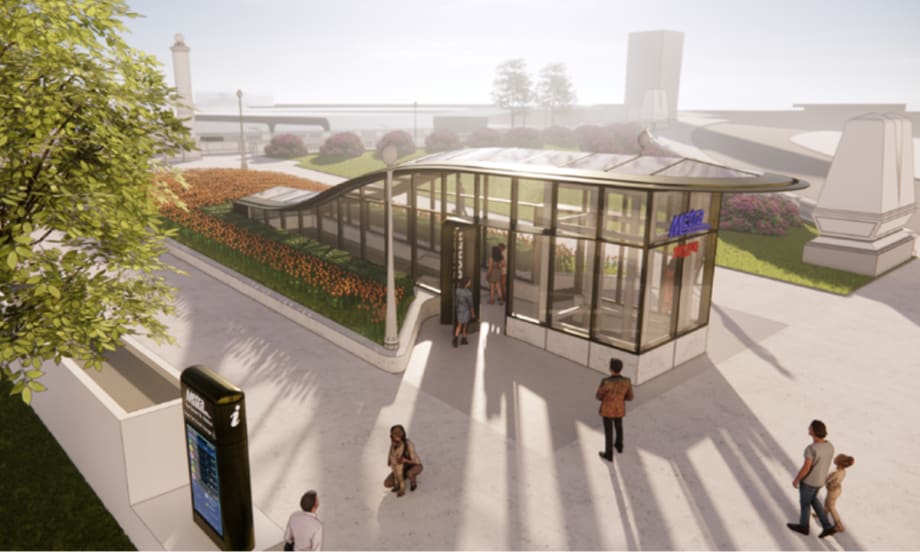
The Congestion Mitigation and Air Quality Improvement (CMAQ) program approved funding as part of CMAP’s 2026-2030 regional program.
Photo: Metra
4 min to read
Metra recently announced that it will receive over $104 million in grant funding from the Chicago Metropolitan Agency for Planning (CMAP).
The Congestion Mitigation and Air Quality Improvement (CMAQ) program approved funding as part of CMAP’s 2026-2030 regional program and includes:
$80 million for renovating the historic Van Buren Street Station on the Metra Electric Line.
$23.7 million for the purchase of three electric-powered switch locomotives.
$800,000 for improvements to the Edgebrook Station on the Milwaukee District North Line.
“We’re grateful CMAP has seen the value of these projects to the region and included funding them in the 2026-2030 CMAP program,” said Metra Executive Director/CEO Jim Derwinski. “Each of these three projects will help us address the goals of the CMAQ program to reduce congestion and pollution levels by improving and strengthening the sustainability of our transit system.”
“The funding announced today will help improve safety and efficiency for Metra passengers while also reducing diesel emissions,” U.S. Senator Dick Durbin (D-IL) said. “These CMAQ program investments will support key projects, including the Van Buren Street Station renovation, for which I helped secure nearly $24.5 million in federal funding earlier this year.”
“No matter their zip code, all Illinoisans deserve reliable and accessible public transportation to get to school, get to work, and more easily get around their communities,” U.S. Senator Tammy Duckworth (D-IL) said. “I’m proud to help secure federal support to modernize the Van Buren Street and Edgebrook Metra Stations while making critical ADA upgrades to support all riders. I’ll keep working with the Metra team, our local leaders, and the Illinois congressional delegation to make public transportation more efficient, safe, and accessible for all.”
Van Buren Street Station to Undergo Major Renovation
The Van Buren Street Station project will be funded through the $80 million CMAQ grant, $10 million in federal Urbanized Area Formula Funding (Section 5307), and $24.5 million from the U.S. Department of Transportation’s Better Utilizing Investments to Leverage Development (BUILD) program, which supports surface transportation infrastructure projects with significant local or regional impact.
Metra will also provide $20 million in local matching funds. Construction is expected to begin in late 2028.
“Whether it be for work or fun, Chicagoans and visitors use the historic Van Buren Street Station every day. This CMAP funding allows the station to begin modernizing and continue supporting Metra’s transition to electric rail, giving passengers a reliable, safe, and eco-friendly transportation option,” said U.S. Rep. Mike Quigley (IL-5), a senior member of the House Appropriations Subcommittee on Transportation, Housing and Urban Development, and Related Agencies (THUD). “I’m also thrilled a portion of this funding will be used to support improvements to Metra’s Edgebrook Station, which will be paired with the $1.2 million I secured for the station last year.”
The 129-year-old Van Buren Street Metra Station is located below street level on the east side of Michigan Avenue adjacent to Grant Park. Decades of water infiltration have damaged the historic facility’s pedestrian tunnels and waiting area, requiring complete rehabilitation.
While maintaining the station’s historic character, the project will provide waterproofing, enclosed platform warming shelters, digital signage, and a modern green roof system. The plans also include two new elevators on the east side of Michigan Avenue, improving ADA accessibility.
“Investments in public transit are investments in equity, access, and opportunity. I applaud Metra and CMAP for advancing projects like the Van Buren Street Station renovation and the shift to clean electric locomotives,” said U.S. Rep. Danny K. Davis (IL-7). “These improvements not only modernize our transportation infrastructure, but they also ensure that underserved communities — including those on the South and West Sides — benefit from safer, greener, and more accessible transit options. This is exactly the kind of future-forward development our region needs.”
Electric Future with Battery-Electric Locomotive Pilot and Station Upgrades
A $23.2 million CMAQ award will fund the purchase of up to three battery-electric switch locomotives to replace switch locomotives used in the yard and maintenance of way operations. They will replace some of Metra’s oldest, most-polluting locomotives.
The purchase, which will comply with the federal Build America Buy America Act, will be a pilot project to test battery-electric technology for railroad locomotives. Metra will also provide $5.8 million as the local match for the project.
Metra will also receive a $800,000 CMAQ grant to improve the Edgebrook Station on the Milwaukee District North Line. Combined with a $1.2 million grant secured by Quigley, the project will improve the inbound platform and platform entrances, add a new fully enclosed warming shelter mid-platform, expand the inbound platform’s existing shelter, and add ADA-compliant curb ramps and bicycle parking.
The project is also being funded by $100,000 in RTA funds and another $100,000 in Metra PAYGO funds.
Over the past six years, Metra has been awarded more than $760 million in capital funding through competitive grant programs. These grants enable Metra to modernize facilities and equipment across its 11 lines, including rehab projects at multiple stations on the Metra Electric Line that expand ADA accessibility and replace century-old bridges on the UP North Line in Chicago.
More Management

METRO Opens Submissions for 2026 Motorcoach Awards
Nominations are now being accepted for METRO Magazine’s Operator of the Year and Innovative Operator of the Year awards.
Read More →
New York MTA Advances Final Contract for Second Avenue Subway Expansion
Contract Four is the largest in the Second Avenue Subway Phase 2 project and includes construction of station infrastructure, tracks, and signals for the subway expansion, MTA officials said. Work on Contract Four will begin in 2027.
Read More →
Transit Agencies Highlight Safety Gains at National Summit
Leaders from 15 major transit systems shared crime-reduction results and safety initiatives while discussing the role of continued federal support.
Read More →

NITA Names New Leadership, Expands Reduced-Fare Program at First Board Meeting
The new regional transit authority appointed its first board chair and interim executive director while extending reduced fares across CTA, Metra, and Pace for eligible riders.
Read More →
Beyond the Checklist: A Structured Approach to Transit Maintenance
Reliability-Centered Maintenance helps transit agencies move beyond routine checklists to focus limited resources on the assets and failures that have the greatest impact on safety, reliability, and service.
Read More →
APTA 2026 Nominating Committee Selects Leadership Slate, Names Chair and Vice Chair Nominees
Leadership changes will help shape the association’s priorities and its representation of the transportation industry during the 2026–2027 term.
Read More →
DART Launches Major Security, Fare Enforcement Initiative
The 90-day demonstration will deploy coordinated security teams at five light rail stations while testing controlled access and gathering data to guide future investments.
Read More →
Sponsored•September 9, 2026
Advancing Fare Collection Through Technology and Innovation
Learn about delivering 1300 gates at 91 stations while managing fare evasion. Explore the large scale deployment, solution customization and real-world results that affect the region. Prepare for deployment in your region now.
Read More →
Game Day in Motion: Moving Millions During the 2026 World Cup
Between packed transit stations and team motorcoaches, see how agencies and operators across North America tackled the transportation demands of the 2026 FIFA World Cup.
Read More →
Surface Transportation Extension Averts Shutdown, Leaves Transit Funding Gap
The stopgap keeps federal transportation programs moving, but missing advance funding could complicate the transit and rail projects agencies are planning next.
Read More →