



N.Y. MTA details efforts to harden, protect transit post Sandy
The MTA is designing solutions to fully prevent water incursion at the approximately 600 entry points in Lower Manhattan as well as vulnerable vent plants and openings in other flood-prone areas.

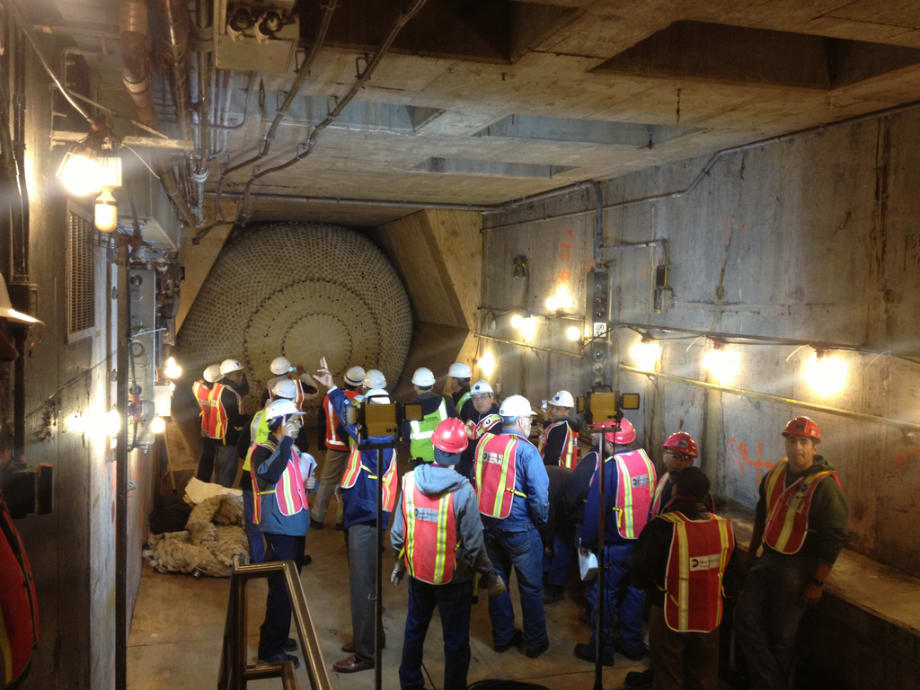
A tunnel plug under development by ILC Dover could protect subway portals from flooding. If successfully prototyped and tested, the MTA hopes the technology could be applied to portals and stairwell locations throughout the system. Photo Marc A. Hermann/ MTAPhotos
A tunnel plug under development by ILC Dover could protect subway portals from flooding. If successfully prototyped and tested, the MTA hopes the technology could be applied to portals and stairwell locations throughout the system. Photo Marc A. Hermann/ MTAPhotos
New York Metropolitan Transportation Authority (MTA) officials unveiled some of the technologies the agency is considering as part of its efforts to protect the system from future storms. The MTA has also been researching and investigating existing flood mitigation and resiliency systems used worldwide for possible adaption in New York.
The MTA is designing solutions to fully prevent water incursion at the approximately 600 entry points in Lower Manhattan as well as vulnerable vent plants and openings in other flood-prone areas. MTA New York City Transit (NYCT) is also analyzing all underground tube locations to ensure that critical points where water can enter the system are protected, according to officials.
Gov. Andrew M. Cuomo and MTA Chairman/CEO Thomas F. Prendergast, accompanied by U.S. Department of Housing and Urban Development Secretary Shaun Donovan and other officials, toured Lower Manhattan to see firsthand some of the emerging technologies being implemented to harden the system.
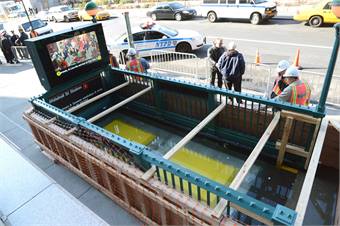
On the first anniversary of Superstorm Sandy, MTA Chairman & CEO Thomas Prendergast, along with Housing & Urban Development Secretary Shaun Donovan and Governor Andrew Cuomo, inspected a removable subway stairs Flood Control Cover at the Whitehall St. Station. Tue., October 29, 2013. Photo by Marc A. Hermann/ MTAPhotos.
Gov. Cuomo and officials viewed a prototype entrance cover at the Whitehall St. subway station, developed by RSA Protective Technologies, to protect at least 13 vulnerable stairwells in Lower Manhattan. This stairway cover will be able to be rapidly installed without the need of mechanized equipment.
Officials also toured the new South Ferry subway station, closed since Superstorm Sandy filled the entire station with more than 14 million gallons of corrosive salt water, to view a tunnel plug under development by ILC Dover to protect subway portals where grade-level tracks transition to underground subways.
A “Tensioned Curtain,” is also under development to help mitigate flooding. If successfully prototyped and tested, the MTA hopes the technology could be applied to portals and stairwell locations throughout the system.
Another vendor, FloodBreak, is producing a permanently implantable device beneath sidewalk ventilation gratings that can be immediately and easily closed, sealing the vent from flood waters. If testing of an installed prototype is successful, several hundred units may be used in gratings at the most vulnerable locations in the city.
Across the MTA, more than 70 projects are in design worth approximately $4.5 billion. Five projects totaling $75 million are in procurement and 16 projects, worth $575 million, are already in construction.
At NYCT, design has begun for repairs to six subway tubes including work on signals, pump rooms, power and communications, tunnel lighting and ducts. More than one million riders use these six tubes on the average weekday. In addition to design of signal and other systems, NYCT is building two new pump trains that will reduce the time needed to pump water out of the subway system.
RELATED: "N.Y. MTA Works to Fix Impacts of Storms Past and Future."
More Bus

New York MTA Plans Largest Bus Fleet Upgrade in More Than a Decade
The agency is seeking manufacturers for 650 new CNG buses to replace aging vehicles, improve reliability, and advance its broader fleet modernization strategy.
Read More →
Building a Flexible Path to Transit Electrification
John Hroncich discusses BAE Systems’ modular and scalable approach, lessons learned from decades of real-world operations, and how agencies can identify electrification strategies that fit their fleets.
Read More →
Bus Tech Talk: Keeping Transit Technicians Ahead of the Technology Curve
LA Metro’s Obed Mejia discusses technician training, evolving maintenance technology, fleet replacement, and strategies for getting the most out of today’s transit fleets.
Read More →
Biz Briefs: RIPTA Unveils New Frontrunners, Clevland RTA Adds New Siemens, and More
In METRO's latest installment, we take a look at recent news from Siemens, Prevost, Dodge, and more partnerships making headlines across the transportation sector.
Read More →
People Movement: Holly Arnold Joins Transdev and More
In this edition, we also cover recent appointments and announcements at Pace, CamTran, MCI, and more, showcasing the individuals helping to shape the future of transportation.
Read More →
The High Cost of Transit Buses: Industry Leaders Look to Procurement Reform
Transit leaders and policymakers examine how standardized bus designs, streamlined procurement, and predictable funding could help agencies stretch budgets and deliver better service.
Read More →
The Business Voice Behind Public Transportation
As chair of APTA’s Business Members Board of Governors, Ray Melleady explains how more than 850 business members are partnering with transit agencies to advance funding, innovation, and industry-wide collaboration.
Read More →
From Surviving to Thriving: Building Stronger Transportation Organizations
Bus Business Consultants founder Brian Dickson shares lessons on leadership, organizational health, and creating options for long-term success in a changing transportation industry.
Read More →
Finding the ‘Happy Medium’: Optimizing Maintenance Without Sacrificing Reliability
The key to maintenance optimization isn’t doing less work—it’s doing the right work at the right time on the right assets.
Read More →
LA Metro, City of West Hollywood, and Partners Advance Smarter Bus Lane Enforcement
The award-winning partnership combines AI-powered detection with human oversight to improve bus reliability, accessibility, and enforcement efficiency.
Read More →