



N.Y. subway ridership reaches 65-year high
The increased number of customers creates challenges for the MTA to operate the subway system while minimizing delays, crowding and inconvenience. The subway system has traditionally performed maintenance work during off-peak hours, which are now experiencing record ridership.

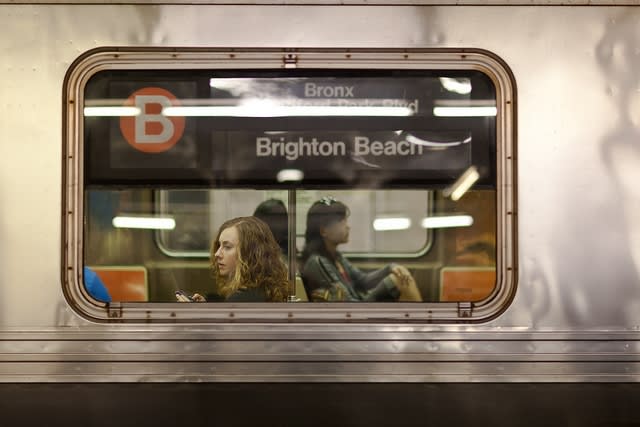
Photo: Jens Schott Knudsen/Flickr
Photo: Jens Schott Knudsen/Flickr
Subway ridership in New York City grew 2.6% to 1.751 billion customers in 2014, the highest annual ridership in more than 65 years, according to new figures from Metropolitan Transportation Authority (MTA) New York City Transit. Some 5.6 million customers rode the subway on an average weekday and 6 million customers on an average weekend. Weekday ridership rose by more than 132,000 last year, and by more than 500,000 over the last five years. At its busiest, the subway system carried more than 6 million customers on 29 weekdays in the last four months of 2014 – a level not seen since the post-World War II boom.
RELATED:Record 10.8 billion trips taken on public transit in 2014
This growth was seen across the city in all boroughs and all lines, with the highest percentage increase in neighborhoods seeing rapid residential development and population increases, such as Bushwick in Brooklyn and Long Island City in Queens. While ridership grew in every part of the day and every day of the week, weekday growth was strongest outside of the traditional morning and evening rush hours.
As subway ridership surges along with New York City’s population, the increased number of customers creates challenges for the MTA to operate the subway system while minimizing delays, crowding and inconvenience. The subway system has traditionally performed maintenance work during off-peak hours, which are now experiencing record ridership.
“The renaissance of the New York City subway is a miracle for those who remember the decrepit system of the 1970s and the 1980s, but moving more than 6 million customers a day means even minor disruptions now can create major delays,” said MTA Chairman/CEO Thomas F. Prendergast. “We are aggressively working to combat delays and improve maintenance, but the ultimate solution requires investing in infrastructure upgrades such as Communications-Based Train Control (CBTC) signaling systems to accommodate every one of our growing number of customers.”
Brooklyn had the largest borough-wide average weekday percentage ridership increase (2.7% or more than 31,000 riders per weekday), followed by 2.5% growth in Manhattan, 2.1% in the Bronx and 1.9% in Queens.
In Brooklyn, every station on the L line saw a ridership increase last year, with ridership increasing 4.7%, or more than 5,600 customers, on an average weekday. The L is the MTA’s only line with CBTC signaling, which has enabled the MTA to add dozens of trains per week to handle the ridership spike in recent years. The Bedford Av station in Williamsburg saw 27,224 average weekday customers, more than any other station on the L in Brooklyn, but the largest weekday percentage increases occurred farther east on the line in Bushwick at Bushwick Av-Aberdeen St (11.5%), Wilson Av (9.9%) and Jefferson St (9.3%).
The M line in Brooklyn serves some of the same areas and also saw rapid growth, with average weekday ridership up 6.2% at stations between Marcy and Metropolitan avs. M stations from Queens through Brooklyn have seen average weekday ridership grow 23.6% since 2009, after the M was rerouted to serve Midtown Manhattan in 2010.
New residential development is driving ridership growth in Long Island City, Queens. Weekday ridership grew by 12%, or 1,500 customers per day, at the Vernon-Jackson Av 7 station, and by 9.7%, or nearly 2,000 customers, at the Court Sq EGM7 station. Ridership at the Vernon-Jackson Av station has more than doubled since 2000. The MTA is installing CBTC on the 7 line, which will allow more trains to run closer together, carrying more customers while also providing countdown clock information.
In the Bronx, the 2 and 5 lines grew by 3.7%, or nearly 4,800 customers per day. In Manhattan, the Lenox Avenue 2 and 3 lines through Harlem saw 3.7% growth, or more than 2,100 customers per day.
More Rail

New York MTA Advances Final Contract for Second Avenue Subway Expansion
Contract Four is the largest in the Second Avenue Subway Phase 2 project and includes construction of station infrastructure, tracks, and signals for the subway expansion, MTA officials said. Work on Contract Four will begin in 2027.
Read More →
San Diego MTS Breaks Monthly Trolley Ridership Record
Agency officials said July’s ridership indicates MTS’s continued recovery from the pandemic.
Read More →
Report Examines NJ TRANSIT Reliability, Funding Challenges
The Garden State Initiative analysis examines the roles of Amtrak infrastructure, fleet management, and agency operations while recommending a more performance-based approach to improving reliability.
Read More →
Stadler, CapMetro Sign Long-Term Rail Fleet Support Agreement
Beginning in 2027, Stadler will provide on-site technical expertise, spare parts support, training, and obsolescence management to help extend the reliability and longevity of CapMetro’s GTW fleet.
Read More →
Biz Briefs: Alstom Lands Canadian Contract, LYT to Supply California TSP, and More
In METRO's latest installment, we take a look at recent news from Complete Coach Works, Beep, FlixBus, and more partnerships making headlines across the transportation sector.
Read More →
CATS Gold Line Marks 5 Years of Service, 2.8M Passenger Trips
With a six-mile expansion planned, the Charlotte streetcar is positioned to connect more neighborhoods and major transit hubs across the region.
Read More →
Why Simulating Pedestrian Movement Has Become Essential for Modern Rail Stations
Pedestrian microsimulation is helping rail planners identify bottlenecks, test station designs, and prepare complex transit hubs for growing passenger volumes.
Read More →
Amtrak Begins Major Construction at New York’s Sunnyside Yard
The new maintenance facility will support Amtrak’s Airo trainsets while improving maintenance efficiency and turnaround times in New York.
Read More →
Chicago Leaders Unveil Plans for O’Hare Airport Express Train
The privately developed project would offer a 15-minute trip between downtown and O’Hare’s Terminal 2, with trains operating every 15 minutes on a dedicated track. The service would use battery-electric trains and three existing freight rail rights-of-way.
Read More →
OCTA Maps Out 30-Year Strategy to Protect Coastal Rail Corridor
The draft feasibility report identifies strategies to protect the coastal rail line for decades as the agency continues near-term stabilization and sand placement efforts.
Read More →