



New Campaign to Highlight Montréal Transit's Importance
The campaign will be featured across the STM’s digital communication channels, online, through signage in the métro network, on bus shelters, and also on roadside billboards.

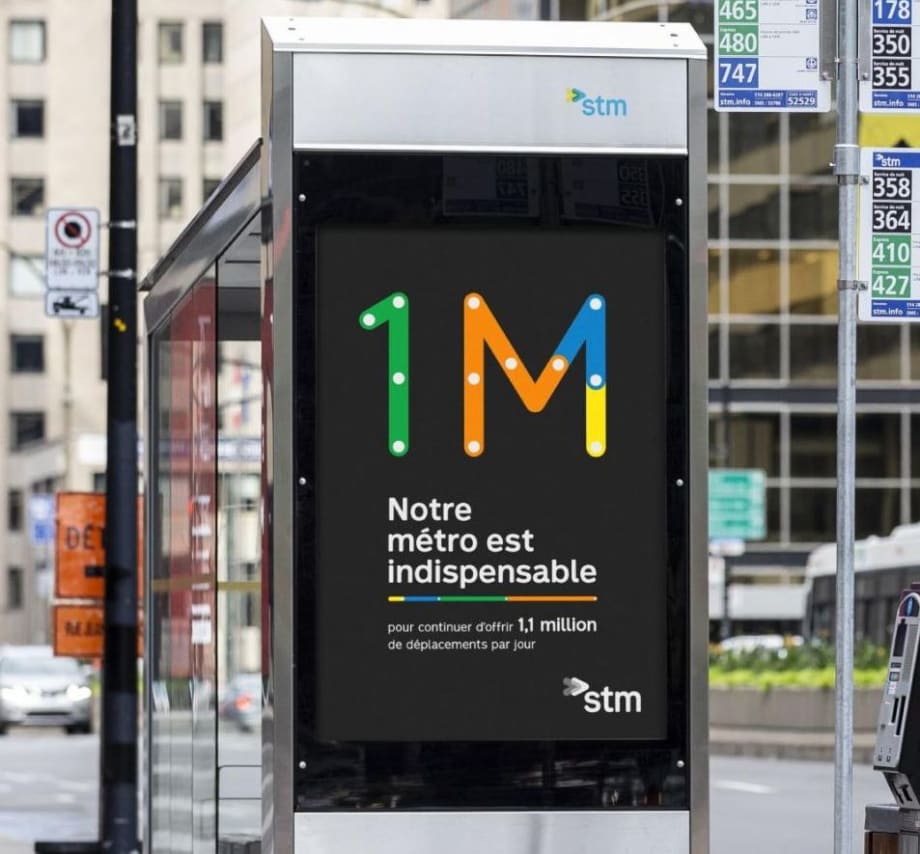
The STM campaign was designed in-house, and advertising costs will be covered under STM partnerships, except for printing costs.
Photo: STM
The Société de transport de Montréal (STM) is launching a public campaign to emphasize the importance of the system’s role in society and, as a result, raise awareness of the need to maintain it so that it remains reliable and safe properly.
The campaign will be featured across the STM’s digital communication channels, online, through signage in the métro network, on bus shelters, and also on roadside billboards.
STM’s New Campaign
The campaign was designed in-house, and advertising costs will be covered under STM partnerships, except for printing costs.
“The Montreal métro represents more in daily trips than any other transportation infrastructure in the country —even more than all five South Shore bridges combined. As long as it’s functional and operating well, we don’t realize how important it is to each of us. It’s taken for granted,” explains STM board chair Éric Alan Caldwell. “However, if we don’t maintain it, it won’t be able to continue to play that role and deliver all the expected services and benefits. Without it, mobility in Greater Montréal is affected.”
Without the métro, thousands of daily trips would be impossible, said STM.
The métro is essential for:
Continuing to provide service for 1.1 million daily trips on the STM network.
215,000 workers who use it every day.
175,000 students take it daily.
The STM collaborates with 1,500 Quebec suppliers.
Reducing traffic congestion costs the Montreal economy more than $6 billion.
Combating climate change by using electricity and generating no GHG emissions.
Fighting Time
The investment deficit for asset maintenance is $6.6 billion and continues to increase each year, according to STM officials.
The average age of métro assets is 48 years, with the aging having very real consequences, including:
40% of metro assets are in poor condition.
A plus 267% increase in service interruptions caused by equipment breakdowns over 10 years.
A 300% increase in critical equipment reports between 2018 and 2022.
The MR-73 trains, which are almost 50 years old, are about 11 times less reliable than the AZUR trains and are among the oldest in the world.
An increase in unexpected closures, such as the shutdown of Saint-Michel station last fall, has occurred.
“The métro, which will turn 60 in 2026, is still safe, but this data reminds us that it mustn’t be taken for granted. It must be maintained so that it continues to deliver all the benefits expected of it,” said STM Executive Director Marie-Claude Léonard. “This inevitably requires additional funding for asset maintenance, which we are still waiting on from the Quebec government. We urge them to step up and deliver.”
More Management

METRO Opens Submissions for 2026 Motorcoach Awards
Nominations are now being accepted for METRO Magazine’s Operator of the Year and Innovative Operator of the Year awards.
Read More →
New York MTA Advances Final Contract for Second Avenue Subway Expansion
Contract Four is the largest in the Second Avenue Subway Phase 2 project and includes construction of station infrastructure, tracks, and signals for the subway expansion, MTA officials said. Work on Contract Four will begin in 2027.
Read More →
Transit Agencies Highlight Safety Gains at National Summit
Leaders from 15 major transit systems shared crime-reduction results and safety initiatives while discussing the role of continued federal support.
Read More →

NITA Names New Leadership, Expands Reduced-Fare Program at First Board Meeting
The new regional transit authority appointed its first board chair and interim executive director while extending reduced fares across CTA, Metra, and Pace for eligible riders.
Read More →
Beyond the Checklist: A Structured Approach to Transit Maintenance
Reliability-Centered Maintenance helps transit agencies move beyond routine checklists to focus limited resources on the assets and failures that have the greatest impact on safety, reliability, and service.
Read More →
APTA 2026 Nominating Committee Selects Leadership Slate, Names Chair and Vice Chair Nominees
Leadership changes will help shape the association’s priorities and its representation of the transportation industry during the 2026–2027 term.
Read More →
DART Launches Major Security, Fare Enforcement Initiative
The 90-day demonstration will deploy coordinated security teams at five light rail stations while testing controlled access and gathering data to guide future investments.
Read More →
Advancing Fare Collection Through Technology and Innovation
Learn about delivering 1300 gates at 91 stations while managing fare evasion. Explore the large scale deployment, solution customization and real-world results that affect the region. Prepare for deployment in your region now.
Read More →
Game Day in Motion: Moving Millions During the 2026 World Cup
Between packed transit stations and team motorcoaches, see how agencies and operators across North America tackled the transportation demands of the 2026 FIFA World Cup.
Read More →
Surface Transportation Extension Averts Shutdown, Leaves Transit Funding Gap
The stopgap keeps federal transportation programs moving, but missing advance funding could complicate the transit and rail projects agencies are planning next.
Read More →