



Related: 8 Tips for Cleaning School Buses in the Age of Coronavirus
New Disinfectant Designed to Kill Coronavirus
Madison Chemical’s MADISAN 75 is a surface sanitizer, disinfectant, mildewstat, and virucide designed to kill coronavirus, as well as other viruses and bacteria.
by Staff
June 10, 2020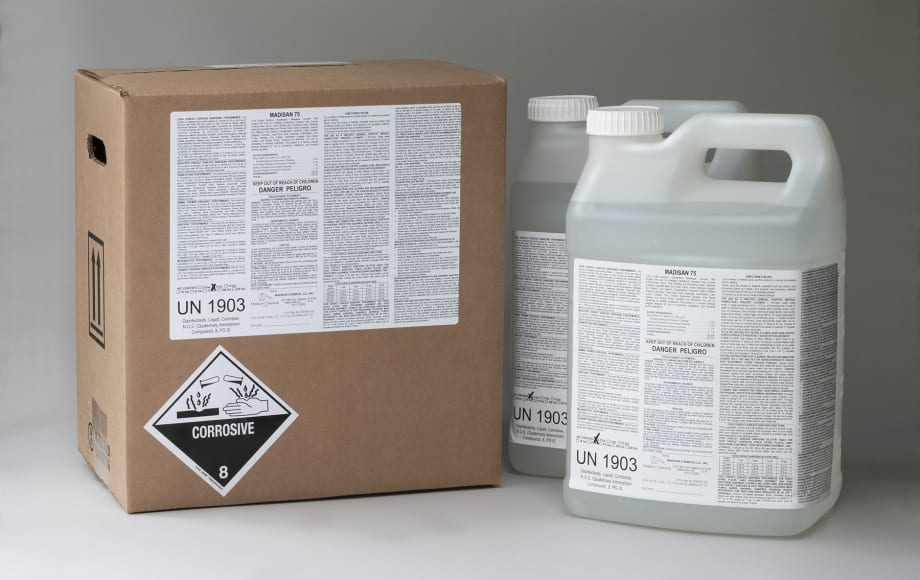
Madison Chemical’s MADISAN 75 is a surface sanitizer, disinfectant, mildewstat, and virucide designed to kill coronavirus, as well as other viruses and bacteria.
Photo courtesy Madison Chemical
2 min to read
MADISON, Ind. — Madison Chemical has introduced a sanitizer and disinfectant designed to kill coronavirus among other viruses and bacteria, in various settings, including on vehicles.Madison Chemical’s MADISAN 75 is a four-chain quaternary surface sanitizer, disinfectant, mildewstat, and virucide designed to be used on hard, non-porous, and inanimate surfaces, according to a news release from the company.
MADISAN 75 kills the Human Coronavirus, Human Immunodeficiency Virus Type 1 (HIV-1), Hepatitis B Virus (HBV), Hepatitis C Virus (HCV) and a variety of animal viruses specified on the EPA-registered label, according to Madison Chemical. MADISAN 75 appears on EPA List N: Disinfectants for Use Against SARS-CoV-2 (MADISAN 75’s EPA registration number is 10324-81-110).
The surface sanitizer and disinfectant is also designed to reduce a variety of pathogenic bacteria, including Listeria monocytogenes, Salmonella, Staphylococcus aureus, and E. Coli.
MADISAN 75 is suitable for a range of industries and applications, including school and public transportation, industrial and manufacturing facilities, schools and churches, restaurants, as well as hospitals and health care facilities, nursing homes, and food and beverage processing.
MADISAN 75 disinfects hard, non-porous surfaces and objects at 3.5 to 13.5 ounces per 4.5 gallons of water. It may be applied using a sponge, brush, cloth, mop, or by immersion or other applications specified on the EPA label. Treated surfaces must remain wet for 10 minutes.
Madison Chemical is a chemical formulator that provides cleaning, sanitation, and maintenance products for the following industries: hospitals and healthcare, food and beverage, surface preparation, metalworking, industrial maintenance, transportation, wastewater treatment, winery, pulp and paper, and others.
Originally posted on School Bus Fleet
More Security and Safety

FTA Ends Direct Oversight of MBTA Safety Actions
The federal agency closed its remaining special directive to the Massachusetts Department of Public Utilities following a safety review that began in 2022.
Read More →
Transit Agencies Highlight Safety Gains at National Summit
Leaders from 15 major transit systems shared crime-reduction results and safety initiatives while discussing the role of continued federal support.
Read More →
DART Launches Major Security, Fare Enforcement Initiative
The 90-day demonstration will deploy coordinated security teams at five light rail stations while testing controlled access and gathering data to guide future investments.
Read More →
RTD Launches NextRide App to Consolidate Trip Planning, Fares, Security Reporting
The app expands on RTD’s existing NextRide web application and allows customers to view real-time vehicle locations and service alerts, purchase and store digital fares, and access customer support.
Read More →
TAPTCO Updates OSHA Compliance Training for Transit Maintenance Operations
The revamped program addresses 26 OSHA standards for maintenance facilities, with TAPTCO pointing to training, documentation, and everyday shop hazards as continuing challenges for transit operations.
Read More →
FRA Announces $5.3B in Rail Investments, Including $2B for Amtrak
Funding will support grade-crossing improvements, infrastructure upgrades, and new Amtrak equipment in 23 states.
Read More →
Chicago, Maryland Expand Non-Law-Enforcement Safety, Rider Support
The CTA and MTA are launching new programs aimed at de-escalation, crisis response, rider assistance, and greater transparency.
Read More →
LA Metro, City of West Hollywood, and Partners Advance Smarter Bus Lane Enforcement
The award-winning partnership combines AI-powered detection with human oversight to improve bus reliability, accessibility, and enforcement efficiency.
Read More →
LA Metro Reports 57% Decline in Homelessness on Transit System Since 2024
The agency's latest homelessness count offers new data on how care-based services and cross-sector partnerships can complement traditional transit security strategies.
Read More →
FTA Launches 'Transit Moves America' Dashboard to Highlight Agency Safety and Performance
The online dashboard transforms National Transit Database information into a public-facing resource that allows users to compare transit agencies on key operational and safety metrics.
Read More →