




RELATED: Lyft offering people $550 to give vehicle up for a month
New study explores transit partnerships with Lyft, Uber
More than two dozen municipal governments and transit agencies have formed partnerships with TNCs to enhance mobility options.
August 6, 2018
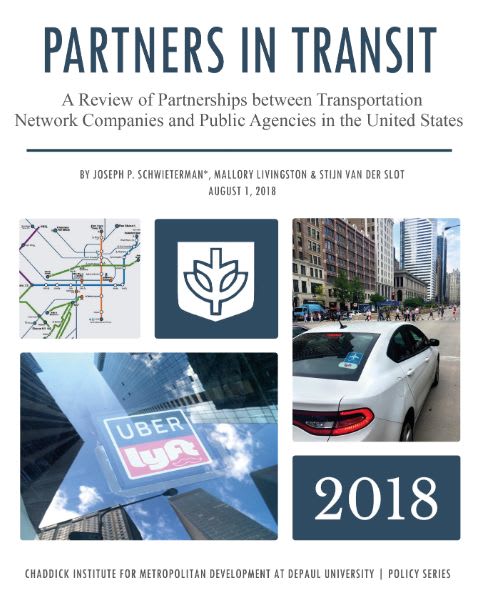
Photo and Map of Transit TNC Partnerships courtesy DePaul University.
3 min to read
Photo and Map of Transit TNC Partnerships courtesy DePaul University.
Most transit agencies and transportation network companies (TNCs) play in different sandboxes, managing their operations independently, but a new study released by DePaul University’s Chaddick Institute shows that many have found the allure of collaborating too powerful to resist. More than two dozen municipal governments and transit agencies have formed partnerships with TNCs to enhance mobility options.
The study, Partners in Transit: A Review of Partnerships between Transportation Network Companies and Public Agencies, explores 29 partnerships designed to allow transit operators and TNCs (predominately Lyft and Uber) to concentrate on what they do best. “The programs allow transit providers direct resources to modernizing top-performing routes, serving commuters, and other core strengths, while TNCs fill gaps, offer first/mile last-mile solutions, and improve demand-responsive services,” notes Joe Schwieterman, a DePaul professor and co-author of the report.
This strategy is not without risk, but is backed by research showing ridesharing and transit can complement each other in many situations. The elephant in the room is heightened competition between them, heralded by new lower-priced services such as Lyft Line and UberPool. Such competition can render partnerships awkward and short-lived, marred by mistrust. Nonetheless, as co-author Mallory Livingston notes, “Many transit officials are reluctant to stand back and watch technological advances buffet their ridership and financial goals. In the minds of many, outside-the-box thinking is imperative.”
As the study shows, the media spotlight tends to shine brightest on partnerships that provide all travelers free or discounted ride-sharing trips within a community. Monrovia, Calif.’s partnership with Lyft subsidizes Lyft rides to the point that all trips starting and ending within its boundaries cost just $0.50. Since the program’s introduction in March, more than 53,000 trips have been taken at this ultra-low rate.
Dublin, Calif. offers across-the-board 50% discounts of up to $5 on all Uber and Lyft trips within its boundaries, including those shuttling to its Bay Area Rapid Transit station. Across the Canadian border, Innsifil, Ontario — reportedly Uber’s first program in that country — boasts a similar partnership and has generated an outsized amount of publicity.
Other partnership focus on particular routes or areas. Programs in Dayton, Ohio (administered by its Regional Transportation Authority), as well as those in San Clemente, Calif., and Marin County, Calif., are good examples of this, limiting ride-share discounts to certain designated transit stops.
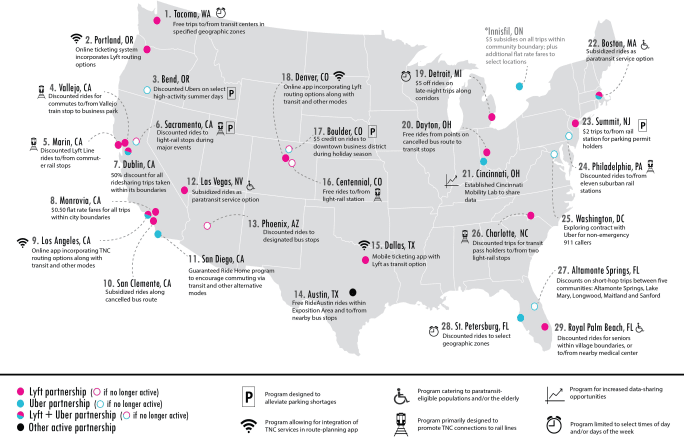
Austin, Texas’s program involves RideAustin, a homegrown TNC. Riders received free trips within its Exposition Area, which has many technology jobs, as well as those trips to/from nearby Capital Metro bus stops. Charlotte, N.C. improves access to its Lynx light-rail system by offering discounted Lyft rides to/from a pair of stations for trips that start or end within certain areas.
The study shows that 11 of the 50 largest transit agencies in the U.S. have made the plunge. If more major players develop programs, there will likely be “strings attached” for users due to the obvious problem that a poorly designed program could cannibalize bus and train ridership — and worsen roadway congestion. Agencies in Boston and Las Vegas, for example, have created programs limited primarily to paratransit-eligible users to test the waters while managing risk.
The evidence suggests that a properly designed program can be cost effective when compared to the cost of buying buses, paying for labor, fuel and maintenance on lightly used routes. But, “the devil is in the details,” notes Schwieterman. Presently, there is a great deal of interest in incorporating payment for both rideshares and transit — and connections between the two — on a single app. Breakthroughs appear imminent — once sensitive issues such as protecting private information and technological hurdles can be crossed.
The Chaddick Institute at DePaul University will host a free webinar featuring officials who manage programs around the country on Tuesday, August 29, from Noon to 1 p.m., CDT. To learn more, receive a copy of Partners in Transit, or speak with the authors, email chaddick@depaul.edu or call 312.362.5732.
More New Mobility

From Hardware to Digital Partner: Luminator Charts Its Next Chapter
CEO Magnus Friberg discusses Luminator’s shift toward becoming a digital partner, the growing importance of software and interoperability, and how AI can help agencies improve operations and passenger experience.
Read More →
Biz Briefs: Alstom Lands Canadian Contract, LYT to Supply California TSP, and More
In METRO's latest installment, we take a look at recent news from Complete Coach Works, Beep, FlixBus, and more partnerships making headlines across the transportation sector.
Read More →
CharterUP’s Armir Harris on Technology, AI, and the Future of Group Mobility
In a recent episode of METROspectives, CharterUP Founder/CEO Armir Harris discussed the company’s evolution from an online charter bus marketplace into a technology platform supporting public- and private-sector mobility and much more.
Read More →
Jacksonville’s NAVI Project Charts a New Course for Autonomous Public Transportation
Through its NAVI program, JTA is showing how autonomous vehicles, intelligent infrastructure, and coordinated operations can work together to deliver everyday public transportation.
Read More →
Biz Briefs: Luminator Marks Milestone and More
From manufacturers and suppliers to transit agencies and motorcoach operators, these updates offer a snapshot of the projects, partnerships and business moves driving the industry forward.
Read More →
New Tricks for Old Bureaucracies: Joshua Schank on Making Transit Innovation Stick
Former LA Metro Chief Innovation Officer Joshua Schank discusses why good ideas aren't enough, how transit agencies can overcome resistance to change, and why today's challenges demand more innovation.
Read More →
How DART's GoPass Is Redefining Regional Mobility
Serving 14 transit agencies, GoPass simplifies multimodal travel by allowing riders to plan, pay for, and manage an entire trip through one app.
Read More →
Biz Briefs: OCTA Taps Clean Energy for Hydrogen Station, Stadler to Supply Via Rail Vehicles, and More
From manufacturers and suppliers to transit agencies and motorcoach operators, these updates offer a snapshot of the projects, partnerships and business moves driving the industry forward.
Read More →CharterUP Expands Into New Mobility and Autonomous Transportation
Vice President of New Mobility Stephen Joos discusses how CharterUP is leveraging its nationwide transportation network, technology platform, and autonomous vehicle partnerships to expand into workforce mobility, campus shuttles, and transit solutions.
Read More →
METRO Magazine Announces 2026 Innovative Solutions Awards Winners
Projects Recognized for Advancing Mobility Through Technology, Accessibility, Workforce Innovation, and Operational Excellence
Read More →