



New York City Moves Forward With Stalled Madison Avenue Bus Lane Project
Once complete, the project will improve speed and reliability for the 92,000 daily riders who rely on local and express buses along the corridor, serving commuters from all five boroughs.

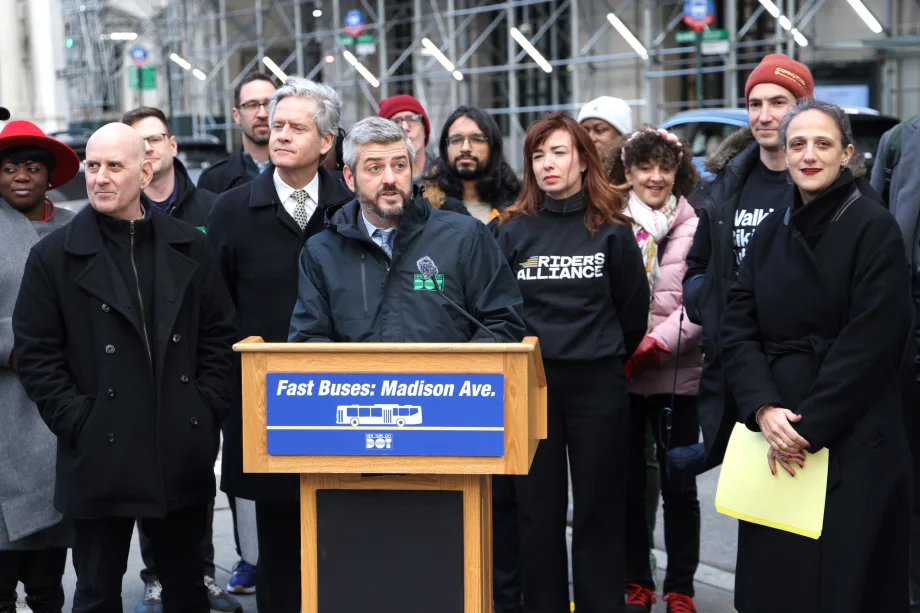
New York City Deputy Mayor of Operations Julia Kerson and New York City Department of Transportation (NYC DOT) Commissioner Mike Flynn announced the agency will complete a stalled street redesign extending double bus lanes on Manhattan’s Madison Avenue from 42nd Street south to 23rd Street.
New York City Deputy Mayor of Operations Julia Kerson and NYC Department of Transportation Commissioner Mike Flynn announced the City will complete a long-stalled redesign project to extend double bus lanes on Madison Avenue, running from 42nd Street to 23rd Street.
Once complete, the project will improve speed and reliability for the 92,000 daily riders who rely on local and express buses along the corridor, serving commuters from all five boroughs. The upgraded bus lanes also support the MTA’s congestion pricing plan by encouraging more car-free trips into Manhattan’s core.
“Madison Avenue is one of the most important bus corridors in the city, yet tens of thousands of riders are crawling along at walking speed,” said NYC DOT Commissioner Mike Flynn. “It’s time to deliver this project and give buses the dedicated space they need so working New Yorkers can get where they’re going faster.”
Improving Mobility
Madison Avenue today features two bus lanes, two travel lanes, and one parking lane from 60th Street to 42nd Street, serving 34 local and express bus routes.
NYC DOT data show buses on these routes are often delayed by traffic below 42nd Street, where riders travel at speeds of just 4.5 miles per hour — nearly half the citywide average bus speed of 8.1 miles per hour. On this stretch of Madison Avenue south of 42nd Street, 55% of people ride the bus, but there was no dedicated bus lane before this project.
To expedite service, NYC DOT proposed in 2025 extending the double bus lane design south to 23rd Street, but the project was paused last year, delaying critical improvements for transit riders. Along with the two bus lanes, the redesign south of 42nd Street will include one travel lane and one parking/rush-hour travel lane.
Data show that double bus lanes can significantly reduce bus travel times. After double bus lanes were installed on the neighboring Fifth Avenue, local bus speeds increased by 6% to 12%, and express bus speeds increased by 11% to 20%.
The announcement follows New York Mayor Mamdani’s recent moves to revive critical street redesign projects on McGuinness Boulevard in Brooklyn and 31st Street in Queens.
“As an early supporter of the 14th Street busway, I knew what we all know today: bus lanes have led to faster and more reliable commutes for riders,” said Councilmember Harvey Epstein. “I applaud DOT’s decision to complete the redesign on Madison Avenue to extend the double bus lane. The sooner this project is implemented, the sooner 90,000 daily riders will start to enjoy the benefits of increased bus speeds along this corridor.”
More Bus

New York MTA Plans Largest Bus Fleet Upgrade in More Than a Decade
The agency is seeking manufacturers for 650 new CNG buses to replace aging vehicles, improve reliability, and advance its broader fleet modernization strategy.
Read More →
Building a Flexible Path to Transit Electrification
John Hroncich discusses BAE Systems’ modular and scalable approach, lessons learned from decades of real-world operations, and how agencies can identify electrification strategies that fit their fleets.
Read More →
Bus Tech Talk: Keeping Transit Technicians Ahead of the Technology Curve
LA Metro’s Obed Mejia discusses technician training, evolving maintenance technology, fleet replacement, and strategies for getting the most out of today’s transit fleets.
Read More →
Biz Briefs: RIPTA Unveils New Frontrunners, Clevland RTA Adds New Siemens, and More
In METRO's latest installment, we take a look at recent news from Siemens, Prevost, Dodge, and more partnerships making headlines across the transportation sector.
Read More →
People Movement: Holly Arnold Joins Transdev and More
In this edition, we also cover recent appointments and announcements at Pace, CamTran, MCI, and more, showcasing the individuals helping to shape the future of transportation.
Read More →
The High Cost of Transit Buses: Industry Leaders Look to Procurement Reform
Transit leaders and policymakers examine how standardized bus designs, streamlined procurement, and predictable funding could help agencies stretch budgets and deliver better service.
Read More →
The Business Voice Behind Public Transportation
As chair of APTA’s Business Members Board of Governors, Ray Melleady explains how more than 850 business members are partnering with transit agencies to advance funding, innovation, and industry-wide collaboration.
Read More →
From Surviving to Thriving: Building Stronger Transportation Organizations
Bus Business Consultants founder Brian Dickson shares lessons on leadership, organizational health, and creating options for long-term success in a changing transportation industry.
Read More →
Finding the ‘Happy Medium’: Optimizing Maintenance Without Sacrificing Reliability
The key to maintenance optimization isn’t doing less work—it’s doing the right work at the right time on the right assets.
Read More →
LA Metro, City of West Hollywood, and Partners Advance Smarter Bus Lane Enforcement
The award-winning partnership combines AI-powered detection with human oversight to improve bus reliability, accessibility, and enforcement efficiency.
Read More →