



NTSB issues update on Philadelphia Amtrak crash investigation
An examination of the signals systems has revealed no anomalies or malfunctions. The NTSB has possession of the Amtrak engineer’s cell phone. Additionally, under its enforcement authority, the Federal Railroad Administration subpoenaed and obtained the engineer’s cell phone records and has shared that data with NTSB forensic experts.

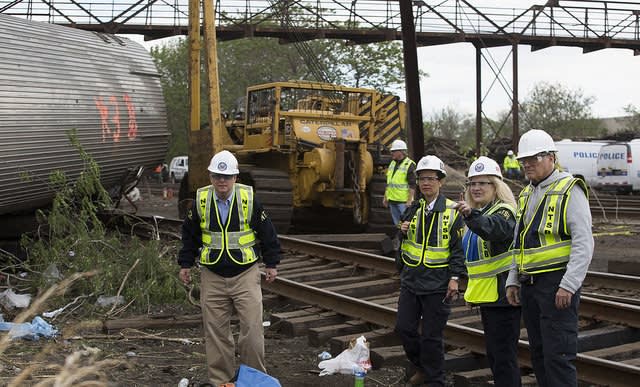
NTSB
NTSB
National Transportation Safety Board (NTSB) investigators have completed most of their on-scene documentation work at the Amtrak Train 188 accident site and at the Amtrak facilities in Delaware. Additional 3D laser scanning of the train cars will be completed in the coming weeks.
An examination of the signals systems has revealed no anomalies or malfunctions.
The NTSB has possession of the Amtrak engineer’s cell phone. Additionally, under its enforcement authority, the Federal Railroad Administration subpoenaed and obtained the engineer’s cell phone records and has shared that data with NTSB forensic experts. Although the records appear to indicate that calls were made, text messages sent and data used on the day of the accident, investigators have not yet made a determination if there was any phone activity during the time the train was being operated.
To make that assessment, investigators have started the process of correlating the time stamps in the engineer’s cell phone records with multiple data sources including the locomotive event recorder, the locomotive outward facing video, recorded radio communications and surveillance video.
The processes involved in correlating time stamps for all these devices are detailed and lengthy. Because of variations in time stamps for each data source, each one must be correlated to the same time zone so that a factual timeline of events can be developed that will allow investigators to understand if any phone activity has any relevance to the accident.
Investigators interviewed the engineer of the SEPTA train that had stopped after being struck by an object that had shattered the windshield of the locomotive. The SEPTA engineer said that the Amtrak engineer announced on the radio, “hot track rail two,” to let him know that the Amtrak train was about to pass the stopped SEPTA train. He saw Amtrak 188 pass on track 2 and did not notice anything unusual.
Interviews with passengers and emergency responders will continue over the coming weeks. Investigative specialists in crashworthiness and survival factors are interviewing passengers that survived the accident in order to understand the circumstances of the evacuation as well as how injuries correlated with train car and seating positions.
Amtrak has provided the NTSB with the engineer’s training and employment records. He had been operating trains in the Washington-Boston Northeast Corridor for about three years. He had been specifically assigned the Washington-New York segment of the corridor for several weeks.
More Security and Safety

FTA Ends Direct Oversight of MBTA Safety Actions
The federal agency closed its remaining special directive to the Massachusetts Department of Public Utilities following a safety review that began in 2022.
Read More →
Transit Agencies Highlight Safety Gains at National Summit
Leaders from 15 major transit systems shared crime-reduction results and safety initiatives while discussing the role of continued federal support.
Read More →
DART Launches Major Security, Fare Enforcement Initiative
The 90-day demonstration will deploy coordinated security teams at five light rail stations while testing controlled access and gathering data to guide future investments.
Read More →
RTD Launches NextRide App to Consolidate Trip Planning, Fares, Security Reporting
The app expands on RTD’s existing NextRide web application and allows customers to view real-time vehicle locations and service alerts, purchase and store digital fares, and access customer support.
Read More →
TAPTCO Updates OSHA Compliance Training for Transit Maintenance Operations
The revamped program addresses 26 OSHA standards for maintenance facilities, with TAPTCO pointing to training, documentation, and everyday shop hazards as continuing challenges for transit operations.
Read More →
FRA Announces $5.3B in Rail Investments, Including $2B for Amtrak
Funding will support grade-crossing improvements, infrastructure upgrades, and new Amtrak equipment in 23 states.
Read More →
Chicago, Maryland Expand Non-Law-Enforcement Safety, Rider Support
The CTA and MTA are launching new programs aimed at de-escalation, crisis response, rider assistance, and greater transparency.
Read More →
LA Metro, City of West Hollywood, and Partners Advance Smarter Bus Lane Enforcement
The award-winning partnership combines AI-powered detection with human oversight to improve bus reliability, accessibility, and enforcement efficiency.
Read More →
LA Metro Reports 57% Decline in Homelessness on Transit System Since 2024
The agency's latest homelessness count offers new data on how care-based services and cross-sector partnerships can complement traditional transit security strategies.
Read More →
FTA Launches 'Transit Moves America' Dashboard to Highlight Agency Safety and Performance
The online dashboard transforms National Transit Database information into a public-facing resource that allows users to compare transit agencies on key operational and safety metrics.
Read More →