



NYC Transit program urges safety when playing Pokémon Go
The digital screen campaign consists of a brief animation warning customers to stay safe as they play the game that seems to have taken the country, and the world, by storm.

NY MTA
NY MTA
By Charles Seaton, MTA New York City Transit
MTA New York City Transit was quick to recognize the popularity of that new electronic gaming sensation Pokémon Go. Officials also spared no time in identifying the potential hazards of trying to catch the creatures in surroundings where there is a four-and-a-half foot drop to the tracks.
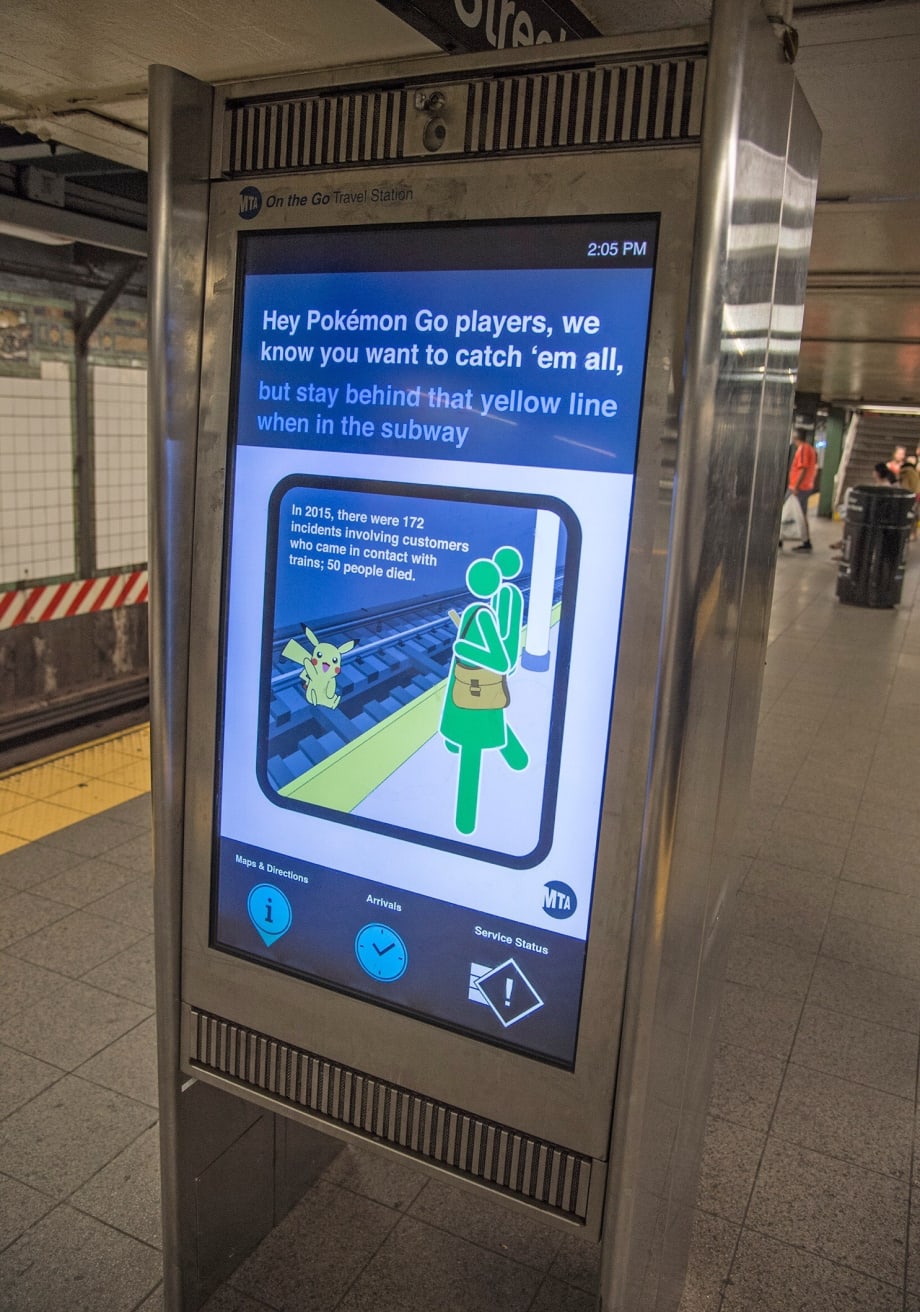
In response, the agency has created a new safety campaign for its “On The Go” (OTG) travel station kiosks, reminding customers to stay safe by remaining behind the yellow line when trying to catch the animated creatures. The digital screen campaign consists of a brief animation warning customers to stay safe as they play the game that seems to have taken the country, and the world, by storm. The messaging uses the iconic red and green “Bubble People” figures used in the popular “Courtesy Counts” campaign combined with language from the agency’s ongoing platform safety campaign. Of course, the red figure turns green once he does the safe thing by stepping behind the yellow line.
The text reads: “Hey Pokémon Go players, we know you want to catch ‘em all, but stay behind the yellow line when in the subway.” The text inside the frame adds: “In 2015, there were 172 incidents involving customers who came into contact with trains; 50 people died.”
The On The Go campaign began running July 15. New York City Transit had previously issued similar warnings through Twitter and Facebook posts that generated more than 400,000 views in less than a week. They both urged customers to be mindful of their surroundings and keep well back from the edge of the platform.
“We like our customers to have fun but want to remind them to play smart and play safe,” said Paul J. Fleuranges, VP, corporate communications, for NYC Transit. “For customers, our key takeaway is please stay behind the yellow line at the platform edge when you ‘gotta catch ‘em all.’”
The MTA OTG network currently consists of 200 units at 39 subway stations in the Bronx, Brooklyn, Manhattan and Queens; by the end of the fourth quarter 2016, there will be 380 kiosks in 73 subway stations. Customers can view the real-time service status of subways, buses and railroads; get travel directions with Trip Planner; access elevator/escalator status; and scan MTA, neighborhood and station maps.
NYC Transit also uses the OTG to push service alert and emergency messaging to the entire kiosk network, a select group of kiosks or an individual unit during a service event or emergency situation, posting granular service alternatives at affected locations.
More Security and Safety

Transit Agencies Highlight Safety Gains at National Summit
Leaders from 15 major transit systems shared crime-reduction results and safety initiatives while discussing the role of continued federal support.
Read More →
DART Launches Major Security, Fare Enforcement Initiative
The 90-day demonstration will deploy coordinated security teams at five light rail stations while testing controlled access and gathering data to guide future investments.
Read More →
RTD Launches NextRide App to Consolidate Trip Planning, Fares, Security Reporting
The app expands on RTD’s existing NextRide web application and allows customers to view real-time vehicle locations and service alerts, purchase and store digital fares, and access customer support.
Read More →

TAPTCO Updates OSHA Compliance Training for Transit Maintenance Operations
The revamped program addresses 26 OSHA standards for maintenance facilities, with TAPTCO pointing to training, documentation, and everyday shop hazards as continuing challenges for transit operations.
Read More →
How VaporVision Adds Value to Transit Door Systems
Wabtec engineers explain how the system improves doorway detection, strengthens diagnostics and gives transit agencies and OEMs greater operating flexibility.
Read More →
FRA Announces $5.3B in Rail Investments, Including $2B for Amtrak
Funding will support grade-crossing improvements, infrastructure upgrades, and new Amtrak equipment in 23 states.
Read More →
Chicago, Maryland Expand Non-Law-Enforcement Safety, Rider Support
The CTA and MTA are launching new programs aimed at de-escalation, crisis response, rider assistance, and greater transparency.
Read More →
LA Metro, City of West Hollywood, and Partners Advance Smarter Bus Lane Enforcement
The award-winning partnership combines AI-powered detection with human oversight to improve bus reliability, accessibility, and enforcement efficiency.
Read More →
LA Metro Reports 57% Decline in Homelessness on Transit System Since 2024
The agency's latest homelessness count offers new data on how care-based services and cross-sector partnerships can complement traditional transit security strategies.
Read More →
FTA Launches 'Transit Moves America' Dashboard to Highlight Agency Safety and Performance
The online dashboard transforms National Transit Database information into a public-facing resource that allows users to compare transit agencies on key operational and safety metrics.
Read More →