



Ohio State U. bus system key to multimodal approach
CABS is just one way OSU is promoting a switch to a more environmentally-friendly, multimodal approach to transit to help reduce fuel consumption, carbon emissions and traffic congestion on campus.

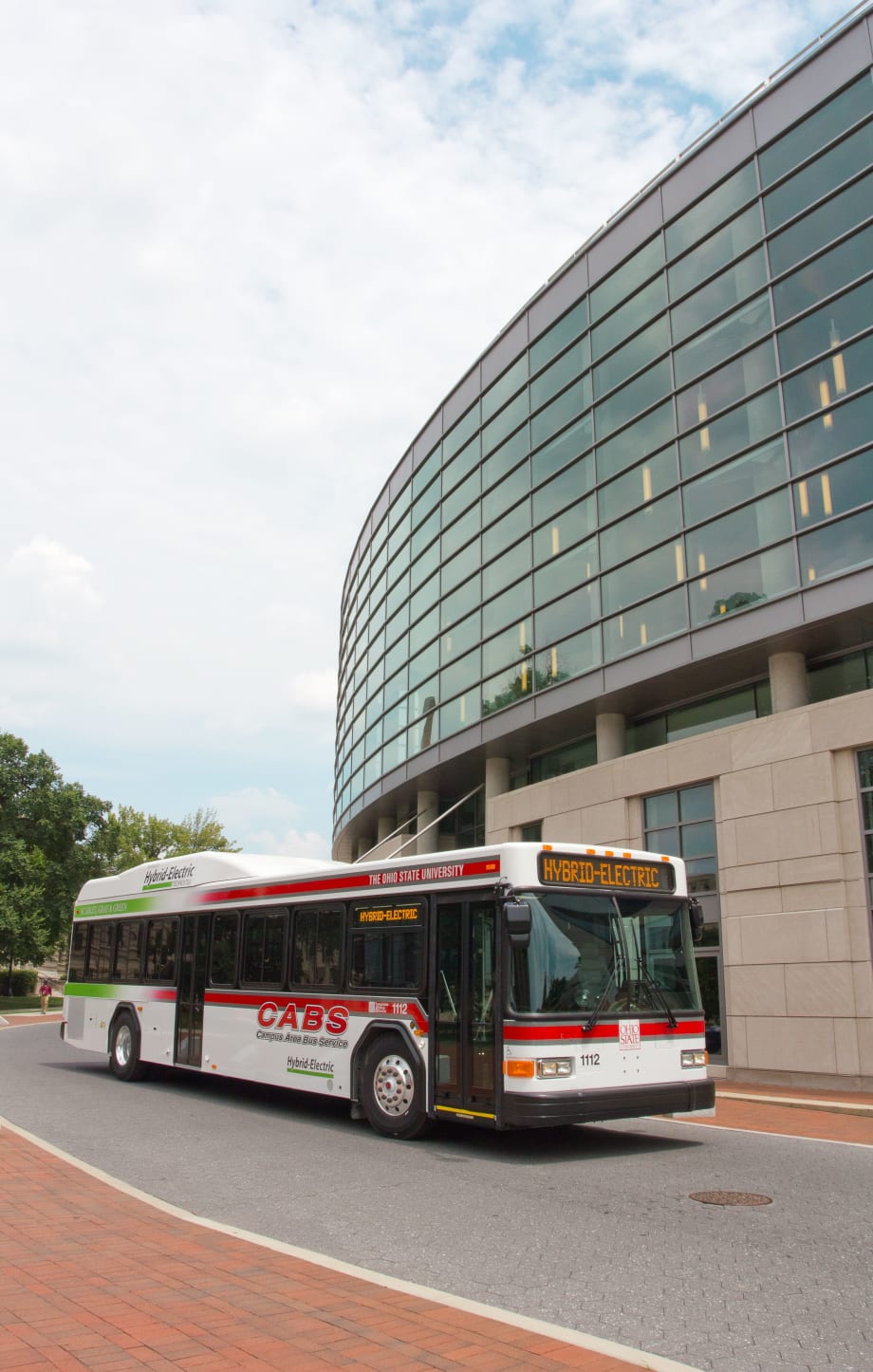

With an estimated 84,000 passenger vehicles traveling through Columbus-based Ohio State University (OSU) daily, the University Campus Area Bus Service (CABS) provides a key access solution to campus parking problems. In fact, CABS provided more than four million rides in 2010.
"We anticipate that number will increase as members of the campus community continue to look for more convenient ways to travel to and from, as well as move around campus," said Nicole Hernandez, assistant director, strategic planning and communications, for OSU's Transportation & Parking Services division, which provides the free CABS service to the university's faculty, staff and students.
Bus service on campus began in the late 1960s and was funded centrally by the university, added Hernandez. As the university budget fluctuated, so did CABS service, which changed service offerings annually, impacting ridership. In 1995, the bus system was merged with the parking system to provide financial stability and allow the university to solve access and transportation problems in a more streamlined way.
"With a stable funding source, a major service expansion took place in 1998 to help address parking needs," Hernandez explained. "This expansion resulted in an increase in service from four routes with nine buses to nine routes with 17 buses. Ridership grew exponentially. Over time, the Central Ohio Transit Authority (COTA) absorbed two of the routes that reached out into the community, which provided new service to city residents while allowing OSU Students to continue using bus service they were used to."
Today, OSU has seven routes with 24 buses running during peak service. CABS provides service 24 hours a day, seven days a week during its main academic session, and reduces service during class breaks and summer session. Route frequency is increased during the day to support higher ridership and decreased in the early evening when the demand is reduced. Routes also cross transit provided by COTA, which creates seamless transportation to the university community. COTA and the university have also partnered for a U-Pass.
At this point in time, Transportation & Parking Services is required to remain budget neutral and self-generate all funds necessary to build, operate and maintain all campus parking as well as CABS from sales and services of parking provided to OSU. However, the university is exploring privatization, according to Hernandez.
"The university is currently exploring the feasibility of concessioning/privatizing the parking operation through a 50-year lease to a private parking operator, so one of the upcoming challenges we face is in defining specific requirements for CABS and other departmental transportation related services so leadership can find alternative ways to fund them over the life of the lease, if the privatization effort moves forward," she said.
CABS is just one way OSU is promoting a switch to a more environmentally-friendly, multimodal approach to transit to help reduce fuel consumption, carbon emissions and traffic congestion on campus.
In FY06, OSU began limiting first-year students who live on campus from bringing cars, resulting in an immediate reduction in overnight parkers of 2,500 cars.
The university has collaborated with Hertz on Demand to provide a car sharing program that offers inexpensive, hourly rates for short-term vehicle use to help support those who commute to campus using alternative modes, but who might need a car at some point during their visit. It has also partnered with the Mid-Ohio Regional Planning Commission to provide a vanpooling program with very low cost monthly rates.
"Our most recent efforts include ways to highlight other transportation modes such as biking and walking through the creation of a Bicycle Advisory Committee, implementation of sharrows on select campus roadways, and the support and promotion of the university-wide 'Share the Road' campaign," said Hernandez. "The university recently was honored as one of only six universities nationwide to receive the Bronze Bicycle Friendly University status as a result of these efforts."
To become even more environmentally-friendly, Transportation and Parking Services recently purchased two Gillig diesel-electric powered hybrid buses for its CABS fleet.
These buses are powered by a clean diesel hybrid-electrical propulsion system that uses both a battery-powered electric motor while accelerating and operating at low speed and a diesel-fueled combustion engine at higher speeds. The low-floor buses also facilitate easy loading and unloading by customers.
The new hybrid-electric buses are expected to reduce diesel fuel consumption by roughly 25 percent, resulting in almost 50 percent lower CO2 emissions.
"The buses will be closely monitored and actual return on the investment will be evaluated over the next year with the intent of ordering additional hybrid buses in the future," explained Hernandez. "Shifting total financial support for the CABS system to the university's general fund if the parking system is concessioned, might impact the university's ability to fund future hybrid bus purchases since the cost is significantly higher."
More New Mobility

From Hardware to Digital Partner: Luminator Charts Its Next Chapter
CEO Magnus Friberg discusses Luminator’s shift toward becoming a digital partner, the growing importance of software and interoperability, and how AI can help agencies improve operations and passenger experience.
Read More →
Biz Briefs: Alstom Lands Canadian Contract, LYT to Supply California TSP, and More
In METRO's latest installment, we take a look at recent news from Complete Coach Works, Beep, FlixBus, and more partnerships making headlines across the transportation sector.
Read More →
CharterUP’s Armir Harris on Technology, AI, and the Future of Group Mobility
In a recent episode of METROspectives, CharterUP Founder/CEO Armir Harris discussed the company’s evolution from an online charter bus marketplace into a technology platform supporting public- and private-sector mobility and much more.
Read More →
Jacksonville’s NAVI Project Charts a New Course for Autonomous Public Transportation
Through its NAVI program, JTA is showing how autonomous vehicles, intelligent infrastructure, and coordinated operations can work together to deliver everyday public transportation.
Read More →
Biz Briefs: Luminator Marks Milestone and More
From manufacturers and suppliers to transit agencies and motorcoach operators, these updates offer a snapshot of the projects, partnerships and business moves driving the industry forward.
Read More →
New Tricks for Old Bureaucracies: Joshua Schank on Making Transit Innovation Stick
Former LA Metro Chief Innovation Officer Joshua Schank discusses why good ideas aren't enough, how transit agencies can overcome resistance to change, and why today's challenges demand more innovation.
Read More →
How DART's GoPass Is Redefining Regional Mobility
Serving 14 transit agencies, GoPass simplifies multimodal travel by allowing riders to plan, pay for, and manage an entire trip through one app.
Read More →
Biz Briefs: OCTA Taps Clean Energy for Hydrogen Station, Stadler to Supply Via Rail Vehicles, and More
From manufacturers and suppliers to transit agencies and motorcoach operators, these updates offer a snapshot of the projects, partnerships and business moves driving the industry forward.
Read More →CharterUP Expands Into New Mobility and Autonomous Transportation
Vice President of New Mobility Stephen Joos discusses how CharterUP is leveraging its nationwide transportation network, technology platform, and autonomous vehicle partnerships to expand into workforce mobility, campus shuttles, and transit solutions.
Read More →
METRO Magazine Announces 2026 Innovative Solutions Awards Winners
Projects Recognized for Advancing Mobility Through Technology, Accessibility, Workforce Innovation, and Operational Excellence
Read More →