



Report outlines how cities can assess transit performance, boost efficiency
Public policy makers should eliminate duplications and/or have high-performing transit agencies manage services for low-performing adjacent areas, report recommends.

Changes wrought by mass transit service planning can heavily influence regional economic growth, even in tough economic times. But how can cities assess transit performance, determine the efficiencies, and develop policies to boost that efficiency? A new Mineta National Transit Research Consortium (MNTRC) report publication addresses those questions and offers policy recommendations using Ohio as a role model.
The peer-reviewed research report, Assessing the Comparative Efficiency of Urban Mass Transit Systems in Ohio: Longitudinal Analysis, is available for no-cost, no-registration download here.
"Ohio's economic growth has been lagging behind the national average for 13 out of the last 15 years, according to some experts," said report author Hokey Min, PhD. "To reverse this trend, Ohio leaders are seeking ways to improve the state's economic vitality and job opportunities. One way to do this is to improve the mobility of Ohio residents by increasing their access to public transportation. This can boost economic activities such as job commuting and retail shopping."
Given the public's growing concerns over government budget deficits, the continuous under-utilization of a mass transit system can increase public scrutiny of additional investments in transit services. To find ways to better use these systems across Ohio and thus make best use of public financial resources, the report evaluates operational efficiency of the current mass transit system relative to benchmark standards.
The report also identifies the leading causes of any transit inefficiencies. To meet these goals, the researchers conducted window data envelopment analysis (DEA) on the past three years of time-series data for 24 of Ohio's 27 urban public transit agencies.
Among its findings, the report said:
•The overall size of a city has no bearing on its mass transit efficiency.
•Local climate and economic conditions are not necessarily tied to transit efficiency.
•Using particular transportation modes could influence mass transit efficiency, based on the DEA analysis of 515 transit agencies across the US.
Recommendations include:
•State and municipal governments in Ohio should reward and prioritize the development of mass transit systems that serve densely settled urban areas (an average population of at least 7,000 per square mile) while increasing the use of bus rapid transit.
•Where financial and human resources are not fully utilized, public policy makers must consider outsourcing the transit operation to private enterprises or building a long-term partnership with them.
•Public policy makers should eliminate duplications and/or have high-performing transit agencies manage services for low-performing adjacent areas.
"In particular, capital investment in public infrastructure, such as mass transit systems, is often linked with local economic improvement. Some experts have observed that such investment tended to yield long-term economic benefits, such as higher residential property value, higher real wages for local workers, lower unemployment, and reduced travel time," Dr. Min said.
Similar conclusions are drawn from recent studies of Africa's and China's transportation infrastructures. However, controlling mass transit operating costs while meeting service demand remains one of the greatest challenges for mass transit authorities, private transit service providers, and public policy makers.
The 37-page report includes tables and figures, such as descriptive statistics of input and output measures, and efficiency scores of U.S. transit systems.
More Paratransit

Driving Smarter Paratransit
John Hanlon shares how AlphaRoute is leveraging AI-powered technology to help paratransit providers optimize operations, support frontline staff, and enhance the rider experience.
Read More →
People Movement: Dan Dipert Coaches Adds Third-Generation Leader, Keolis Names New Valley Metro VP/GM, and More
In this edition, we also cover recent appointments and announcements at the Wabtec, SilverRide, HNTB, and more, showcasing the individuals helping to shape the future of transportation.
Read More →
Biz Briefs: RIPTA Unveils New Frontrunners, Clevland RTA Adds New Siemens, and More
In METRO's latest installment, we take a look at recent news from Siemens, Prevost, Dodge, and more partnerships making headlines across the transportation sector.
Read More →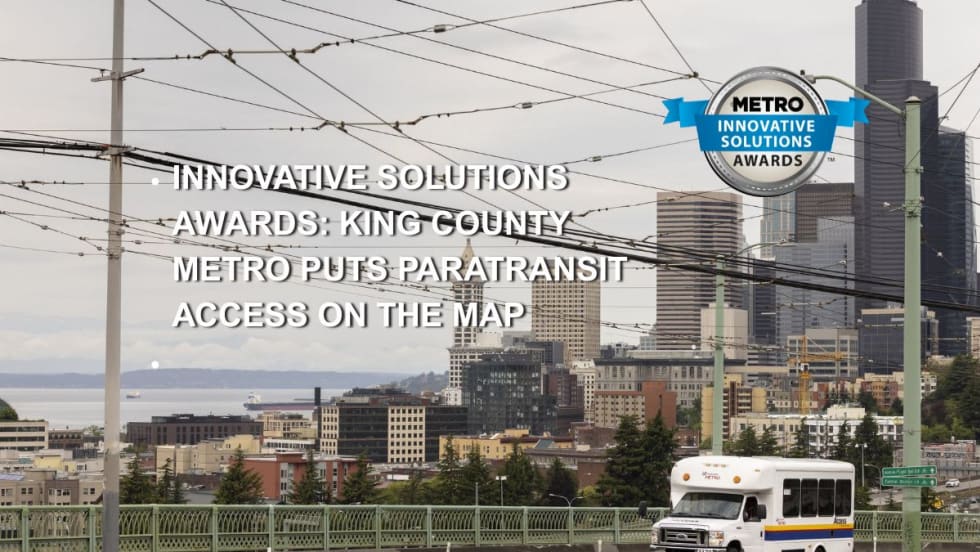
King County Metro Makes ADA Paratransit Easier to Navigate
METRO's Innovative Solutions Award winner replaces complex service-area descriptions with an accessible, interactive map that puts paratransit information directly in customers’ hands.
Read More →
Jacksonville’s NAVI Project Charts a New Course for Autonomous Public Transportation
Through its NAVI program, JTA is showing how autonomous vehicles, intelligent infrastructure, and coordinated operations can work together to deliver everyday public transportation.
Read More →
Driving Smarter Paratransit
John Hanlon shares how AlphaRoute is leveraging AI-powered technology to help paratransit providers optimize operations, support frontline staff, and enhance the rider experience.
Read More →
METRO Magazine Announces 2026 Innovative Solutions Awards Winners
Projects Recognized for Advancing Mobility Through Technology, Accessibility, Workforce Innovation, and Operational Excellence
Read More →
Biz Briefs: STV teams with Amtrak, Motorcoach Operators Boost Fleet and Land Contracts, and More
From manufacturers and suppliers to transit agencies and motorcoach operators, these updates offer a snapshot of the projects, partnerships and business moves driving the industry forward.
Read More →
Biz Briefs: Masabi Teams with St. Louis Metro and More
In METRO's latest installment, we take a look at recent news from Transdev, Hitachi, and more partnerships making headlines across the transportation sector.
Read More →
New York MTA Leverages Zoning Program to Advance Station Accessibility
Accessibility enhancements at Nevins St Station will be financed through a development agreement tied to the MTA's Zoning for Accessibility initiative.
Read More →