



ROUSH CleanTech Develops Propane Autogas Fuel System for the Ford E-350
Propane vehicle technology company’s new cutaway option designed for public transit fleets.

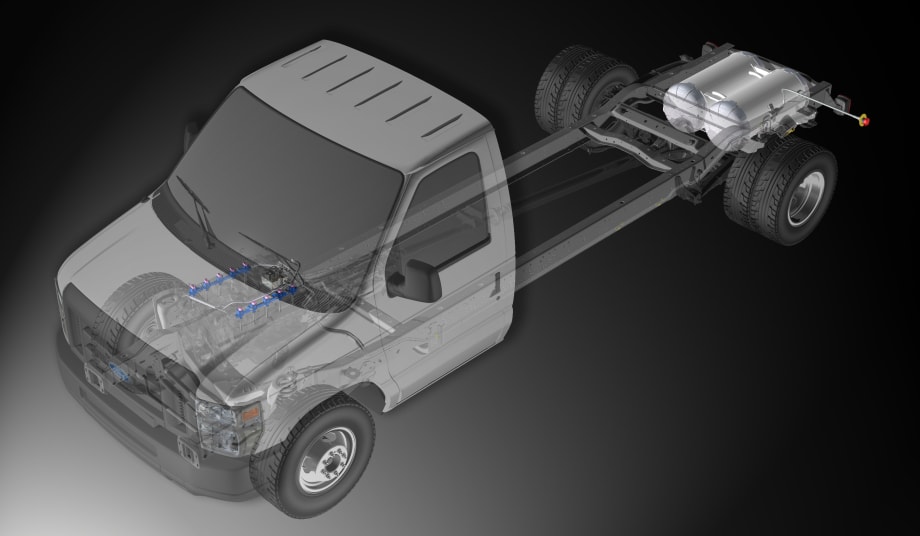
Graphic courtesy of ROUSH CleanTech.

Graphic courtesy of ROUSH CleanTech.
ROUSH CleanTech revealed its newest propane autogas vehicle, the Ford E-350 single-rear-wheel and dual-rear-wheel cutaway, which provides public transit agencies a smaller propane vehicle option for servicing routes with fewer customers, the company announced.
In addition to transit shuttles, the propane-fueled Ford E-350 cutaway is well suited for Type A school buses and delivery trucks in markets such as food and beverage and parcel.
The vehicles maintain the same horsepower, torque and towing capacity as their Ford gasoline-fueled counterparts, and are powered by a Ford 6.8L V10 2-valve engine. They will be certified by the Environmental Protection Agency and California Air Resources Board and compliant with heavy-duty onboard diagnostics.
Each of the extended-range shuttles will emit about 90,000 fewer pounds of carbon dioxide over its lifetime compared to gasoline-fueled counterparts. Historically, propane autogas costs up to 40 percent less than gasoline and 50 percent less than diesel, and reduces maintenance costs due to its clean-burning properties.
ROUSH CleanTech launched the new propane autogas model at the American Public Transportation Association (APTA) Expo in Atlanta.
The propane autogas Ford E-350 cutaway will be available in 2018 model year. Orders are now being taken with deliveries beginning by late spring 2018.
More Technology

From Hardware to Digital Partner: Luminator Charts Its Next Chapter
CEO Magnus Friberg discusses Luminator’s shift toward becoming a digital partner, the growing importance of software and interoperability, and how AI can help agencies improve operations and passenger experience.
Read More →
Beyond the Checklist: A Structured Approach to Transit Maintenance
Reliability-Centered Maintenance helps transit agencies move beyond routine checklists to focus limited resources on the assets and failures that have the greatest impact on safety, reliability, and service.
Read More →
NJ TRANSIT Advances Bus Technology Upgrades Across Statewide Fleet
More than 1,500 buses now feature upgraded technology designed to improve arrival predictions and provide free Wi-Fi, with deployment expected to reach nearly 2,000 buses by the end of 2026.
Read More →

Building a Flexible Path to Transit Electrification
John Hroncich discusses BAE Systems’ modular and scalable approach, lessons learned from decades of real-world operations, and how agencies can identify electrification strategies that fit their fleets.
Read More →
Biz Briefs: Alstom Lands Canadian Contract, LYT to Supply California TSP, and More
In METRO's latest installment, we take a look at recent news from Complete Coach Works, Beep, FlixBus, and more partnerships making headlines across the transportation sector.
Read More →
From Legacy Silos to Conversational Intelligence
What if transit leaders could ask any operational question and get a trusted answer in seconds? Conversational AI is transforming how agencies use their data.
Read More →
USDOT Announces Rail Vehicle Replacement Grants, Chattanooga AV Shuttle Funding
More than $191 million in federal funding will help three transit agencies replace aging rail vehicles and support a new autonomous shuttle service in Chattanooga.
Read More →
Bus Tech Talk: Keeping Transit Technicians Ahead of the Technology Curve
LA Metro’s Obed Mejia discusses technician training, evolving maintenance technology, fleet replacement, and strategies for getting the most out of today’s transit fleets.
Read More →
Biz Briefs: RIPTA Unveils New Frontrunners, Clevland RTA Adds New Siemens, and More
In METRO's latest installment, we take a look at recent news from Siemens, Prevost, Dodge, and more partnerships making headlines across the transportation sector.
Read More →
Why Simulating Pedestrian Movement Has Become Essential for Modern Rail Stations
Pedestrian microsimulation is helping rail planners identify bottlenecks, test station designs, and prepare complex transit hubs for growing passenger volumes.
Read More →