



SARTA, Ohio State unveil the first of 10 hydrogen fuel-cell buses
Under the terms of an agreement between SARTA and the Ohio State University, the new bus will be operated by the university's Department of Transportation and Traffic Management as part of the Campus Area Bus Service for the next 12 months.

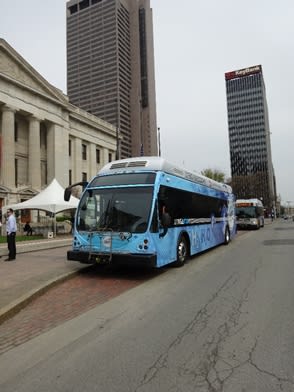
Canton, Ohio’s Stark Area Regional Transit Authority (SARTA) and Ohio State University (OSU) unveiled the first of 10 hydrogen fuel cell-powered buses it will acquire over the next two years at the Ohio Statehouse in Columbus, Ohio.
Under the terms of an agreement between SARTA and the OSU, the new bus will be operated on the Columbus campus by the university's Department of Transportation and Traffic Management as part of the Campus Area Bus Service (CABS) for the next 12 months. The unique arrangement will enable Ohio State's Center for Automotive Research (CAR), a nationally-recognized leader in interdisciplinary automotive research, to collect important data on the vehicle's performance in everyday use on campus streets.
During the next year, the bus will travel throughout the Columbus campus with an exterior design that highlights the technology. CABS will provide basic maintenance for the bus, including tire and oil changes, for the duration of the test period.
When all 10 vehicles join its fleet, SARTA will become the third largest operator of fuel-cell buses in the U.S., and the largest outside California. The unveiling ceremony was held in conjunction with the Ohio Public Transportation Association's Annual Conference.
The second of the 10 vehicles will be delivered to the Altoona Bus Testing and Research Center in Altoona, Pa. The vehicle will be put into service in Stark County when testing is completed. All 10 buses will join SARTA's fleet in 2017 and 2018.
"While we'd obviously like to add the buses to our fleet today, our willingness to engage in this type of research and testing is one of the primary reasons we were able to obtain the federal and state funding that is paying for the entire cost of the first two vehicles,” SARTA Executive Director/CEO Kirt Conrad said. "Under normal circumstances, we would have had to come up with a 20% local match to purchase the buses. The Federal Transportation Administration match is not required because we're allowing Ohio State and Penn State to test them. That saved us more than $1.6 million dollars."
These two buses were funded under FTA's National Fuel Cell Bus Program, in partnership with Calstart of Pasadena, Calif., which requires a 50% in-kind contribution. Additionally, the partners for building the bus, El Dorado, Ballard Power Systems and BAE, have also contributed to the in-kind match.
The remaining eight buses were funded under FTA's No and Low Emission program. Five buses were funded in 2015. Last week, Senator Brown announced the award of funding for three additional buses.
More Technology

ENC Lands MATA Contract and More in Biz Briefs
In this edition of Biz Briefs, we spotlight the latest developments shaping the future of mobility.
Read More →
Strada360’s Steve Lassey on Turning Transit Data Into Better Decisions
From breaking down data silos to preparing for AI, Strada360 CEO Steve Lassey discusses how transit agencies can use technology to improve operations, customer information, and long-term decision-making.
Read More →
Almaviva Looks to Open Architecture to Advance Transit Technology
Eric Reese discusses how interoperability, open architecture, and modular design can help transit agencies control costs, reduce vendor lock-in, and upgrade technology without starting over.
Read More →

Driving Smarter Paratransit
John Hanlon shares how AlphaRoute is leveraging AI-powered technology to help paratransit providers optimize operations, support frontline staff, and enhance the rider experience.
Read More →
From Hardware to Digital Partner: Luminator Charts Its Next Chapter
CEO Magnus Friberg discusses Luminator’s shift toward becoming a digital partner, the growing importance of software and interoperability, and how AI can help agencies improve operations and passenger experience.
Read More →
Beyond the Checklist: A Structured Approach to Transit Maintenance
Reliability-Centered Maintenance helps transit agencies move beyond routine checklists to focus limited resources on the assets and failures that have the greatest impact on safety, reliability, and service.
Read More →
NJ TRANSIT Advances Bus Technology Upgrades Across Statewide Fleet
More than 1,500 buses now feature upgraded technology designed to improve arrival predictions and provide free Wi-Fi, with deployment expected to reach nearly 2,000 buses by the end of 2026.
Read More →
Building a Flexible Path to Transit Electrification
John Hroncich discusses BAE Systems’ modular and scalable approach, lessons learned from decades of real-world operations, and how agencies can identify electrification strategies that fit their fleets.
Read More →
Biz Briefs: Alstom Lands Canadian Contract, LYT to Supply California TSP, and More
In METRO's latest installment, we take a look at recent news from Complete Coach Works, Beep, FlixBus, and more partnerships making headlines across the transportation sector.
Read More →
From Legacy Silos to Conversational Intelligence
What if transit leaders could ask any operational question and get a trusted answer in seconds? Conversational AI is transforming how agencies use their data.
Read More →