



Scotland to test first autonomous full-sized bus fleet in passenger service
The trial — to begin during 2019 — will include five autonomous single-deck Alexander-Dennis vehicles.


Once complete, the 38-foot ADL Enviro200 vehicles will operate between Ferrytoll Park & Ride facility in Fife and the Edinburgh Park train and tram interchange.

Once complete, the 38-foot ADL Enviro200 vehicles will operate between Ferrytoll Park & Ride facility in Fife and the Edinburgh Park train and tram interchange.
Scotland will host the trial of the first autonomous full-sized passenger bus fleet after Innovate UK announced funding to support a successful bid from bus operator Stagecoach along with partners Transport Scotland, Alexander Dennis Ltd. (ADL), Fusion Processing Ltd, ESP Group, Edinburgh Napier University, and University of the West of England.
The trial — to begin during 2019 — will include five autonomous single-deck vehicles.
The buses — operated by Stagecoach East Scotland — will be used autonomously to Level 4 standard, which means that a driver must remain on board during any journey in line with UK regulations.
Once complete, the 38-foot ADL Enviro200 vehicles will operate between Ferrytoll Park & Ride facility in Fife and the Edinburgh Park train and tram interchange. The bus will use both on-road and hard-shoulder running, and will use the dedicated public transport corridor across the Forth Road Bridge that allows buses and taxis to use dedicated lanes between the M9 near Newbridge and Halbeath in Fife.
The autonomous buses will provide a service capable of carrying up to 42 passengers 14 miles across the Forth Bridge to Edinburgh Park train and tram interchange. With buses every 20 minutes this could provide an estimated 10,000 weekly journeys.
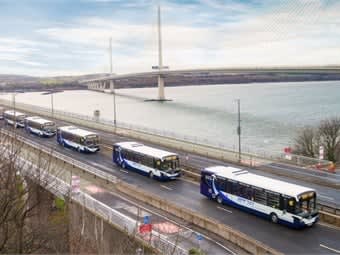
The bus will use both on-road and hard shoulder running, and will use the dedicated public transport corridor across the Forth Road Bridge that allows buses and taxis to use dedicated lanes between the M9 near Newbridge and Halbeath in Fife.
Work on the project is expected to get underway during the second quarter of next year at ADL’s manufacturing depot in Guildford with the first vehicles expected to go into service during 2020.
Stagecoach, ADL and Fusion Processing announced earlier this year that work was underway to trial the first full-sized autonomous vehicle within a Stagecoach depot.
Work on the vehicle is currently being carried out at ADL’s site in Guildford and the bus is expected to be ready for use at the beginning of 2019.
In the short term, the bus will be used in autonomous mode only within the depot environment, to carry out movements such as parking and moving into the fueling station and bus wash. Using self-driving vehicles within depots more widely could help improve safety, efficiency and space utilization within the depot.
Stagecoach has made a significant investment in new technologies to improve transport for customers and make its services more efficient. It includes the UK’s biggest rollout of contactless payment technology on buses, automated vehicle location systems to provide live bus information, and telematics technology to deliver smoother and more fuel efficient journeys.
More New Mobility

From Hardware to Digital Partner: Luminator Charts Its Next Chapter
CEO Magnus Friberg discusses Luminator’s shift toward becoming a digital partner, the growing importance of software and interoperability, and how AI can help agencies improve operations and passenger experience.
Read More →
Biz Briefs: Alstom Lands Canadian Contract, LYT to Supply California TSP, and More
In METRO's latest installment, we take a look at recent news from Complete Coach Works, Beep, FlixBus, and more partnerships making headlines across the transportation sector.
Read More →
CharterUP’s Armir Harris on Technology, AI, and the Future of Group Mobility
In a recent episode of METROspectives, CharterUP Founder/CEO Armir Harris discussed the company’s evolution from an online charter bus marketplace into a technology platform supporting public- and private-sector mobility and much more.
Read More →
Jacksonville’s NAVI Project Charts a New Course for Autonomous Public Transportation
Through its NAVI program, JTA is showing how autonomous vehicles, intelligent infrastructure, and coordinated operations can work together to deliver everyday public transportation.
Read More →
Biz Briefs: Luminator Marks Milestone and More
From manufacturers and suppliers to transit agencies and motorcoach operators, these updates offer a snapshot of the projects, partnerships and business moves driving the industry forward.
Read More →
New Tricks for Old Bureaucracies: Joshua Schank on Making Transit Innovation Stick
Former LA Metro Chief Innovation Officer Joshua Schank discusses why good ideas aren't enough, how transit agencies can overcome resistance to change, and why today's challenges demand more innovation.
Read More →
How DART's GoPass Is Redefining Regional Mobility
Serving 14 transit agencies, GoPass simplifies multimodal travel by allowing riders to plan, pay for, and manage an entire trip through one app.
Read More →
Biz Briefs: OCTA Taps Clean Energy for Hydrogen Station, Stadler to Supply Via Rail Vehicles, and More
From manufacturers and suppliers to transit agencies and motorcoach operators, these updates offer a snapshot of the projects, partnerships and business moves driving the industry forward.
Read More →CharterUP Expands Into New Mobility and Autonomous Transportation
Vice President of New Mobility Stephen Joos discusses how CharterUP is leveraging its nationwide transportation network, technology platform, and autonomous vehicle partnerships to expand into workforce mobility, campus shuttles, and transit solutions.
Read More →
METRO Magazine Announces 2026 Innovative Solutions Awards Winners
Projects Recognized for Advancing Mobility Through Technology, Accessibility, Workforce Innovation, and Operational Excellence
Read More →