




RELATED: Scientists map bedbug genome, follow through NYC subway
Study of subway 'bugs' aimed to improve public health
Harvard researchers collected samples from three MBTA subway lines, including swabbing seats, seat backs, walls, vertical and horizontal poles, and hanging grips inside train cars.
June 29, 2016
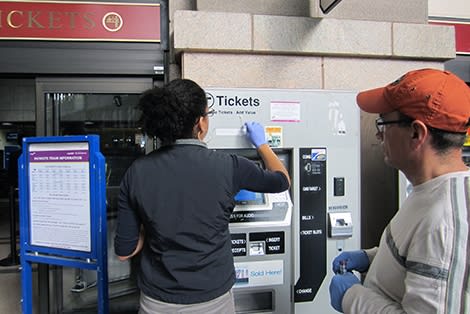
Researchers Regina Joice and Jose Vallarino swab subway ticket machines. Photo: Harvard T.H. Chan - School of Public Health
2 min to read
Researchers Regina Joice and Jose Vallarino swab subway ticket machines. Photo: Harvard T.H. Chan - School of Public Health
The trillions of microbes that transfer from people to surfaces could provide an early warning system for the emergence of public health threats such as a flu outbreak or a rise in antibiotic resistance, according to a study from Harvard T.H. Chan School of Public Health. The researchers took to the Boston subway system to find out what kinds of bugs people across the city are passing around — and how they might help preserve or disrupt our health.
The study, which was published online June 28, 2016 in the American Society for Microbiology’s journal mSystems, is the first high-precision microbial survey in a mass-transit environment to look at multiple surface types and materials.
“We were surprised to find that the microbes that we collected of surfaces that people touch — and sometimes sneeze on — had low numbers of worrisome pathogens or antibiotic resistance genes. These environments have drastically lower virulence profiles, in fact, than are observed in a typical human gut,” said senior author Curtis Huttenhower, associate professor of computational biology and bioinformatics. “Our findings establish a baseline against which deviations can be used as an early warning system to monitor public health.”
With the support of the Massachusetts Bay Transit Authority, the researchers collected samples by swabbing seats, seat backs, walls, vertical and horizontal poles, and hanging grips inside train cars from three subway lines, as well as touchscreens and walls of indoor and outdoor ticketing machines at five subway stations. Detailed data were collected on the environment in which each sample was taken. The samples were then studied using metagenomic sequencing.
The researchers found that the type of surface — and how humans interact with it — was the greatest determinant of microbial community structure. Skin- and oral-associated microbes — transferred by touching and coughing or sneezing — were found on surfaces such as poles and hand grips. Vaginal microbes, which can be transferred through clothing, were found on seats. Greater amounts of non-human microbes, such as those seen in plants, were found on outdoor ticketing touchscreens. Little variation was observed between geographically distinct train lines and stations serving different demographics.
The findings are consistent with previous microbial DNA sequencing-based studies that have revealed that microbial communities in the built environment are greatly influenced by their human occupants. Further study of the separate influences of human contact, surface type, and surface material will help identify mechanisms through which microbial communities form and persist on surfaces within built environments.
“Our next steps are to find out which microbes are dead or alive and which can be transferred between people,” said first author Tiffany Hsu, a research assistant in the department of biostatistics.
More Rail

New York MTA Advances Final Contract for Second Avenue Subway Expansion
Contract Four is the largest in the Second Avenue Subway Phase 2 project and includes construction of station infrastructure, tracks, and signals for the subway expansion, MTA officials said. Work on Contract Four will begin in 2027.
Read More →
San Diego MTS Breaks Monthly Trolley Ridership Record
Agency officials said July’s ridership indicates MTS’s continued recovery from the pandemic.
Read More →
Report Examines NJ TRANSIT Reliability, Funding Challenges
The Garden State Initiative analysis examines the roles of Amtrak infrastructure, fleet management, and agency operations while recommending a more performance-based approach to improving reliability.
Read More →
Stadler, CapMetro Sign Long-Term Rail Fleet Support Agreement
Beginning in 2027, Stadler will provide on-site technical expertise, spare parts support, training, and obsolescence management to help extend the reliability and longevity of CapMetro’s GTW fleet.
Read More →
Biz Briefs: Alstom Lands Canadian Contract, LYT to Supply California TSP, and More
In METRO's latest installment, we take a look at recent news from Complete Coach Works, Beep, FlixBus, and more partnerships making headlines across the transportation sector.
Read More →
CATS Gold Line Marks 5 Years of Service, 2.8M Passenger Trips
With a six-mile expansion planned, the Charlotte streetcar is positioned to connect more neighborhoods and major transit hubs across the region.
Read More →
Why Simulating Pedestrian Movement Has Become Essential for Modern Rail Stations
Pedestrian microsimulation is helping rail planners identify bottlenecks, test station designs, and prepare complex transit hubs for growing passenger volumes.
Read More →
Amtrak Begins Major Construction at New York’s Sunnyside Yard
The new maintenance facility will support Amtrak’s Airo trainsets while improving maintenance efficiency and turnaround times in New York.
Read More →
Chicago Leaders Unveil Plans for O’Hare Airport Express Train
The privately developed project would offer a 15-minute trip between downtown and O’Hare’s Terminal 2, with trains operating every 15 minutes on a dedicated track. The service would use battery-electric trains and three existing freight rail rights-of-way.
Read More →
OCTA Maps Out 30-Year Strategy to Protect Coastal Rail Corridor
The draft feasibility report identifies strategies to protect the coastal rail line for decades as the agency continues near-term stabilization and sand placement efforts.
Read More →