



Study: Young adults driving less, using public transit more
The average young person (age 16-34) drove 23% fewer miles in 2009 than the average young person in 2001. The report also notes that a growing number of young Americans do not have driver’s licenses.

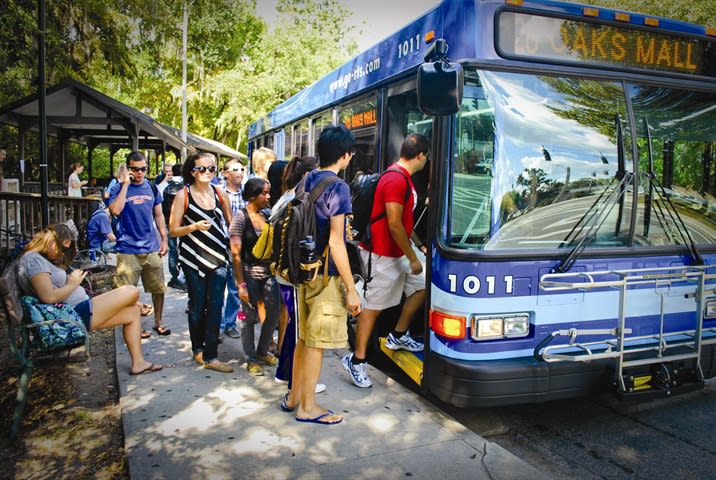
Photo courtesy Gainesville, Fla., Regional Transit System.
Photo courtesy Gainesville, Fla., Regional Transit System.
Young adults in America are decreasing the amount they drive and increasing their use of transportation alternatives, according to a new report released today by a public interest group.
The report, "Transportation and the New Generation: Why Young People are Driving Less and What it Means for Transportation Policy," released by the CalPIRG Education Fund with Frontier Group, shows that Americans have been driving less since the middle of last decade.
“For the first time in two generations, there has been a significant shift in how many miles Americans are driving each year,” said Jon Fox, consumer advocate with the CalPIRG Education Fund. “America needs to understand these trends when deciding how to focus our future transportation investments, especially when transportation dollars are so scarce.”
Transportation and the New Generation reveals that for the first time since World War II, Americans are driving less and have been doing so since the middle of last decade. The report shows that by 2011, the average American was driving 6% fewer miles per year than in 2004.
This trend away from driving is even more pronounced among young people. The average young person (age 16-34) drove 23% fewer miles in 2009 than the average young person in 2001. The report also notes that a growing number of young Americans do not have driver’s licenses; from 2000 to 2010, the share of 14-year-olds to 34-year-olds without a license increased from 21% to 26%.
“The shift away from six decades of increasing vehicle travel to a new reality of slow-growing or even declining vehicle travel has potentially seismic implications for transportation policy,” said Benjamin Davis, analyst with Frontier Group. “It calls into question the wisdom of our current transportation investment priorities.”
According to the report, between 2001 and 2009, the annual number of miles traveled by 16 to 34 year olds on public transit, such as trains and buses increased by 40%.
“I would rather have good public transportation options than the hassle and expense of driving a car,” said Sofie Karasek, a freshman at UC Berkeley. “It’s time for our leaders to stop debating how much to spend expanding our grandparents’ transportation network and start figuring out how to build the infrastructure that my generation will need for the future.”
More Bus

People Movement: Dan Dipert Coaches Adds Third-Generation Leader, Keolis Names New Valley Metro VP/GM, and More
In this edition, we also cover recent appointments and announcements at the Wabtec, SilverRide, HNTB, and more, showcasing the individuals helping to shape the future of transportation.
Read More →
New York MTA Plans Largest Bus Fleet Upgrade in More Than a Decade
The agency is seeking manufacturers for 650 new CNG buses to replace aging vehicles, improve reliability, and advance its broader fleet modernization strategy.
Read More →
Building a Flexible Path to Transit Electrification
John Hroncich discusses BAE Systems’ modular and scalable approach, lessons learned from decades of real-world operations, and how agencies can identify electrification strategies that fit their fleets.
Read More →
Bus Tech Talk: Keeping Transit Technicians Ahead of the Technology Curve
LA Metro’s Obed Mejia discusses technician training, evolving maintenance technology, fleet replacement, and strategies for getting the most out of today’s transit fleets.
Read More →
Biz Briefs: RIPTA Unveils New Frontrunners, Clevland RTA Adds New Siemens, and More
In METRO's latest installment, we take a look at recent news from Siemens, Prevost, Dodge, and more partnerships making headlines across the transportation sector.
Read More →
People Movement: Holly Arnold Joins Transdev and More
In this edition, we also cover recent appointments and announcements at Pace, CamTran, MCI, and more, showcasing the individuals helping to shape the future of transportation.
Read More →
The High Cost of Transit Buses: Industry Leaders Look to Procurement Reform
Transit leaders and policymakers examine how standardized bus designs, streamlined procurement, and predictable funding could help agencies stretch budgets and deliver better service.
Read More →
The Business Voice Behind Public Transportation
As chair of APTA’s Business Members Board of Governors, Ray Melleady explains how more than 850 business members are partnering with transit agencies to advance funding, innovation, and industry-wide collaboration.
Read More →
From Surviving to Thriving: Building Stronger Transportation Organizations
Bus Business Consultants founder Brian Dickson shares lessons on leadership, organizational health, and creating options for long-term success in a changing transportation industry.
Read More →
Finding the ‘Happy Medium’: Optimizing Maintenance Without Sacrificing Reliability
The key to maintenance optimization isn’t doing less work—it’s doing the right work at the right time on the right assets.
Read More →