



TNCs caused half of San Francisco's congestion since 2010: Report
Employment and population growth were primarily responsible for the remainder of the worsening congestion.


TNCs caused increased congestion across all times of day, including the morning peak, mid-day, and evening peak, but the increase attributable to TNCs was most pronounced in the evening.
© Frank Schulenburg / CC BY-SA 3.0
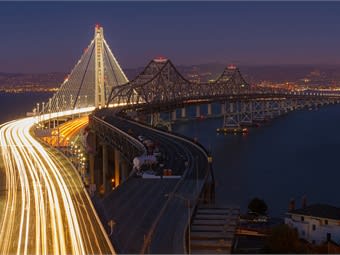
TNCs caused increased congestion across all times of day, including the morning peak, mid-day, and evening peak, but the increase attributable to TNCs was most pronounced in the evening.
© Frank Schulenburg / CC BY-SA 3.0
The San Francisco County Transportation Authority released “TNCs & Congestion,” a report providing the first comprehensive analysis of how Transportation Network Companies (TNCs) Uber and Lyft collectively have affected roadway congestion in San Francisco.
The report found that TNCs accounted for approximately 50% of the rise in congestion in San Francisco between 2010 and 2016, as indicated by three congestion measures: vehicle hours-of-delay, vehicle-miles traveled, and average speeds. Employment and population growth were primarily responsible for the remainder of the worsening congestion. As a share of total congestion citywide, TNCs account for an estimated 25%.
The TNCs and Congestion report follows the agency’s 2017 “TNCs Today” report that quantified the number and distribution of local TNC trips in San Francisco.
Major findings show that collectively the ride-hail services accounted for:
Fifty-one percent of the increase in daily vehicle hours of delay between 2010 and 2016.
Forty-seven percent of the increase in vehicle miles traveled during that same time period.
Fifty-five percent of the average speed decline on roadways during that same time period.
On an absolute basis, TNCs comprise an estimated 25% of total vehicle congestion (as measured by vehicle hours of delay) citywide and 36% of delay in the downtown core.
Notably, the report indicates that TNC activity affects congestion differently throughout the day and throughout the city. TNCs caused increased congestion across all times of day, including the morning peak, mid-day, and evening peak, but the increase attributable to TNCs was most pronounced in the evening.
Consistent with prior findings from the Transportation Authority’s 2017 TNCs Today report, TNCs also caused the greatest increases in congestion in the densest parts of the city — up to 73% in the downtown financial district — and along many of the city’s busiest corridors. TNCs had little impact on congestion in the western and southern San Francisco neighborhoods.
The report also found that changes to street configuration, such as when a traffic lane is converted to a bus-only lane, contributed less than 5% to congestion.
“This report further quantifies the impact ride-hail services have on our streets,” said Aaron Peskin, chair of the San Francisco County Transportation Authority (SFCTA) and District 3 Supervisor. “It underscores the importance of our current collaboration with Transportation Network Companies to develop a per-trip tax to help mitigate the impacts of these trips, and informs our efforts to balance the availability of these new mobility options with our Transit First policies.”
How is congestion measured?
The TNCs and Congestion report uses the following common measures of roadway congestion:
Vehicle Hours-of-Delay: Measuring the overall amount of excess time spent in congestion, it is the difference between congested travel times and free flow travel times on a given roadway segment.
Vehicle-Miles Traveled: A measure of the overall amount of travel, as measured in distance, that occurs on the streets.
Speed: The average speeds on streets.
More New Mobility

From Hardware to Digital Partner: Luminator Charts Its Next Chapter
CEO Magnus Friberg discusses Luminator’s shift toward becoming a digital partner, the growing importance of software and interoperability, and how AI can help agencies improve operations and passenger experience.
Read More →
Biz Briefs: Alstom Lands Canadian Contract, LYT to Supply California TSP, and More
In METRO's latest installment, we take a look at recent news from Complete Coach Works, Beep, FlixBus, and more partnerships making headlines across the transportation sector.
Read More →
CharterUP’s Armir Harris on Technology, AI, and the Future of Group Mobility
In a recent episode of METROspectives, CharterUP Founder/CEO Armir Harris discussed the company’s evolution from an online charter bus marketplace into a technology platform supporting public- and private-sector mobility and much more.
Read More →
Jacksonville’s NAVI Project Charts a New Course for Autonomous Public Transportation
Through its NAVI program, JTA is showing how autonomous vehicles, intelligent infrastructure, and coordinated operations can work together to deliver everyday public transportation.
Read More →
Biz Briefs: Luminator Marks Milestone and More
From manufacturers and suppliers to transit agencies and motorcoach operators, these updates offer a snapshot of the projects, partnerships and business moves driving the industry forward.
Read More →
New Tricks for Old Bureaucracies: Joshua Schank on Making Transit Innovation Stick
Former LA Metro Chief Innovation Officer Joshua Schank discusses why good ideas aren't enough, how transit agencies can overcome resistance to change, and why today's challenges demand more innovation.
Read More →
How DART's GoPass Is Redefining Regional Mobility
Serving 14 transit agencies, GoPass simplifies multimodal travel by allowing riders to plan, pay for, and manage an entire trip through one app.
Read More →
Biz Briefs: OCTA Taps Clean Energy for Hydrogen Station, Stadler to Supply Via Rail Vehicles, and More
From manufacturers and suppliers to transit agencies and motorcoach operators, these updates offer a snapshot of the projects, partnerships and business moves driving the industry forward.
Read More →CharterUP Expands Into New Mobility and Autonomous Transportation
Vice President of New Mobility Stephen Joos discusses how CharterUP is leveraging its nationwide transportation network, technology platform, and autonomous vehicle partnerships to expand into workforce mobility, campus shuttles, and transit solutions.
Read More →
METRO Magazine Announces 2026 Innovative Solutions Awards Winners
Projects Recognized for Advancing Mobility Through Technology, Accessibility, Workforce Innovation, and Operational Excellence
Read More →