




RELATED: Driverless shuttle service coming to U. of Michigan
Transportation technologies receive $600K from U. of Mich.
The statewide program funds translational research applications in advanced transportation materials, robotics and autonomy, sensors, electric vehicle drivetrain/propulsion, software/controls/data, and advanced manufacturing processes.
July 31, 2017
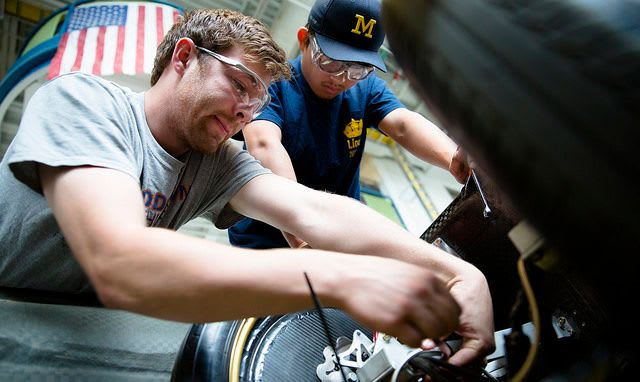
Since 2012, U-M has been running the MTRAC advanced transportation program. Photo: University of Michigan
3 min to read
Since 2012, U-M has been running the MTRAC advanced transportation program. Photo: University of Michigan
Seven technologies demonstrating high potential to help solve transportation issues are receiving a total of $600,000 in funding from a University of Michigan research program to continue their advancement into the commercial market.
The Michigan Translational Research and Commercialization (MTRAC) Innovation Hub for Advanced Transportation is a statewide program that funds translational research applications in advanced transportation materials, robotics and autonomy, sensors, electric vehicle drivetrain/propulsion, software/controls/data, and advanced manufacturing processes.
Five technologies will receive a $100,000 grant while two will receive $50,000 with the opportunity to unlock the remaining $50,000, after certain milestones are reached throughout the year.
“These teams have made the connection between their research and future transportation systems, and are working hard to get their technology to market,” said Eric Petersen, newly appointed U-M MTRAC Program Director. “Investing in projects and people will help the state retain leadership in the transportation industry as vehicles become electrified and as autonomous systems are proposed for moving people and goods.”
Projects receiving $100,000 in funding include:
High-Frequency RADAR for Automotive Autonomous Applications (U-M): A sub-millimeter-wave radar system with superior detection resolutions, wide-scanning range and minimal size, weight and power consumption.
High-Performance Coatings for Engine Cylinder Bores (Michigan State University): A process to deposit diamond-like coatings onto the inner surface of cylinder bores to reduce friction and resultant fuel consumption.
Multi-Material 3D Printing (U-M): A method which integrates electrical assemblies into components through micro-additive manufacturing.
Variable Coupling Wireless Power Transfer System (U-M): A wireless power transfer system that achieves high efficiency at a wide range of positions and distances between transmitter and receiver.
Your Own Planner (U-M): An optimal travel planning search engine producing lower costs at minimal effort for given constraints and preferences.
Projects receiving $50,000 in funding include:
Enhanced Object Recognition LIDARs for Robotics (U-M): A system to compliment the distance ranging of LIDARs with fast and accurate object recognition, which will enable LIDAR point clouds to be efficiently translated into object semantics.
Sensor Fusion and Cognitive Computing Solution for Autonomous Driving (U-M): A reduced computing power system that converts raw sensor inputs into highly compressed “cues” to enhance the accuracy of real-time decision making tasks such as trajectory prediction and multi-object tracking.
Since 2012, U-M has been running the MTRAC advanced transportation program. Over the course of five years, the program received 47 project proposals, funding 17 of them, generating a total of nearly $8 million in follow-on funding. Due to the program’s success, U-M was designated a statewide innovation hub for advanced transportation projects in February 2017.
Funding for the U-M innovation hub projects begins August 1, 2017 and runs through July 31, 2018. The Statewide U-M MTRAC innovation hub transportation program will accept new applications beginning in January 2018.
More New Mobility

From Hardware to Digital Partner: Luminator Charts Its Next Chapter
CEO Magnus Friberg discusses Luminator’s shift toward becoming a digital partner, the growing importance of software and interoperability, and how AI can help agencies improve operations and passenger experience.
Read More →
Biz Briefs: Alstom Lands Canadian Contract, LYT to Supply California TSP, and More
In METRO's latest installment, we take a look at recent news from Complete Coach Works, Beep, FlixBus, and more partnerships making headlines across the transportation sector.
Read More →
CharterUP’s Armir Harris on Technology, AI, and the Future of Group Mobility
In a recent episode of METROspectives, CharterUP Founder/CEO Armir Harris discussed the company’s evolution from an online charter bus marketplace into a technology platform supporting public- and private-sector mobility and much more.
Read More →
Jacksonville’s NAVI Project Charts a New Course for Autonomous Public Transportation
Through its NAVI program, JTA is showing how autonomous vehicles, intelligent infrastructure, and coordinated operations can work together to deliver everyday public transportation.
Read More →
Biz Briefs: Luminator Marks Milestone and More
From manufacturers and suppliers to transit agencies and motorcoach operators, these updates offer a snapshot of the projects, partnerships and business moves driving the industry forward.
Read More →
New Tricks for Old Bureaucracies: Joshua Schank on Making Transit Innovation Stick
Former LA Metro Chief Innovation Officer Joshua Schank discusses why good ideas aren't enough, how transit agencies can overcome resistance to change, and why today's challenges demand more innovation.
Read More →
How DART's GoPass Is Redefining Regional Mobility
Serving 14 transit agencies, GoPass simplifies multimodal travel by allowing riders to plan, pay for, and manage an entire trip through one app.
Read More →
Biz Briefs: OCTA Taps Clean Energy for Hydrogen Station, Stadler to Supply Via Rail Vehicles, and More
From manufacturers and suppliers to transit agencies and motorcoach operators, these updates offer a snapshot of the projects, partnerships and business moves driving the industry forward.
Read More →CharterUP Expands Into New Mobility and Autonomous Transportation
Vice President of New Mobility Stephen Joos discusses how CharterUP is leveraging its nationwide transportation network, technology platform, and autonomous vehicle partnerships to expand into workforce mobility, campus shuttles, and transit solutions.
Read More →
METRO Magazine Announces 2026 Innovative Solutions Awards Winners
Projects Recognized for Advancing Mobility Through Technology, Accessibility, Workforce Innovation, and Operational Excellence
Read More →