



U. of Minnesota report ranks job accessibility by bicycle
The study incorporates traffic stress and cycling comfort in its evaluation of access to destinations by bicycle.

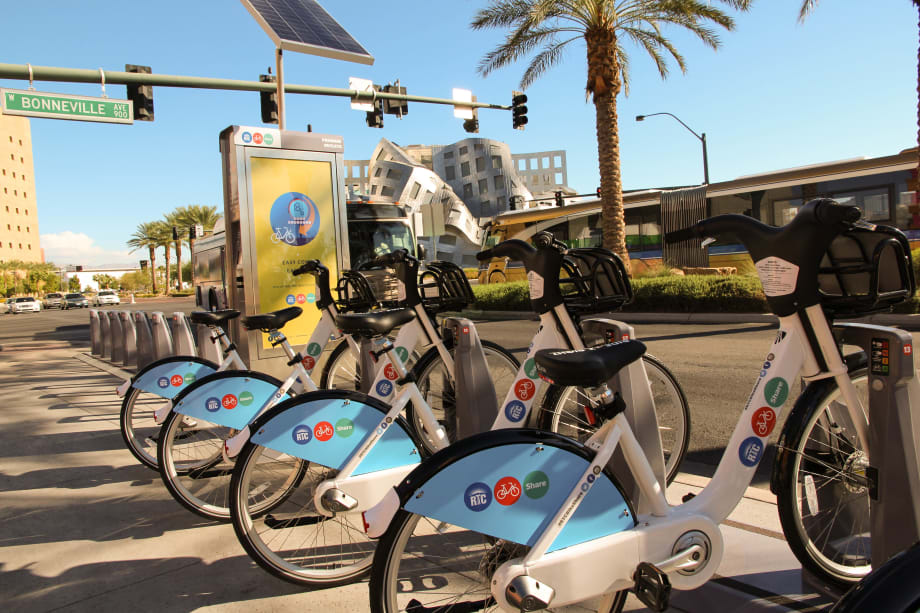
The new rankings are part of a national pooled-fund study that began in 2013 and focuses on accessibility.
RTC of Southern Nevada
The new rankings are part of a national pooled-fund study that began in 2013 and focuses on accessibility.
RTC of Southern Nevada
Research from the Accessibility Observatory at the University of Minnesota ranks the 50 largest (by population) metropolitan areas in the U.S. for connecting workers with jobs via bicycle.
The new rankings in “Access Across America: Biking 2017” are part of a national pooled-fund study that began in 2013 and focuses on accessibility. Accessibility, which examines both land use and transportation systems, measures how many destinations, such as jobs, can be reached in a given time.
“This new data provides a baseline to evaluate how well a metro area is facilitating access to jobs by bicycle from year to year,” said Andrew Owen, director of the Observatory. “Bike commuting is a cost-effective, healthy, and environmentally sustainable alternative to being stuck in traffic. State departments of transportation, metropolitan planning organizations, and local agencies can use our findings to better coordinate investments in bicycle facilities with the location of jobs and housing to improve job accessibility by bike.”
The study incorporates traffic stress and cycling comfort in its evaluation of access to destinations by bicycle. According to the study, low-stress routes are separated bike lanes and paths. Medium-stress routes include all bike infrastructure — low-stress facilities plus on-street unprotected bike lanes, certain shared lanes, and mixing with traffic on some non-arterial streets.
Many cities exhibit different rankings between their low-stress and medium-stress job accessibility metrics. For example, Philadelphia places fifth by low-stress access, but only 13th by medium-stress access. Minneapolis–St. Paul places 12th by low-stress access and seventh by medium-stress access. Generally, residents in Philadelphia who are only willing to bike on low-stress facilities reach more jobs than those on low-stress routes in Minneapolis. However, residents in Minneapolis willing to travel on all bicycle facilities reach more jobs than those in Philadelphia.
The metropolitan areas that perform the best when comparing medium-stress access to the maximum-possible bike access are Minneapolis–St. Paul, San Francisco, and Portland. All have bicycle networks that, on average, allow their residents to reach more than 74% of the job opportunities theoretically available to cyclists, if all routes felt as safe as an off-street path.
Since 2010, the number of bicycle commuters nationwide has increased nearly 22%. “Though biking is used for less than one percent of commuting trips in the United States, biking infrastructure investments are much more cost-effective at providing access to jobs than infrastructure investments to support automobiles,” Owen said. “Ultimately, our findings give policymakers and planners more options to improve transportation performance goals related to congestion and reliability and sustainability, as well as increased access to jobs.”
Top 10 metro areas for job accessibility by biking, medium stress:
New York San Francisco Chicago Denver Washington, D.C. Portland, Ore. Minneapolis Seattle Boston San Jose
More New Mobility

From Hardware to Digital Partner: Luminator Charts Its Next Chapter
CEO Magnus Friberg discusses Luminator’s shift toward becoming a digital partner, the growing importance of software and interoperability, and how AI can help agencies improve operations and passenger experience.
Read More →
Biz Briefs: Alstom Lands Canadian Contract, LYT to Supply California TSP, and More
In METRO's latest installment, we take a look at recent news from Complete Coach Works, Beep, FlixBus, and more partnerships making headlines across the transportation sector.
Read More →
CharterUP’s Armir Harris on Technology, AI, and the Future of Group Mobility
In a recent episode of METROspectives, CharterUP Founder/CEO Armir Harris discussed the company’s evolution from an online charter bus marketplace into a technology platform supporting public- and private-sector mobility and much more.
Read More →
Jacksonville’s NAVI Project Charts a New Course for Autonomous Public Transportation
Through its NAVI program, JTA is showing how autonomous vehicles, intelligent infrastructure, and coordinated operations can work together to deliver everyday public transportation.
Read More →
Biz Briefs: Luminator Marks Milestone and More
From manufacturers and suppliers to transit agencies and motorcoach operators, these updates offer a snapshot of the projects, partnerships and business moves driving the industry forward.
Read More →
New Tricks for Old Bureaucracies: Joshua Schank on Making Transit Innovation Stick
Former LA Metro Chief Innovation Officer Joshua Schank discusses why good ideas aren't enough, how transit agencies can overcome resistance to change, and why today's challenges demand more innovation.
Read More →
How DART's GoPass Is Redefining Regional Mobility
Serving 14 transit agencies, GoPass simplifies multimodal travel by allowing riders to plan, pay for, and manage an entire trip through one app.
Read More →
Biz Briefs: OCTA Taps Clean Energy for Hydrogen Station, Stadler to Supply Via Rail Vehicles, and More
From manufacturers and suppliers to transit agencies and motorcoach operators, these updates offer a snapshot of the projects, partnerships and business moves driving the industry forward.
Read More →CharterUP Expands Into New Mobility and Autonomous Transportation
Vice President of New Mobility Stephen Joos discusses how CharterUP is leveraging its nationwide transportation network, technology platform, and autonomous vehicle partnerships to expand into workforce mobility, campus shuttles, and transit solutions.
Read More →
METRO Magazine Announces 2026 Innovative Solutions Awards Winners
Projects Recognized for Advancing Mobility Through Technology, Accessibility, Workforce Innovation, and Operational Excellence
Read More →