




RELATED: Alstom launches turnkey tram solution, charging system at UITP 2015
UITP 2015 in Milan focused on 'smart' cities, technology
Major event themes on the show floor included efficiency, with the bus industry working to improve fuel economy, in addition to the hybrid, CNG and all-electric buses on display. Safety and smart energy usage were a big focus in the rail industry, while a variety of IT companies presented their latest passenger information, ticketing and payment solutions.
June 17, 2015
3 min to read
More than 2,200 delegates from 83 countries and 284 exhibitors from across the public transport sector gathered in the Italian city of Milan for the biennial UITP World Congress June 8 to 10 where industry leaders discussed the challenges of: financing; the arrival of new mobility services; infrastructure needs in smart and growing cities; the impact on cities of new vehicle and IT technologies and focusing on customer service.
"The smart cities revolution will change our life in the coming years -- making life in the city better," said UITP Secretary General Alain Flausch during the press meeting.
Flausch discussed how technology will enable operators to do more with data management. He cited the city of Thessaloniki, Greece, where sensors were installed in the roads to adjust traffic in real time as well as German rail operator, Deutsch Bahn, which implemented a policy where the company as a whole has to use digital tools as much as possible so they can better serve customers, Flausch added. "People will have to adapt to the use of data."

UITP Secretary General Alain Flausch and UITP President Sir Peter Hendy (shown left to right).
"All people want to use public transport the way they live the rest of their lives," said UITP President (Transport for London's) Sir Peter Hendy, when discussing the future of public transport. "We need to make using public transport as simple as buying books [online]," he said.
Major event themes on the show floor included efficiency, with the bus industry working to improve fuel economy, in addition to the hybrid, CNG and all-electric buses on display. Safety and smart energy usage are currently a big focus in the rail industry, while a variety of IT companies presented their latest passenger information, ticketing and payment solutions that are all helping to enhance the customer experience.
Alstom Transport was among the exhibitors showcasing new innovations during the event, including Attractis, an integrated tramway system for growing cities, and SRS, a new ground-based static charging system for both trams and electrical buses. During the exhibition, Alstom also announced the extension of the APS’s (ground-level power supplier) application to hybrid trucks.
By utilizing optimized project management and construction methods, Attractis tram system projects can be built in 30 months, with up to 20% savings in investment compared to a traditional tramway system, said Alstom Transport President Henri Poupart-Lafarge.
A key aspect of Alstom's newly launched SRS charging system is the ability to charge a tram stopped at a station in less than 20 seconds.
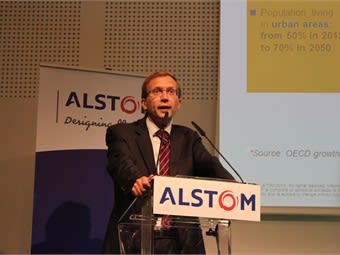
Alstom Transport President Henri Poupart-Lafarge discusses the launch of the two major innovation solutions: Attractis and SRS
At Alstom’s exhibit, interactive presentations of Citadis and Metropolis were made by Alstom experts and visitors are able to simulate the creation of their own train and drive a tramway in a driving simulator.
During the plenary session meanwhile demonstrated the drive within the sector to continue developing the market share of public transport and shone a light on some of the successful urban policies that are already bearing fruit in some major cities, such as Vienna, Oslo, London, Paris and Geneva. Successful measures to control urban sprawl and reduce private car transport in these cities led to an increase in public transport modal share of more than 20%.
High-profile leaders from the public transport sector were in attendance, including CEOs from SNCF (Guillaume Pepy), Trenitalia (Vincenzo Soprano), Arriva (David Martin), Transdev (Jean-Marc Janaillac), Keolis (Jean-Pierre Farandou), RTA (Dr. Eng. Yousif Mohammed Al Ali), LTA (Chew Men Leong), MTR (Morris Cheung), TfL (Sir Peter Hendy), Jordanian Transport Minister (H.E. Dr. Lina Shbeeb), CasaTransports (Youseff Draiss), RATP Dev (François-Xavier Perin), Iveco Bus (Sylvain Blaise) and Evobus (Hartmut Schick) rubbed shoulders with the likes of policy watchers, bureaucrats and technology trendsetters including both Uber and Moovit, as well as city leaders from Montreal, Brussels, Johannesburg, Milan and Turin.
With the closing of the event, it was announced that the next edition of the UITP World Congress in 2017 will be held in Montreal.
More New Mobility

From Hardware to Digital Partner: Luminator Charts Its Next Chapter
CEO Magnus Friberg discusses Luminator’s shift toward becoming a digital partner, the growing importance of software and interoperability, and how AI can help agencies improve operations and passenger experience.
Read More →
Biz Briefs: Alstom Lands Canadian Contract, LYT to Supply California TSP, and More
In METRO's latest installment, we take a look at recent news from Complete Coach Works, Beep, FlixBus, and more partnerships making headlines across the transportation sector.
Read More →
CharterUP’s Armir Harris on Technology, AI, and the Future of Group Mobility
In a recent episode of METROspectives, CharterUP Founder/CEO Armir Harris discussed the company’s evolution from an online charter bus marketplace into a technology platform supporting public- and private-sector mobility and much more.
Read More →
Jacksonville’s NAVI Project Charts a New Course for Autonomous Public Transportation
Through its NAVI program, JTA is showing how autonomous vehicles, intelligent infrastructure, and coordinated operations can work together to deliver everyday public transportation.
Read More →
Biz Briefs: Luminator Marks Milestone and More
From manufacturers and suppliers to transit agencies and motorcoach operators, these updates offer a snapshot of the projects, partnerships and business moves driving the industry forward.
Read More →
New Tricks for Old Bureaucracies: Joshua Schank on Making Transit Innovation Stick
Former LA Metro Chief Innovation Officer Joshua Schank discusses why good ideas aren't enough, how transit agencies can overcome resistance to change, and why today's challenges demand more innovation.
Read More →
How DART's GoPass Is Redefining Regional Mobility
Serving 14 transit agencies, GoPass simplifies multimodal travel by allowing riders to plan, pay for, and manage an entire trip through one app.
Read More →
Biz Briefs: OCTA Taps Clean Energy for Hydrogen Station, Stadler to Supply Via Rail Vehicles, and More
From manufacturers and suppliers to transit agencies and motorcoach operators, these updates offer a snapshot of the projects, partnerships and business moves driving the industry forward.
Read More →CharterUP Expands Into New Mobility and Autonomous Transportation
Vice President of New Mobility Stephen Joos discusses how CharterUP is leveraging its nationwide transportation network, technology platform, and autonomous vehicle partnerships to expand into workforce mobility, campus shuttles, and transit solutions.
Read More →
METRO Magazine Announces 2026 Innovative Solutions Awards Winners
Projects Recognized for Advancing Mobility Through Technology, Accessibility, Workforce Innovation, and Operational Excellence
Read More →