



UNLV collab to position Nevada as autonomous mobility leader
German-based research institute will send one of its engineers to Las Vegas to establish and expand mobility research projects.


The new partnership among UNLV, GOED, and Fraunhofer IVI allows the city to take the crucial next step toward being an industry leader in autonomous mobility research and operation.
Greytl

The new partnership among UNLV, GOED, and Fraunhofer IVI allows the city to take the crucial next step toward being an industry leader in autonomous mobility research and operation.
Greytl
A new partnership between UNLV, the Nevada Governor’s Office of Economic Development (GOED), and Fraunhofer Institute for Transportation and Infrastructure Systems IVI is looking to make Las Vegas a global leader in autonomous transportation.
Since a 2015 trade mission to Germany, Nevada Gov. Brian Sandoval and GOED have been working to develop an international collaboration between Nevada’s research-focused educational institutions and Fraunhofer IVI, one of 72 Fraunhofer institutes located throughout Germany. Fraunhofer IVI’s focus is transportation research, including everything from traffic planning to autonomous vehicle sensor technology. The partnership was recently made official through a statement of work agreement.
“Partnering with Fraunhofer IVI, a member institute of the world’s leading applied research network, will attract industry in the field of autonomous vehicle technologies to select Las Vegas and the Fraunhofer IVI-UNLV team as the applied research partner of choice while continuously strengthening the transatlantic collaboration between the two institutions for years to come,” said Karsten Heise, director of technology commercialization at GOED.
As part of the newly formed research collaboration, Fraunhofer IVI will send one of its engineers to Las Vegas for 15 to 18 months to establish and expand mobility research projects in Southern Nevada, in collaboration with researchers in UNLV’s Transportation Research Center. Together, they will work on Fraunhofer IVI’s AutoTruck project, which seeks to equip distribution center trucks with sensors and other technologies that enable delivery automation. In turn, UNLV will send one of its engineers to Fraunhofer IVI in Dresden, Germany, during the same time period to assist with computer vision — the process by which computers are able to detect or “see” objects in a similar fashion to a human eye — and learn the “Fraunhofer model” of research.
“We want to establish the transatlantic exchange of personnel and know-how as a lever for the developments at both institutions,” said Frank Steinert, group manager for vehicle and propulsion technologies at Fraunhofer IVI. “With our program, the institutions are able to benefit from new approaches and solutions of their foreign partners. The research results can be aligned to the market needs in the U.S. and Europe and hence be established much more successfully. The bundling of development capacities increases the efficiency of the teams as well as the dissemination of the developments and, finally, the derived products.”
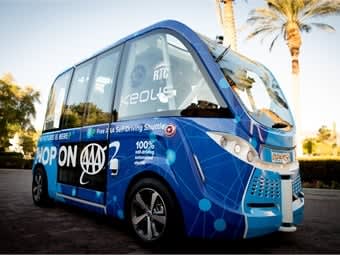
With autonomous vehicle infrastructure already in place and a willingness to act as testing grounds for self-driving vehicle pilot programs, Las Vegas is already positioning itself as a global leader in autonomous vehicle systems.
Keolis
With autonomous vehicle infrastructure already in place and a willingness to act as testing grounds for self-driving vehicle pilot programs, Las Vegas is already positioning itself as a global leader in autonomous vehicle systems. The city is home to the country’s first completely autonomous electric shuttle, which is currently operational almost daily in a 0.6-mile fixed-route around downtown and represents the largest self-driving vehicle trial in the U.S. The new partnership among UNLV, GOED, and Fraunhofer IVI allows the city to take the crucial next step toward being an industry leader in autonomous mobility research and operation.
“Previous collaborations I’ve participated in with Fraunhofer have resulted in the development of products and services that would not have been possible otherwise, and I see the same possibilities for transformative innovations to come out of this new partnership between UNLV, Fraunhofer IVI, and the Nevada Governor’s Office of Economic Development” said Zachary Miles, UNLV’s associate VP of economic development. “Together, we could create a new breed of research and economic development opportunities in Southern Nevada.”
More New Mobility

From Hardware to Digital Partner: Luminator Charts Its Next Chapter
CEO Magnus Friberg discusses Luminator’s shift toward becoming a digital partner, the growing importance of software and interoperability, and how AI can help agencies improve operations and passenger experience.
Read More →
Biz Briefs: Alstom Lands Canadian Contract, LYT to Supply California TSP, and More
In METRO's latest installment, we take a look at recent news from Complete Coach Works, Beep, FlixBus, and more partnerships making headlines across the transportation sector.
Read More →
CharterUP’s Armir Harris on Technology, AI, and the Future of Group Mobility
In a recent episode of METROspectives, CharterUP Founder/CEO Armir Harris discussed the company’s evolution from an online charter bus marketplace into a technology platform supporting public- and private-sector mobility and much more.
Read More →
Jacksonville’s NAVI Project Charts a New Course for Autonomous Public Transportation
Through its NAVI program, JTA is showing how autonomous vehicles, intelligent infrastructure, and coordinated operations can work together to deliver everyday public transportation.
Read More →
Biz Briefs: Luminator Marks Milestone and More
From manufacturers and suppliers to transit agencies and motorcoach operators, these updates offer a snapshot of the projects, partnerships and business moves driving the industry forward.
Read More →
New Tricks for Old Bureaucracies: Joshua Schank on Making Transit Innovation Stick
Former LA Metro Chief Innovation Officer Joshua Schank discusses why good ideas aren't enough, how transit agencies can overcome resistance to change, and why today's challenges demand more innovation.
Read More →
How DART's GoPass Is Redefining Regional Mobility
Serving 14 transit agencies, GoPass simplifies multimodal travel by allowing riders to plan, pay for, and manage an entire trip through one app.
Read More →
Biz Briefs: OCTA Taps Clean Energy for Hydrogen Station, Stadler to Supply Via Rail Vehicles, and More
From manufacturers and suppliers to transit agencies and motorcoach operators, these updates offer a snapshot of the projects, partnerships and business moves driving the industry forward.
Read More →CharterUP Expands Into New Mobility and Autonomous Transportation
Vice President of New Mobility Stephen Joos discusses how CharterUP is leveraging its nationwide transportation network, technology platform, and autonomous vehicle partnerships to expand into workforce mobility, campus shuttles, and transit solutions.
Read More →
METRO Magazine Announces 2026 Innovative Solutions Awards Winners
Projects Recognized for Advancing Mobility Through Technology, Accessibility, Workforce Innovation, and Operational Excellence
Read More →