




RELATED: Utah Transit Authority honored as nation's best transit system
Utah rail projects spur $225M value in local economy, study shows
Major companies including Adobe, eBay, Goldman Sachs, Overstock.com and Workday have made office location decisions based, in part, by proximity to the TRAX and FrontRunner stations.
June 25, 2015
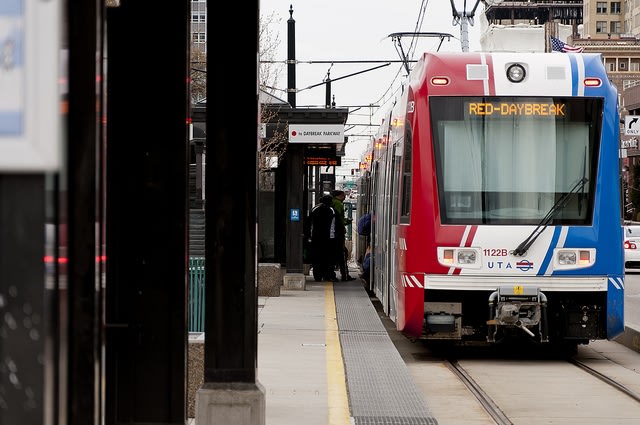
Utah Transit Authority TRAX Red Line train to Daybreak. Photo: vxla/Flickr
3 min to read
Utah Transit Authority TRAX Red Line train to Daybreak. Photo: vxla/Flickr
A public transportation technology partnership between Salt Lake City and Siemens has resulted in 1,300 new jobs that have spurred an estimated $225 million in value to the local economy, according to a newly released study.
Results of the study, conducted by the Economic Development Research Group, a Boston-based research company Siemens hired to assess the economic impact of the project, were announced in conjunction with the American Public Transportation Association Rail Conference.
“The Siemens cars that form the backbone of our TRAX light rail system and recently opened S-Line Streetcar here in Salt Lake City are reliably getting tens of thousands of our residents where they need to go every day,” said Salt Lake City Mayor Ralph Becker. “Siemens technology is integral in our efforts to get cars off the roads, address our local air quality challenges and continue to improve the livability, and sustainability, of our community.”
"TRAX has been reliable and a success by any measure with some of the highest ridership numbers in the entire UTA system. The economic development along our lines has been steady and a huge benefit to the entire community," said UTA President/CEO Michael Allegra.
Since 1996, Siemens has manufactured and delivered 117 light rail vehicles for UTA’s TRAX light rail streetcar lines. The company is building the customized light rail vehicles out of its 800-person rail manufacturing hub in Sacramento, Calif. Results indicate that the light rail extension reduced residents’ dependence on private vehicles and spurred high-density development, thereby decreasing the region’s carbon footprint, improving local air quality and proactively managing traffic congestion.
"Utah's economy is leading the nation and this reports shows part of our success can be attributed to our commitment to transportation investment as a state," said Abby Albrecht, director of Utah Transportation Coalition. "As we look to the future, building on these investments wisely will ensure we continue to economically prosper."
The study looked beyond well-documented short-term spending effects to also examine long-term economic benefits like spatial efficiency, private sector investment and cost savings that are reinvested elsewhere. For instance, major companies including Adobe, eBay, Goldman Sachs Overstock.com, and Workday have made office location decisions based, in part, by proximity to the TRAX and FrontRunner stations.
“Rail projects like these are proof that when you spend on infrastructure, you get a multiplier effect that boosts productivity and attractiveness for investment,” said Michael Cahill, president of Siemens Rolling Stock.
Siemens provides sustainable technologies for metropolitan areas to help move people and goods safely and efficiently, while improving the environmental footprint. Siemens' portfolio for infrastructure includes complete traffic and rail transportation systems, efficient energy supply and environmentally compatible building technologies. Siemens also provides ways to modernize how power is transmitted and distributed to enhance the smart utilization of electric power.
Researchers prepared the study using IMPLAN, an economic modeling system used by more than 500 U.S. public and private agencies. The system uses economic data specific to certain industries and regions to translate direct economic effects into spinoff effects.
For more information, visit http://inr.synapticdigital.com/siemens/intelligentinfrastructure/.
More Management

METRO Opens Submissions for 2026 Motorcoach Awards
Nominations are now being accepted for METRO Magazine’s Operator of the Year and Innovative Operator of the Year awards.
Read More →
New York MTA Advances Final Contract for Second Avenue Subway Expansion
Contract Four is the largest in the Second Avenue Subway Phase 2 project and includes construction of station infrastructure, tracks, and signals for the subway expansion, MTA officials said. Work on Contract Four will begin in 2027.
Read More →
Transit Agencies Highlight Safety Gains at National Summit
Leaders from 15 major transit systems shared crime-reduction results and safety initiatives while discussing the role of continued federal support.
Read More →

NITA Names New Leadership, Expands Reduced-Fare Program at First Board Meeting
The new regional transit authority appointed its first board chair and interim executive director while extending reduced fares across CTA, Metra, and Pace for eligible riders.
Read More →
Beyond the Checklist: A Structured Approach to Transit Maintenance
Reliability-Centered Maintenance helps transit agencies move beyond routine checklists to focus limited resources on the assets and failures that have the greatest impact on safety, reliability, and service.
Read More →
APTA 2026 Nominating Committee Selects Leadership Slate, Names Chair and Vice Chair Nominees
Leadership changes will help shape the association’s priorities and its representation of the transportation industry during the 2026–2027 term.
Read More →
DART Launches Major Security, Fare Enforcement Initiative
The 90-day demonstration will deploy coordinated security teams at five light rail stations while testing controlled access and gathering data to guide future investments.
Read More →
Sponsored•September 9, 2026
Advancing Fare Collection Through Technology and Innovation
Learn about delivering 1300 gates at 91 stations while managing fare evasion. Explore the large scale deployment, solution customization and real-world results that affect the region. Prepare for deployment in your region now.
Read More →
Game Day in Motion: Moving Millions During the 2026 World Cup
Between packed transit stations and team motorcoaches, see how agencies and operators across North America tackled the transportation demands of the 2026 FIFA World Cup.
Read More →
Surface Transportation Extension Averts Shutdown, Leaves Transit Funding Gap
The stopgap keeps federal transportation programs moving, but missing advance funding could complicate the transit and rail projects agencies are planning next.
Read More →