




Work Being Done: WMATA Launches Program to Help Low-Income Customers
WMATA Details Plan to Address Funding Issues
Without an increase in funding, Metro would be forced to make drastic cuts to rail, bus, and paratransit services across the region.
June 23, 2023
Over the next year, Metro said it will engage with federal, state, and local leaders, businesses, and other key stakeholders to explore long-term funding solutions that would be incorporated into the budget process and implemented next year.
Photo: Metro
3 min to read
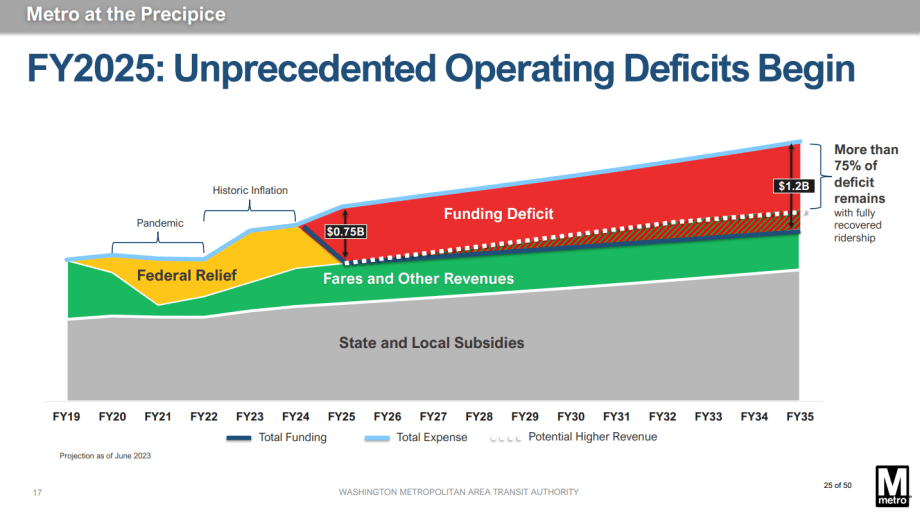
The Washington Metropolitan Area Transit Authority (Metro) announced it has detailed its future financial planning to address structural funding issues that will leave a projected $750 million shortfall in the fiscal year 2025 budget when federal COVID-19 relief funding runs out.
Without an increase in funding, Metro said it would be forced to make drastic cuts to rail, bus, and paratransit services across the region.
Financial Issues Facing Metro
The long-term financial issues facing Metro, come amid improving service, investments in modernization, and growing ridership.
As of May, weekday ridership on Metrorail and Metrobus is at 50% and 88% of pre-pandemic levels, respectively, with ridership as high as 800,000 trips or more combined on bus and rail.
Customer satisfaction is also rising, with rail at 84%, a 16-point increase over the same time last year, and bus up two points to 71%.
Fare increases and service cuts alone would not close the gap and could devastate the region financially and economically, reversing the progress made over the past year.
"We cannot afford to let Metro fail. It is too important to the region, our economy, and quality of life, connecting people to jobs and family, reducing gridlock, and cutting carbon emissions," said Metro GM/CEO Randy Clarke. "Concerns were first raised about the lack of a dedicated and ongoing funding source in 1976 when Metrorail opened, and it is time for the region to come together to solve this serious financial challenge."
Metro's Future Financial Planning
Metro staff presented a detailed analysis of Metro’s future financial planning to the Board of Directors.
"Without a strong, reliable transit system millions of people across the region stand to lose," said Metro Board Chair Paul C. Smedberg. "Customers would see longer waits, constant gridlock, higher fares, and reduced operating hours and the region’s economy could stagnate."
Nearly three million people living in the region, 70% of jobs, and 50% of employers are located within a half-mile of a Metro station or bus stop.
Metro's structural funding issues were accelerated by the pandemic with an unprecedented shortfall projected for FY25, the result of inflation and labor costs, decreased revenue from ridership, subsidy reduction, and forgone annual funding increases to support our local and state funding partners during the pandemic.
Balancing the budget with service cuts would require eliminating two-thirds of Metro's existing service, with no service after 9:30 p.m. All but 37 of 135 bus lines would no longer operate, customers would wait 20-30 minutes for trains on all lines, and MetroAccess would serve a much smaller area with fewer hours.
Transit agencies across the country, from Chicago to Los Angeles are facing similar financial difficulties starting as early as FY25 due to the pandemic. In New York and California, lawmakers have come together to pass legislation to save their transit agencies from financial collapse.
Over the next year, Metro said it will engage with federal, state, and local leaders, businesses, and other key stakeholders to explore long-term funding solutions that would be incorporated into the budget process and implemented next year.
More Management

METRO Opens Submissions for 2026 Motorcoach Awards
Nominations are now being accepted for METRO Magazine’s Operator of the Year and Innovative Operator of the Year awards.
Read More →
New York MTA Advances Final Contract for Second Avenue Subway Expansion
Contract Four is the largest in the Second Avenue Subway Phase 2 project and includes construction of station infrastructure, tracks, and signals for the subway expansion, MTA officials said. Work on Contract Four will begin in 2027.
Read More →
Transit Agencies Highlight Safety Gains at National Summit
Leaders from 15 major transit systems shared crime-reduction results and safety initiatives while discussing the role of continued federal support.
Read More →

NITA Names New Leadership, Expands Reduced-Fare Program at First Board Meeting
The new regional transit authority appointed its first board chair and interim executive director while extending reduced fares across CTA, Metra, and Pace for eligible riders.
Read More →
Beyond the Checklist: A Structured Approach to Transit Maintenance
Reliability-Centered Maintenance helps transit agencies move beyond routine checklists to focus limited resources on the assets and failures that have the greatest impact on safety, reliability, and service.
Read More →
APTA 2026 Nominating Committee Selects Leadership Slate, Names Chair and Vice Chair Nominees
Leadership changes will help shape the association’s priorities and its representation of the transportation industry during the 2026–2027 term.
Read More →
DART Launches Major Security, Fare Enforcement Initiative
The 90-day demonstration will deploy coordinated security teams at five light rail stations while testing controlled access and gathering data to guide future investments.
Read More →
Sponsored•September 9, 2026
Advancing Fare Collection Through Technology and Innovation
Learn about delivering 1300 gates at 91 stations while managing fare evasion. Explore the large scale deployment, solution customization and real-world results that affect the region. Prepare for deployment in your region now.
Read More →
Game Day in Motion: Moving Millions During the 2026 World Cup
Between packed transit stations and team motorcoaches, see how agencies and operators across North America tackled the transportation demands of the 2026 FIFA World Cup.
Read More →
Surface Transportation Extension Averts Shutdown, Leaves Transit Funding Gap
The stopgap keeps federal transportation programs moving, but missing advance funding could complicate the transit and rail projects agencies are planning next.
Read More →