



How GPS tracking can provide certainty for operations, customers
Although the technology has been around for some time, advances allow for more real-time tracking and simplified reporting.
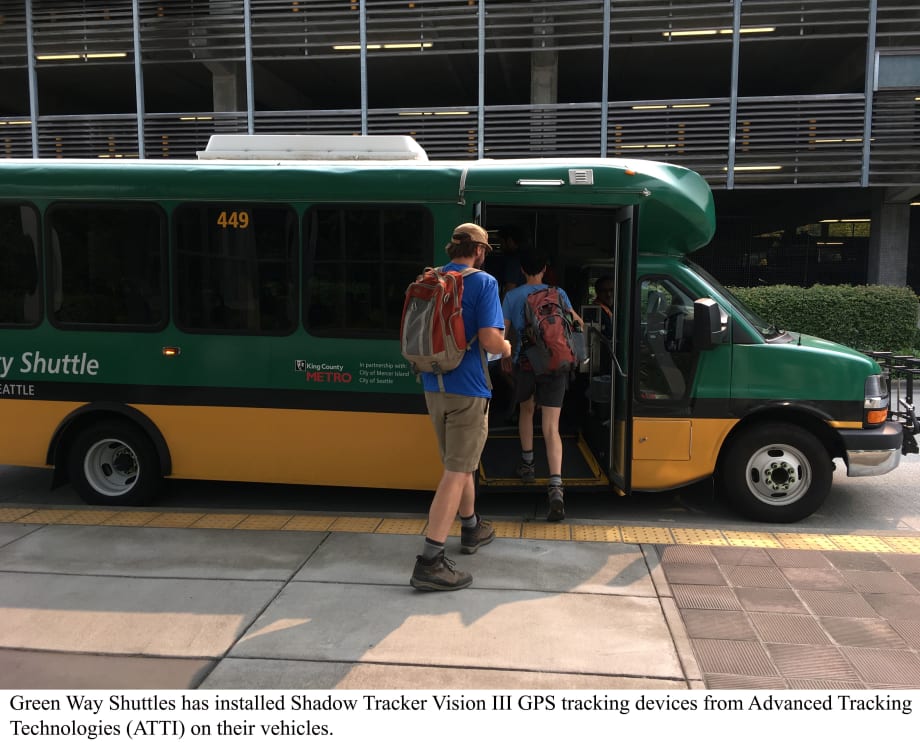
Green Way, which specializes mostly in professional student transportation, currently serves over 125 properties at 52 universities across the U.S.
ATTI
Green Way, which specializes mostly in professional student transportation, currently serves over 125 properties at 52 universities across the U.S.
ATTI
In the transportation business, fleet owners and managers need to know their bus, shuttle, or taxi drivers are exactly where they need to be, arriving and departing on time, so as not to inconvenience or worse — strand — any passengers. This is even more important when there is a set schedule that must be precisely kept.
However, even when drivers are thoroughly vetted, qualified, and trained, any disagreements about the reliability of on-time pickup or drop off can lead to ill will.
For Doug Dickherber, owner of O’Fallon, Mo.-based Green Way Shuttles, efficiently tracking his bus fleet was key to providing quality service to passengers. Green Way, which specializes mostly in professional student transportation, currently serves over 125 properties at 52 universities across the U.S.
“I needed an indisputable way to ensure that the bus was in the right spot at the right time for pick up or drop off,” says Dickherber. “Our chief complaint from the students we pick up was the driver wasn’t at the stop on time, so they missed their class. The driver would say, ‘I was there.’”
Dickherber says that if a bus leaves early, it can become a serious issue if it causes a student to miss their class. “We may have to pick up students up at 7 a.m. at an apartment complex and get them to school at 7:15 a.m. So, if a driver leaves at 6:58 a.m. there may be people waiting at 7 a.m. to get on that could get left behind.”
For fleet managers, achieving certainty about the current location and speed of every vehicle — along with increased driver accountability — can only be accomplished through real-time GPS tracking devices.
Drivers that know they are being monitored by such systems are not only less likely to make unnecessary detours or stops for personal reasons, but also will no longer have to dispute whether they made an on-time pick up or drop off.
Today, GPS tracking can be extended to the user side as well. Passengers, through GPS tracking integrated with a smartphone app, can also feel greater peace of mind by knowing the whereabouts of their bus at all times.
So, with a host of benefits for everyone involved, fleet managers that have avoided the “leap” to GPS tracking are missing out on a win-win scenario. It is an argument that is increasingly hard to deny, particularly as GPS tracking continues to improve while the cost of entry plummets.
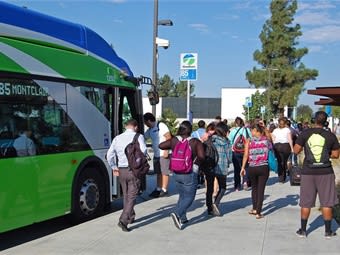
Although GPS trackers have been around for some time, advances in the technology allows for more real-time tracking and simplified reporting.
Omnitrans
Certainty, service at a higher standard
Although GPS trackers have been around for some time, advances in the technology allow for more real-time tracking and simplified reporting. Fleet managers, after all, don’t want to spend all day on their computers sifting through complex analytical data. Instead, they want real-time information they can act on to correct problems immediately, as well as simplified reports that can provide important historical data. Fortunately, such systems exist today at rates of less than $30 per vehicle.
Green Way Shuttles had sought GPS tracking to improve service and management. The company typically runs daily bus service to and from university campuses during the school year from apartment complexes that offer it as a student amenity, with only shuttle clients having access to the bus.
When Dickherber first evaluated his options a few years ago, he found implementing a GPS tracker would cost him about $2,700 per vehicle the first year, including installation, plus hundreds a month to run the program.
However, with additional online research, Dickherber says that he was able to find a GPS tracker that met his criteria at a much more cost-effective price.
Green Way Shuttles has since installed Shadow Tracker Vision III GPS tracking devices from Advanced Tracking Technologies (ATTI), a Houston-based designer and manufacturer of GPS tracking products, on its fleet. The company owns and operates a fleet of more than 110 buses and acquires five to eight new vehicles per year.
“Now, our buses have real-time GPS tracking, and I pay less than $20 a month per vehicle,” says Dickherber. He notes that the buses also have separate video and audio monitored security systems from other vendors at additional cost.
Compared with typical GPS tracking devices that may only update every few minutes, the device provides real-time location updates every 10 seconds, as well as location, speed, and idle time alerts if something is amiss. This data is transmitted via satellite and cellular networks to a smartphone or PC on a 24/7 basis.
As a transportation company with established routes the buses need to stay on, Dickherber found the GPS tracking device’s geo-sensing capability particularly valuable.
“I can put a geo boundary around a set route, and if the bus gets outside of it the GPS tracker will email me,” he says. “Then I can figure out, did the driver go and grab a snack, get gas, or go home?”
According to Dickherber, ATTI provided a free downloadable smartphone app, which integrates with GPS tracking. The app quickly alerts him to virtually anything that requires his attention.
“The manager app emails me if a bus leaves the designated area, starts after the assigned time, or stops earlier than expected,” he says. “If it’s 8 a.m. and a bus is supposed to be running but hasn’t started, it emails me so I can ask why the driver hasn’t shown up. If my 1 p.m. bus takes off and isn’t supposed to, it emails me where it started and where it is now so I can figure out why it’s running.”
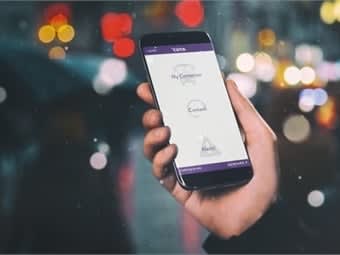
The use of GPS can not only help the transportation operation improve its services, but also gives the end-user to plan their trips using real-time information via websites and mobile apps.
COTA
Impact of GPS
The app makes it easy to resolve disputes, says Dickherber. “If a student says, ‘The bus left early,’ I can quickly find out exactly when the bus left that location.”
Because the GPS system is automated, transportation manager reports that analyze vital historical data, such as on time pick-ups or drop-offs, can also be emailed without anyone having to open software. The reports can also be customized as needed.
According to Dickherber, the GPS system also helps to improve safety since it has access to speed limits throughout the country in its database. “I have the system set for five to seven miles an hour over the speed limit. So, if a bus exceeds this threshold, the system emails me an alert that includes how fast the bus was going, along with when and where.”
ATTI also developed a free app for users of public transportation, called Shuttle Tracker Mobile (available in the App store), that allows users to track where their buses are at any time.
In the case of Green Way Shuttles, students can immediately locate the buses running in their area. This is accomplished when students enter a location-specific password into the bus transportation app.
“The app allows students to track where their bus is on their smartphones by GPS and is really accurate,” says Dickherber. “So, if they get to the bus stop at 7:01 and pick up was at 7, they can immediately see if they missed their ride or not.”
While public transportation managers may have put off looking into GPS tracking devices, the technology has advanced so it is not only easier to use but also more cost-effective than ever to implement.
Del Williams is a technical writer based in Torrance, Calif.
More Technology

From Hardware to Digital Partner: Luminator Charts Its Next Chapter
CEO Magnus Friberg discusses Luminator’s shift toward becoming a digital partner, the growing importance of software and interoperability, and how AI can help agencies improve operations and passenger experience.
Read More →
Beyond the Checklist: A Structured Approach to Transit Maintenance
Reliability-Centered Maintenance helps transit agencies move beyond routine checklists to focus limited resources on the assets and failures that have the greatest impact on safety, reliability, and service.
Read More →
NJ TRANSIT Advances Bus Technology Upgrades Across Statewide Fleet
More than 1,500 buses now feature upgraded technology designed to improve arrival predictions and provide free Wi-Fi, with deployment expected to reach nearly 2,000 buses by the end of 2026.
Read More →

Building a Flexible Path to Transit Electrification
John Hroncich discusses BAE Systems’ modular and scalable approach, lessons learned from decades of real-world operations, and how agencies can identify electrification strategies that fit their fleets.
Read More →
Biz Briefs: Alstom Lands Canadian Contract, LYT to Supply California TSP, and More
In METRO's latest installment, we take a look at recent news from Complete Coach Works, Beep, FlixBus, and more partnerships making headlines across the transportation sector.
Read More →
From Legacy Silos to Conversational Intelligence
What if transit leaders could ask any operational question and get a trusted answer in seconds? Conversational AI is transforming how agencies use their data.
Read More →
USDOT Announces Rail Vehicle Replacement Grants, Chattanooga AV Shuttle Funding
More than $191 million in federal funding will help three transit agencies replace aging rail vehicles and support a new autonomous shuttle service in Chattanooga.
Read More →
Bus Tech Talk: Keeping Transit Technicians Ahead of the Technology Curve
LA Metro’s Obed Mejia discusses technician training, evolving maintenance technology, fleet replacement, and strategies for getting the most out of today’s transit fleets.
Read More →
Biz Briefs: RIPTA Unveils New Frontrunners, Clevland RTA Adds New Siemens, and More
In METRO's latest installment, we take a look at recent news from Siemens, Prevost, Dodge, and more partnerships making headlines across the transportation sector.
Read More →
Why Simulating Pedestrian Movement Has Become Essential for Modern Rail Stations
Pedestrian microsimulation is helping rail planners identify bottlenecks, test station designs, and prepare complex transit hubs for growing passenger volumes.
Read More →