



Mobility in Context: New York City
As the MTA’s largest-ever capital plan, the agency hopes to make over $40 billion in capital investments in New York City Transit.
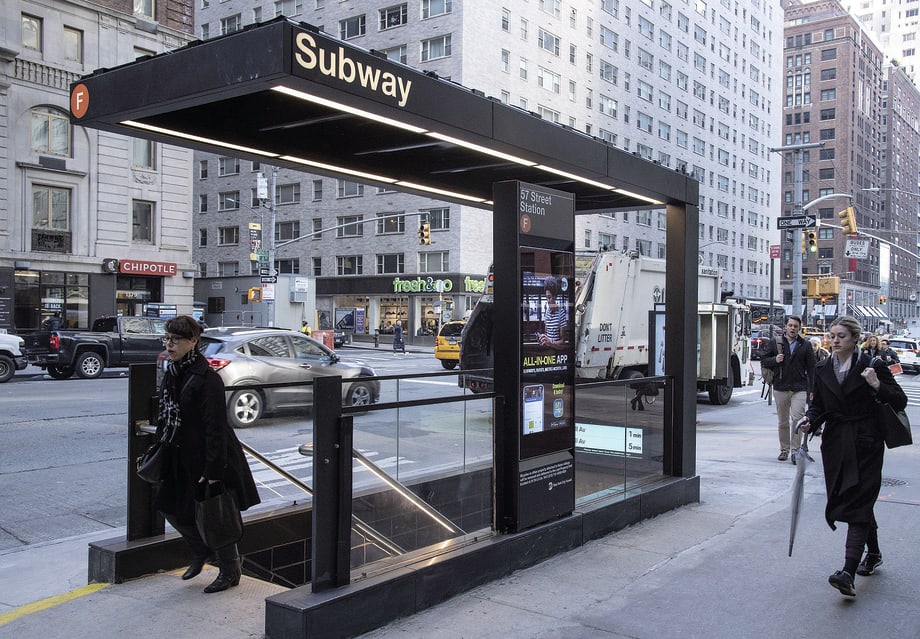
Transportation stakeholders in the NYC region are working on several initiatives to advance the city’s leadership on sustainable transportation.
Marc A. Hermann/MTA NYCT
Transportation stakeholders in the NYC region are working on several initiatives to advance the city’s leadership on sustainable transportation.
Marc A. Hermann/MTA NYCT
As New York City grows in population, jobs, and tourists, so too have the challenges facing the city’s mobility network. According to NYCDOT, roadways have grown increasingly congested with for-hire vehicles, which have added 36.9 million trips a year between 2016-17. What’s more, vehicle registrations citywide have increased, while freight traffic and home deliveries also continued to rise. Public transport modes have suffered as well: citywide bus speeds have declined to 7.58 mph, and the on-time rate for the subway hit the lowest point of 75.2% in January 2018. Ridership, which historically has grown in line with population increases, saw declines; the number of riders on the Subway and bus fell 2.1% and 5% respectively between 2016-2017.
With these challenges in mind, transportation stakeholders in the NYC region are working on several initiatives to advance the city’s leadership on sustainable transportation. To help tackle traffic congestion, Mayor DeBlasio announced policies in June of this year that extends the cap of for-hire vehicle registrations and seeks to limit the amount of time their drivers spend cruising, making New York City one of the toughest regulators of TNCs in the country. In tandem with these efforts, the New York State Legislature passed the state budget, granting MTA the authority to levy a charge on motor vehicles entering Manhattan’s central business district beginning January 2021. This congestion charge brings NYC in line with peer cities like London, Singapore, Milan, and Stockholm, and has the dual purpose of reducing congestion and raising funds to improve the MTA’s aging subway and bus systems.
The additional revenue from the CBD Tolling is anticipated to generate $15 billion in capital for the MTA, as detailed in the agency’s newly released Capital Program 2020-2024. As the MTA’s largest-ever capital plan, the agency hopes to make over $40 billion in capital investments in New York City Transit that build off the Subway Action Plan. These investments will support signal modernization, new subway cars, track replacement, station renewal, and station accessibility with elevators and ramps.
At the city level, NYCDOT has sought expansion of the Citi Bike bike-share program, improvements to bus travel speeds via the Better Buses initiative, and the creation of more accessible built environments for all New Yorkers. In alignment with the city’s Vision Zero initiative, the newly released Green Wave plan seeks to expand the rollout of dedicated cycling infrastructure and targeted enforcement. Altogether, NYCDOT and the MTA’s efforts promise to make sustainable transport modes more attractive and accessible for all New Yorkers as the city moves forward in planning, evaluating, and building new mobility systems.
More New Mobility

From Hardware to Digital Partner: Luminator Charts Its Next Chapter
CEO Magnus Friberg discusses Luminator’s shift toward becoming a digital partner, the growing importance of software and interoperability, and how AI can help agencies improve operations and passenger experience.
Read More →
Biz Briefs: Alstom Lands Canadian Contract, LYT to Supply California TSP, and More
In METRO's latest installment, we take a look at recent news from Complete Coach Works, Beep, FlixBus, and more partnerships making headlines across the transportation sector.
Read More →
CharterUP’s Armir Harris on Technology, AI, and the Future of Group Mobility
In a recent episode of METROspectives, CharterUP Founder/CEO Armir Harris discussed the company’s evolution from an online charter bus marketplace into a technology platform supporting public- and private-sector mobility and much more.
Read More →
Jacksonville’s NAVI Project Charts a New Course for Autonomous Public Transportation
Through its NAVI program, JTA is showing how autonomous vehicles, intelligent infrastructure, and coordinated operations can work together to deliver everyday public transportation.
Read More →
Biz Briefs: Luminator Marks Milestone and More
From manufacturers and suppliers to transit agencies and motorcoach operators, these updates offer a snapshot of the projects, partnerships and business moves driving the industry forward.
Read More →
New Tricks for Old Bureaucracies: Joshua Schank on Making Transit Innovation Stick
Former LA Metro Chief Innovation Officer Joshua Schank discusses why good ideas aren't enough, how transit agencies can overcome resistance to change, and why today's challenges demand more innovation.
Read More →
How DART's GoPass Is Redefining Regional Mobility
Serving 14 transit agencies, GoPass simplifies multimodal travel by allowing riders to plan, pay for, and manage an entire trip through one app.
Read More →
Biz Briefs: OCTA Taps Clean Energy for Hydrogen Station, Stadler to Supply Via Rail Vehicles, and More
From manufacturers and suppliers to transit agencies and motorcoach operators, these updates offer a snapshot of the projects, partnerships and business moves driving the industry forward.
Read More →CharterUP Expands Into New Mobility and Autonomous Transportation
Vice President of New Mobility Stephen Joos discusses how CharterUP is leveraging its nationwide transportation network, technology platform, and autonomous vehicle partnerships to expand into workforce mobility, campus shuttles, and transit solutions.
Read More →
METRO Magazine Announces 2026 Innovative Solutions Awards Winners
Projects Recognized for Advancing Mobility Through Technology, Accessibility, Workforce Innovation, and Operational Excellence
Read More →