OCTA's microtransit fills customer need to help boost ridership
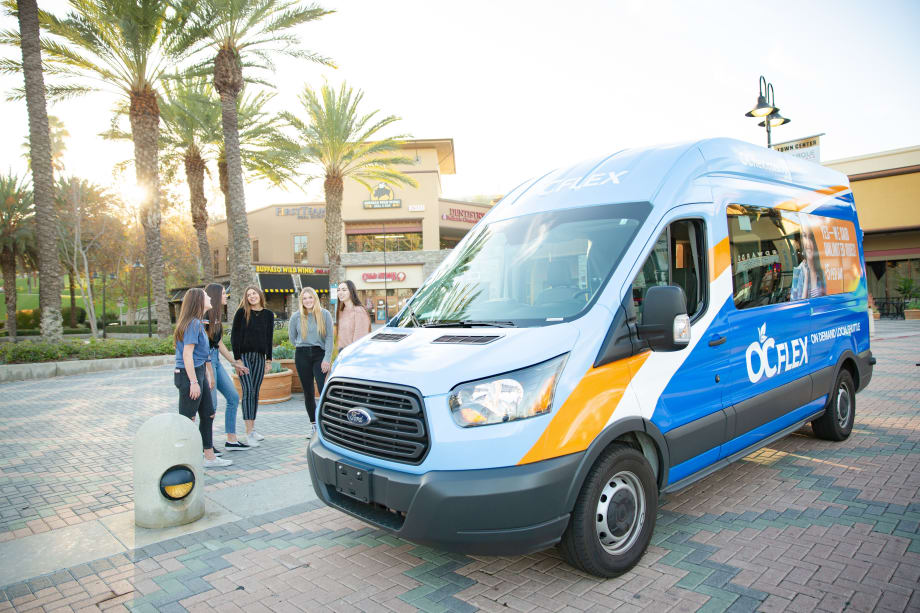
OC Flex provides on-demand service that takes passengers curb-to-curb within two designated zones.
by Alex Roman, Managing Editor
June 27, 2019
The two zones cover approximately six to eight square miles and have the potential to expand into additional zones.
Photos courtesy OCTA
4 min to read
The two zones cover approximately six to eight square miles and have the potential to expand into additional zones.
Photos courtesy OCTA
Since October, the Orange County Transportation Authority (OCTA) has been running its OC Flex microtranist pilot program in two zones, in an effort to help boost ridership.
“The concept was derived from out OC Bus 360 program, which was endorsed by the board in 2015 with an aim to address ridership decline,” says Johnny Dunning, department manager, scheduling and customer advocacy, for OCTA.
Ad Loading...
With OC Bus 360, the agency was looking for ways to address ridership decline and either stabilize it, or get it going in the other direction. The effort included optimizing its routes, looking at its social media and social interfaces, and examining how its services were branded. It also included looking at technology and how it could be used to help improve OCTA’s services to better meet customer needs.
“Through the technology angle, we looked at microtransit as a way to offer a service that our riders, or people who may not be so inclined to use our fixed-route bus service, would find attractive,” Dunning says. “We thought since there’s an inclination for people to use Uber, Lyft, and other TNCs, that this type of tech-enabled transit option would enable us to provide a service that meets our customers’ needs.”
A new option
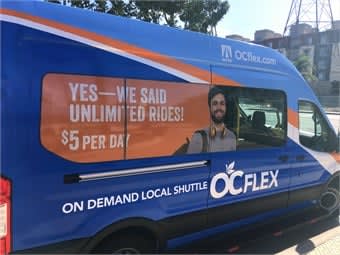
OCTA’s OC Flex microtransit service uses wheelchair-accessible shuttles, which are each capable of holding up to eight passengers, to provide on-demand service that takes passengers curb-to-curb within the two designated zones for $4.50 using the mobile app, or $5 cash on board. An OCTA pass gives customers unlimited daily rides in either of the zones and on any OC Bus fixed route for the day.
The service also enables Metrolink and Amtrak commuter rail pass holders to use the service as a first-mile, last-mile option to and from train stations for free.
Ad Loading...
The two zones cover approximately six to eight square miles and have the potential to expand into additional zones.
OCTA’s OC Flex microtransit service uses wheelchair-accessible shuttles to provide on-demand service for $4.50 using the mobile app, or $5 cash on board.
“In selecting the areas, it was based on our review of demographics, high ridership potential, good connections to transit, and recent customer requests for service in areas where fixed-route service could be removed, or was recently removed, meaning those areas weren’t able to productively support regular fixed-route service,” Dunning says.
He adds that the service areas were also based on public survey.
“When gauging this technology there’s considerations that had to be looked at, including what the maximum price people would pay and what would their ideal wait time be for this service,” Dunning says. “So, that feedback, coupled with our studies predominantly drove the choice to evaluate this service in the two areas we selected.”
The service during the pilot program is primarily funded with a grant from the Mobile Source Air Pollution Reduction Review Committee, which supports projects that take cars off the road and reduce air pollution.
Ad Loading...
OCTA partnered with one of its contractors, Keolis, to provide the service, and Via to provide the software package, which includes the mobile app, tablets, and dispatching system used, as well as the real-time trip information for the customers.
OC Flex Takeaways
When asked about some of his key takeaways and lessons learned six months into OCTA’s OC Flex microtransit program, Dunning says that the factors below are important points to consider when launching a pilot program of any kind.
Know what you are trying to accomplish and set goals – Are you looking to attract new riders, or using the new pilot service as an extension of your existing services? It’s important for agencies to know what they want to accomplish or prove by the end of the pilot project.
Have criteria in place to measure the success of the program – OCTA has five performance metrics they are using to gauge the success of the OC Flex program, which is important to measure how well the program did from launch to completion.
Gather input from your customers – Dunning says this is important so that the agency can properly meet customer need.
Realize it’s not a solo venture – While Dunning is the point person for OC Flex, he says it’s important to realize you will have to interface with many departments within your organization, including but not limited to external affairs, IT, planning, and operations.
The midway point
Dunning says at the midway point OC Flex has been received fairly well, with the agency receiving several requests to either expand the zones of the current pilot or to bring the service to other areas.
He adds, operationally, OC Flex is also performing well for the agency, considering it typically takes time for a new service to take hold once it is launched.
“Usually, there is an 18 to 24 month maturation period for a new service, but what we’ve seen is that the trends right now are positive,” Dunning says. “We have a series of metrics we are using to gauge success, and we have already met two of the goals we set, are close to meeting another, and two more are below targets but trending positively.”
Ad Loading...
Because it is a pilot, the agency has made some minor tweaks to the service along the way and is open to making further minor tweaks along the way.
“We’ve been charged by our CEO to be nimble and to make minor tweaks that allow us to put our best foot forward to meet our customers’ needs, but still allows us to effectively evaluate the concept in general,” Dunning says, adding the changes made have been in terms of the parameters of the program and within the software technology they are using.
As for the future of the microtransit service, Dunning says the agency will continue to gauge the service based on the five performance metrics, as well as collect as much customer feedback as possible, while it considers its next steps. OCTA is also conducting a peer review of other agencies that are implementing microtransit services to collect information from them, to get an outside look at what they are doing in other operational contexts.
“At the end of the evaluation period in October, we are going to evaluate our findings and take that information to the board, and it would be up them and their decision-making in terms of how we continue the program or expand the service,” Dunning says.
CEO Magnus Friberg discusses Luminator’s shift toward becoming a digital partner, the growing importance of software and interoperability, and how AI can help agencies improve operations and passenger experience.
In METRO's latest installment, we take a look at recent news from Complete Coach Works, Beep, FlixBus, and more partnerships making headlines across the transportation sector.
In a recent episode of METROspectives, CharterUP Founder/CEO Armir Harris discussed the company’s evolution from an online charter bus marketplace into a technology platform supporting public- and private-sector mobility and much more.
Through its NAVI program, JTA is showing how autonomous vehicles, intelligent infrastructure, and coordinated operations can work together to deliver everyday public transportation.
From manufacturers and suppliers to transit agencies and motorcoach operators, these updates offer a snapshot of the projects, partnerships and business moves driving the industry forward.
Former LA Metro Chief Innovation Officer Joshua Schank discusses why good ideas aren't enough, how transit agencies can overcome resistance to change, and why today's challenges demand more innovation.
From manufacturers and suppliers to transit agencies and motorcoach operators, these updates offer a snapshot of the projects, partnerships and business moves driving the industry forward.
Vice President of New Mobility Stephen Joos discusses how CharterUP is leveraging its nationwide transportation network, technology platform, and autonomous vehicle partnerships to expand into workforce mobility, campus shuttles, and transit solutions.