



10 questions to ask before writing your Automatic Passenger Counting RFP
Since many APC systems are now being installed at the bus or train vendor’s manufacturing facility — before they are delivered to the agency — the importance of accurate APC technology descriptions is crucial.

Data gathering is how you justify funding and more effectively manage your system. Without a reporting system, the data is useless.
Since many Automatic Passenger Counting (APC) systems are now being installed at the bus or train vendor’s manufacturing facility — before they are delivered to the agency — the importance of accurate APC technology descriptions is crucial.
Understanding what to expect and how to ensure the most up-to-date functionality is the first step. Secondly, choosing an experienced partner in APC implementations is equally essential.
There are different APC systems on the market. A low-cost system can include a horizontal beam in the doorway or only an active sensor in the door’s overhead. That means the counting accuracy on those vehicles will be at a disadvantage for raw data gathering. Data gathering is how you justify funding and more effectively manage your system. Without a reporting system, the data is useless.
The result of not predefining the system requirements in your Request for Proposal (RFP) — onboard and wayside — is that this opens up the possibility of the bus or train vendor installing the least functional APC system on the vehicle. If the reporting section is not clearly defined, the vehicle data may be delivered in CSV format only, which means the agency will need to invest in additional software to process the ridership data into valuable reports. This will incur additional project management fees, as well as possible delays.
RFP Examples
So, how do you write a comprehensive RFP for your next APC system?
Today, we see more and more details for new vehicle specifications in the RFP, but the specs have only one or two line items in regards to installing an APC system. This usually causes issues on the back side of installation. Some examples listed below demonstrate the point:
Section: 13 Automatic Passengers Counting:
1. A method of Automatic Passenger counting and reporting shall be Vendor proposed and approved by the agency.
This example does not indicate details regarding a reporting system or identify which reports may be needed.
Another RFP reads:
a. The APC system shall identify the number of passengers exiting and entering each car at each station, including crew stops. The APC’s shall identify the number of passengers onboard each car during each station-to-station segment of operation.
b. The sensor system shall have a minimum 95% counting accuracy and … air spring pressure shall not be used to determine passenger counts.
Reading this spec raises further questions. For instance: What does “accuracy of at least 95%” mean? Is there a reporting system required? In the above examples, it appears that one is not required.
Indicating the sensor system “shall have a minimum 95% counting accuracy” is sometimes subjective. Such broad statements in the RFP have been known to introduce countless discussions between the supplier and agency in getting final approval of the system.

Transit agencies should ask questions and provide detailed specifications about the functionality and reliability of an APC system in their RFP.
10 Questions To Ask When Writing an RFP
Transit agencies should ask questions and provide detailed specifications about the functionality and reliability of an APC system in their RFP. Start with a clear picture of your APC requirements when new vehicles are ordered and involve your planning department in writing the specification. Defining this information upfront will help you save time, money and resources after your system is delivered.
- What is the required sensor accuracy and how is this defined?
- How will the data transfer from the vehicle to the agency take place?
- How will the vehicle data be matched with the agency scheduling information system?
- Which APC reports are required?
- Does the data need to be exported in a specific format?
- What is the required level of security for Data Transfer?
- What is the scheduling system for interfacing with the central system?
- What is the required testing and calibration process?
- Which sensor type shall be installed on the vehicle?
- Should the technology be able to distinguish between passengers and bikes or wheelchairs?
When confirming the accuracy of a system, it is a standard process to verify through test rides. Here, agencies may also want to define the testing criteria in advance so approval is a smooth process instead of a rocky road. Arranged together with the vendor, quality analysis of the system data can be done on the first day the vehicle is in service. The agency should also be able to use the data that same day.
The test evaluation should include manual counts of boarding and alighting passengers compared with automatic counting from an installed APC system. Below is an example of a statistical evaluation from the manual and automatic count data results. The report is displayed and generated using IRMA Windows software solution. The proposed accuracy from the Contract Data Requirement List (CDRL) can later be measured and verified together with the customer. This chart shows the raw data accuracy provided on the vehicle. It is important to have high accuracy for better reporting.
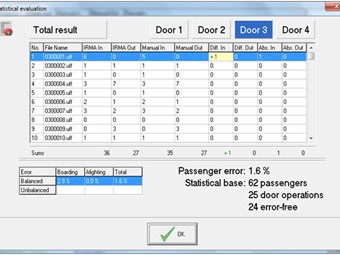
Statistical analyses of manual and automatic passenger counts
Sensor Technology
APC systems are evolving from active infrared systems to more advanced video-based or Time of Flight (TOF) systems. Today, the technology is smarter and the data can be analyzed with greater resolution. For instance, knowing at which locations passengers boarded with a bike or a wheelchair gives planners a better understanding of their riders’ needs.
Previously, this information was recorded in the onboard computer when the passenger or the operator pushed the button to activate the wheelchair ramp. But today, more and more low-floor vehicles are being used that do not require these passenger activators. In fact, passengers can enter the door with a bike or a wheelchair at level boarding with no problem at all. So, how can agencies gather this important rider information today?
The answer is simpler than you might think. It starts with a better understanding of APC technology and a clearer spec in your RFP.
Better Planning, Better Results
Passenger data reporting can improve planning, increase efficiencies and positively affect the bottom line. But, it starts with a clear specification in the RFP. Keep in mind, the cheapest solution is not always the best solution. Better results begin with modern technology and that includes a reliable reporting system.
In the end, having the direct statistics provides the best value. Use of the data by your planning and reporting departments can be used for improving the schedule, reporting ridership data and utilizing the counts for new funding requests. So, take the time to define your needs, understand the options and choose wisely. The return on investment is always greater when a predefined plan is clearly in place.
Andreas Rakebrandt is director business development for APC with INIT.
More Management

APTA 2026 TRANSform & EXPO Kicks Off in Chicago
After 45 years, APTA returns to Chicago with a focus on next-generation fleets, AI, connected transit networks, and the funding strategies shaping public transportation’s future.
Read More →
New York MTA Warns Federal Tariffs Could Add $1 Billion to Rolling Stock Costs
The agency said tariffs on specialized imported components could reduce the purchasing power of its $23 billion investment in new subway cars, railcars, and buses.
Read More →
From the Show Floor: What’s Happening at APTA TRANSform & EXPO 2026
Follow the latest product launches, partnerships, technology updates, and transit industry announcements coming out of APTA TRANSform & EXPO in Chicago.
Read More →
How Valley Metro Is Balancing Transit Growth With the Rider Experience
The APTA award-winning agency is pairing rapid system expansion with investments in workforce, safety, technology, and the fundamentals of transit service.
Read More →
Bus Tech Talk: Keeping Transit Technicians Ahead of the Technology Curve
In this episode of Bus Tech Talk, Complete Coach Works’ Business Development Manager Mark Hollenbeck and METRO’s Executive Editor Alex Roman sit down with Obed Mejia, Senior Technical Trainer for Bus Maintenance, at LA Metro to discuss how rapidly evolving bus technology is changing the maintenance shop — and the skills technicians need to keep pace.
Read More →
Michael Schneider Joins Paslay Group to Expand Transportation Practice
The longtime transportation executive will help Paslay Group grow its advisory and program management work across transit, highway, and other infrastructure sectors.
Read More →
People Movement: Connectpoint Expands Leadership Team, Stadler Names New Group CEO, and More
In this edition, we also spotlight recent personnel moves at Burns, UZURV, and more, highlighting the people taking on new roles across the transportation industry.
Read More →
More Than a Summer Job: Building the Next Generation of Transit Talent
The Delaware River Port Authority and PATCO have transformed their internship program into a hands-on professional development experience that introduces students to the breadth of transportation careers — and creates a pipeline for future employees.
Read More →
LA Metro Board Awards 220 Battery-Electric Bus Contract to ENC
The contract, which is the largest base award of battery-electric buses by a U.S. transit agency, will be built in Southern California, sustaining good jobs as LA prepares to welcome the world in 2028
Read More →
What’s Behind San Diego MTS’s Award-Winning Transit Strategy
Named one of APTA’s 2026 Outstanding Public Transportation Systems with 50 million or more annual passenger trips, California’s San Diego Metropolitan Transit System points to gains in ridership, safety, technology, and reliability as foundations of its success.
Read More →