



Jacksonville’s NAVI Project Charts a New Course for Autonomous Public Transportation
Through its NAVI program, JTA is showing how autonomous vehicles, intelligent infrastructure, and coordinated operations can work together to deliver everyday public transportation.

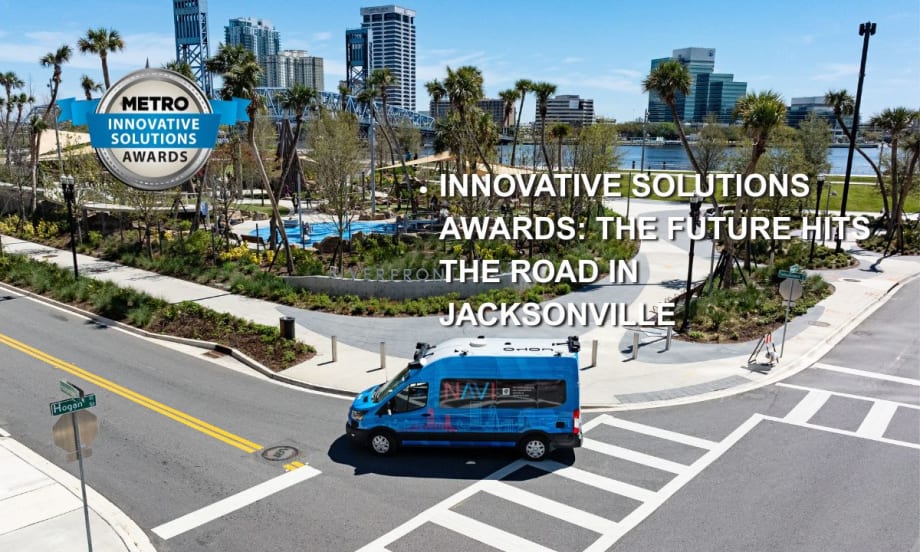
NAVI is the first phase of the JTA's Ultimate Urban Circulator, a long-term initiative to connect downtown Jacksonville and surrounding neighborhoods through autonomous transit.
JTA/METRO
- The NAVI program by JTA integrates autonomous vehicles and intelligent infrastructure for public transportation.
- The initiative demonstrates the potential of coordinated operational systems in enhancing transit services.
- The project aims to provide everyday public transportation solutions through innovative technology.
*Summarized by AI
Florida's Jacksonville Transportation Authority (JTA) is demonstrating that autonomous public transportation has moved from concept to reality. The agency's Neighborhood Autonomous Vehicle Innovation (NAVI) program recently earned one of METRO's Innovative Solutions Awards for what is recognized as the nation's first fully autonomous public transportation network.
NAVI is the first phase of the JTA's Ultimate Urban Circulator (U2C), a long-term initiative to connect downtown Jacksonville and surrounding neighborhoods through autonomous transit.
Operating along a 3.5-mile route through the city's urban core, the service links the central business district with residential neighborhoods and the sports and entertainment district, providing a glimpse of how autonomous technology can be integrated into everyday public transportation.
For the JTA, the award represents more than recognition for deploying autonomous vehicles.
"Receiving METRO's Innovative Solutions Award is a tremendous honor and a meaningful validation of the work our team and partners have accomplished together," said officials at the JTA. "While we're proud of the recognition, what makes this award especially significant is that it acknowledges years of collaboration, innovation, and persistence by a broad coalition of public and private partners who believed in a bold vision for the future of public transportation."
Building an Autonomous Mobility Ecosystem
Although the autonomous vehicles are the most visible element of NAVI, JTA officials said the project's real innovation lies in how multiple technologies work together to support safe, reliable service.
The Bay Street Innovation Corridor features connected infrastructure that allows the vehicles to communicate continuously with the roadway. Traffic signal priority helps optimize travel through intersections, while pedestrian detection systems, cameras, and flood sensors provide additional layers of operational awareness.
Together, those technologies give vehicles real-time information about roadway conditions while enhancing safety for passengers, pedestrians, and other road users.
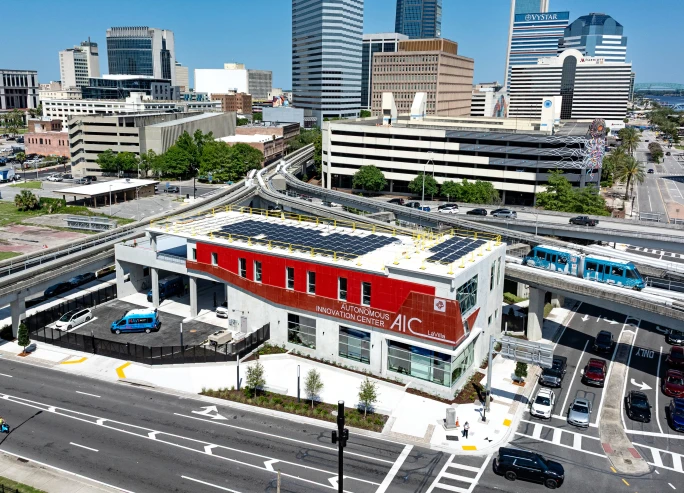
Supporting the entire operation is the Autonomous Innovation Center (AIC), which serves as NAVI's command center. The facility oversees vehicle monitoring, fleet management, charging, maintenance, and system operations, while also serving as a hub for research, testing, and technology development.
"The vehicles, signals, sensors, communications systems, and the Autonomous Innovation Center all work together," JTA officials said. "When these technologies work together, they create multiple layers of redundancy and operational support that enhance safety while delivering a more reliable passenger experience."
The AIC itself incorporates several innovative features, including a microgrid powered by 129 solar panels designed to offset the building's normal energy demand, battery storage, public charging stations, and a dedicated cybersecurity system separate from JTA's broader network.
The center was also constructed using accelerated fabrication techniques and was designed to accommodate future expansion as the Ultimate Urban Circulator grows.
NAVI traces its origins to JTA's effort to modernize Jacksonville's aging Skyway system and create a more flexible downtown circulator capable of serving both existing destinations and future development.
That vision evolved into the Ultimate Urban Circulator, a phased initiative that will eventually extend autonomous transit beyond downtown into adjacent neighborhoods.
Transforming that concept into an operating transit service required years of planning and coordination. JTA secured funding through the Florida Department of Transportation and the Federal Transit Administration, developed the Bay Street Innovation Corridor, selected and tested autonomous vehicles, and built the supporting infrastructure and completed extensive pre-revenue testing before opening the system to passengers.
Today, the route serves 12 passenger stops, connecting employment centers, residential developments, entertainment venues, and EverBank Stadium, demonstrating how autonomous transit can operate in mixed urban traffic.
Building Public Confidence, Growing Mobility
As the Ultimate Urban Circulator expands into future phases, NAVI is expected to serve as both a model for Jacksonville's mobility future and a real-world case study for transit agencies nationwide.
JTA
Introducing autonomous vehicles into public transportation requires more than reliable technology — it also requires earning public trust.
According to the JTA, community response has been encouraging since NAVI began service. Curiosity has attracted first-time customers, while firsthand experience has helped many better understand how autonomous transit can complement existing transportation options.
“The response has been very encouraging," said JTA officials. "People are curious, and once they ride NAVI, they begin to see how autonomous transportation can fit into everyday mobility."
The agency recognizes that public confidence develops over time, which is why it continues emphasizing safety, operational reliability, and consistent service. By allowing customers to experience autonomous transit in routine trips through downtown Jacksonville, JTA hopes to normalize the technology while demonstrating its practical benefits.
Beyond supporting daily operations, the AIC is helping prepare the workforce needed to sustain autonomous transportation in the years ahead.
The facility serves as both an operations center and a research and development hub, allowing engineers and technicians to test new technologies, validate autonomous systems, and refine operational procedures.
Working with Florida State College at Jacksonville and other partners, the JTA is also developing training programs focused on autonomous vehicle technology, cybersecurity, communications systems, electric fleets, and advanced maintenance. Those efforts are intended to ensure that both the agency and the broader transportation industry have the skilled workforce needed as automation becomes more prevalent.
Rather than simply introducing new vehicles, the JTA views workforce development as an essential component of long-term success.
Lessons for the Industry
As transit agencies across North America continue exploring autonomous vehicle technology, the JTA believes its experience offers valuable guidance for future deployments.
The agency emphasizes that successful autonomous transit is not simply about purchasing self-driving vehicles. Instead, it requires creating an integrated ecosystem that combines infrastructure, communications, operations, maintenance, workforce development, and community engagement.
Equally important is beginning with a clearly defined transportation need rather than allowing technology to drive decision-making. Strong partnerships among public agencies, private technology providers, academic institutions, and community stakeholders have also been critical to NAVI's development.
"Our experience shows that autonomous public transportation is no longer a future concept; it can be safely and successfully deployed today when supported by the right infrastructure, partnerships, and operational framework," said JTA officials.
As the Ultimate Urban Circulator expands into future phases, NAVI is expected to serve as both a model for Jacksonville's mobility future and a real-world case study for transit agencies nationwide. By combining autonomous vehicles with intelligent infrastructure, operational oversight, and workforce preparation, JTA has demonstrated that autonomous public transportation is not simply an emerging technology — it's an integrated mobility solution that is already reshaping how communities can move people safely and efficiently.
Quick Answers
The goal of Jacksonville's NAVI program is to demonstrate how autonomous vehicles, intelligent infrastructure, and coordinated operations can collaboratively provide everyday public transportation solutions.
*Summarized by AI
More Technology

Public Transit Conference Returning to GFX in 2027, Call for Papers Now Open
The Call for Papers is now open, allowing transit agency professionals and industry experts to help shape the PTC educational program by submitting session ideas for consideration.
Read More →
ENC Lands MATA Contract and More in Biz Briefs
In this edition of Biz Briefs, we spotlight the latest developments shaping the future of mobility.
Read More →
Strada360’s Steve Lassey on Turning Transit Data Into Better Decisions
From breaking down data silos to preparing for AI, Strada360 CEO Steve Lassey discusses how transit agencies can use technology to improve operations, customer information, and long-term decision-making.
Read More →
Almaviva Looks to Open Architecture to Advance Transit Technology
Eric Reese discusses how interoperability, open architecture, and modular design can help transit agencies control costs, reduce vendor lock-in, and upgrade technology without starting over.
Read More →
Driving Smarter Paratransit
John Hanlon shares how AlphaRoute is leveraging AI-powered technology to help paratransit providers optimize operations, support frontline staff, and enhance the rider experience.
Read More →
From Hardware to Digital Partner: Luminator Charts Its Next Chapter
CEO Magnus Friberg discusses Luminator’s shift toward becoming a digital partner, the growing importance of software and interoperability, and how AI can help agencies improve operations and passenger experience.
Read More →
Beyond the Checklist: A Structured Approach to Transit Maintenance
Reliability-Centered Maintenance helps transit agencies move beyond routine checklists to focus limited resources on the assets and failures that have the greatest impact on safety, reliability, and service.
Read More →
NJ TRANSIT Advances Bus Technology Upgrades Across Statewide Fleet
More than 1,500 buses now feature upgraded technology designed to improve arrival predictions and provide free Wi-Fi, with deployment expected to reach nearly 2,000 buses by the end of 2026.
Read More →
Building a Flexible Path to Transit Electrification
John Hroncich discusses BAE Systems’ modular and scalable approach, lessons learned from decades of real-world operations, and how agencies can identify electrification strategies that fit their fleets.
Read More →
Biz Briefs: Alstom Lands Canadian Contract, LYT to Supply California TSP, and More
In METRO's latest installment, we take a look at recent news from Complete Coach Works, Beep, FlixBus, and more partnerships making headlines across the transportation sector.
Read More →